
红细胞与人类衰老:探索它们作为生物标志物的潜力。
Red Blood Cells and Human Aging: Exploring Their Biomarker Potential.
作者信息
Kyriacou Roula P, Shibeeb Sapha
机构信息
School of Health and Biomedical Sciences, RMIT University, P.O. Box 71, Bundoora, Melbourne, VIC 3083, Australia.
出版信息
Diagnostics (Basel). 2025 Aug 8;15(16):1993. doi: 10.3390/diagnostics15161993.
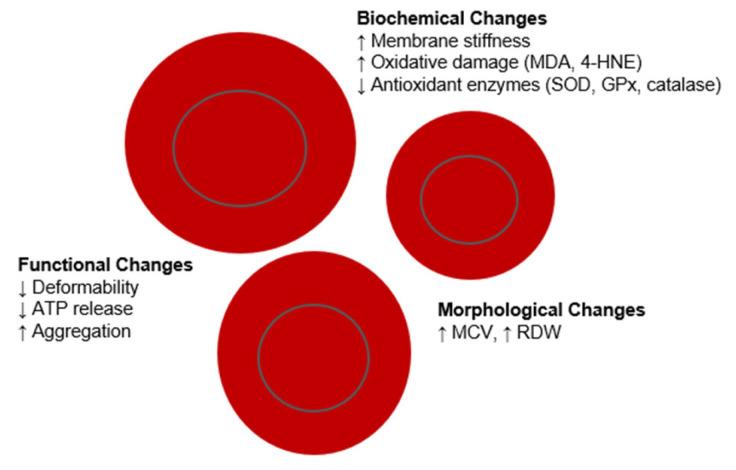
Aging is a complex biological process marked by progressive physiological decline with increasing vulnerability to diseases such as cardiovascular disorders, neurodegenerative conditions, and metabolic syndromes. Identifying reliable biomarkers of aging is essential for assessing biological age, predicting health outcomes, and guiding interventions to promote healthy aging. Among various candidate biomarkers, red blood cells (RBCs) offer a unique and accessible window into the aging process due to their abundance, finite lifespan, and responsiveness to systemic changes. This review examines the potential of RBCs as biomarkers of aging by exploring their age-associated morphological, functional, and biochemical alterations. Age-related reduction in key haematological parameters such as RBC count, haemoglobin concentration, and haematocrit, and increases in mean cell volume (MCV) and red cell distribution width (RDW), reflect underlying shifts in erythropoiesis and cellular turnover. Functional changes include reduced oxygen-carrying capacity, decreased deformability, diminished ATP release, and increased RBC aggregation, all of which may impair both macrocirculatory and microcirculatory flow and tissue oxygenation. Biochemically, aging RBCs exhibit altered membrane lipid and protein composition, reduced membrane fluidity, and diminished antioxidant and enzymatic activity, contributing to cellular senescence and clearance. Despite these promising indicators, challenges persist in establishing RBC parameters as definitive biomarkers of aging. Inter-individual and intra-individual variability and storage-related artifacts complicate their use. In conclusion, RBCs present a compelling, though currently underutilized, avenue for aging biomarker research. Further longitudinal validation and mechanistic research are essential to support the clinical utility of RBC parameters as biomarkers of aging.
衰老 是一个复杂的生物学过程,其特征是生理机能逐渐衰退,对心血管疾病、神经退行性疾病和代谢综合征等疾病的易感性增加。识别可靠的衰老生物标志物对于评估生物年龄、预测健康结果以及指导促进健康衰老的干预措施至关重要。在各种候选生物标志物中,红细胞(RBC)因其数量丰富、寿命有限以及对全身变化的反应性,为了解衰老过程提供了一个独特且可获取的窗口。本综述通过探讨红细胞与年龄相关的形态、功能和生化改变,研究了其作为衰老生物标志物的潜力。关键血液学参数如红细胞计数、血红蛋白浓度和血细胞比容随年龄增长而降低,平均红细胞体积(MCV)和红细胞分布宽度(RDW)增加,反映了红细胞生成和细胞更新的潜在变化。功能变化包括携氧能力降低、变形性下降、ATP释放减少以及红细胞聚集增加,所有这些都可能损害大循环和微循环血流以及组织氧合。在生化方面,衰老的红细胞表现出膜脂质和蛋白质组成改变、膜流动性降低以及抗氧化和酶活性减弱,导致细胞衰老和清除。尽管有这些有前景的指标,但将红细胞参数确立为衰老的确定性生物标志物仍存在挑战。个体间和个体内的变异性以及与储存相关的假象使其应用复杂化。总之,红细胞为衰老生物标志物研究提供了一条引人关注但目前未得到充分利用的途径。进一步的纵向验证和机制研究对于支持红细胞参数作为衰老生物标志物的临床应用至关重要。
 Zotero 插件