
含杀伤肽的聚电解质纳米复合物用于抗感染
Killer Peptide-Containing Polyelectrolytic Nanocomplexes to Fight Infection.
作者信息
Bucella Arianna, Semeraro Manuela, Giovati Laura, Artesani Lorenza, Bettini Ruggero, Bianchera Annalisa, Vismarra Alice
机构信息
Department of Food and Drug, University of Parma, Parco Area delle Scienze 27/a Parma, 43124 Parma, Italy.
Department of Veterinary Science, University of Parma, Strada del Taglio 10, 43126 Parma, Italy.
出版信息
Pharmaceutics. 2025 Aug 20;17(8):1075. doi: 10.3390/pharmaceutics17081075.
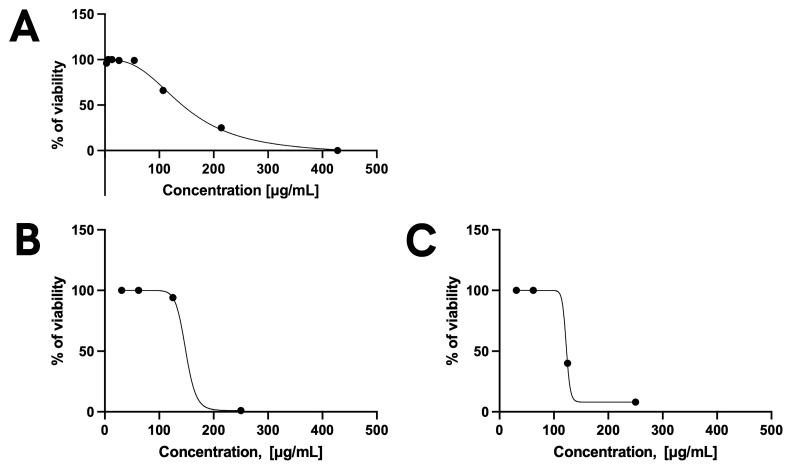
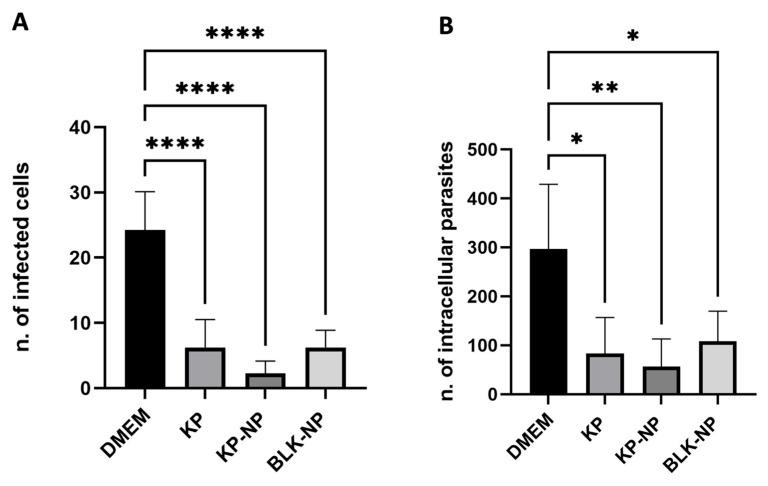
Toxoplasmosis, a zoonotic disease caused by , typically is asymptomatic in immunocompetent individuals but causes severe complications in immunocompromised subjects and during pregnancy. Current treatments such as pyrimethamine and sulfadiazine are effective for acute infections but cannot eliminate encysted bradyzoites and have significant side effects. The antimicrobial killer peptide (KP) has interesting therapeutic potential, but its intracellular delivery is challenging; hyaluronate-based nanoparticles loaded with KP (KP-NPs) were evaluated to target -infected cells that overexpress CD44. KP-NPs made of chitosan and hyaluronate were produced by microfluidics and were characterized for size, surface charge, encapsulation efficiency, and stability under stress conditions. After excluding their toxicity, their activity was tested in vitro against and as free tachyzoite or in infected human foreskin fibroblasts (HFFs). : KP was efficiently encapsulated in nanoparticles and protected from harsh acidic conditions at high temperature. Preliminary in vitro testing against showed that, at the lowest candidacidal concentration of KP (2.5 μg/mL), KP-NPs killed 90.97% of yeast cells. KP itself proved to be non-toxic for HFFs as host cells and effective against . Comparable results were obtained for KP-NPs and blank nanoparticles (BLK-NPs), with no observed toxicity to host cells, confirming that encapsulation did not alter peptide efficacy. The parasiticidal effect of KP alone, as well as KP-NPs at 250 µg/mL and BLK-NPs, was confirmed through tests on free tachyzoites. Reduction rates for the number of infected cells ranged from 66% to 90% with respect to control, while the reduction in the number of intracellular tachyzoites ranged from 66% to 80%. Interestingly, KP alone was not effective against intracellular tachyzoite, while KP-NPs maintained an efficacy comparable to the extracellular model, suggesting that particles helped the internalization of the peptide. Encapsulation of KP into hyaluronate/chitosan nanoparticles does not alter its activity and improves its efficacy against the intracellular parasite. Notably, BLK-NPs appeared to exhibit efficacy against the parasite on its own, without the presence of KP.
弓形虫病是一种由[病原体名称未给出]引起的人畜共患病,在免疫功能正常的个体中通常无症状,但在免疫功能低下的个体以及孕期会引发严重并发症。当前的治疗方法如乙胺嘧啶和磺胺嘧啶对急性感染有效,但无法清除包囊内的缓殖子,且有显著的副作用。抗菌杀伤肽(KP)具有有趣的治疗潜力,但其细胞内递送具有挑战性;对负载有KP的基于透明质酸的纳米颗粒(KP-NPs)进行了评估,以靶向过度表达CD44的[感染病原体名称未给出]感染细胞。由壳聚糖和透明质酸制成的KP-NPs通过微流控技术制备,并对其大小、表面电荷、包封效率以及在应激条件下的稳定性进行了表征。在排除其毒性后,测试了它们在体外对[病原体名称未给出]作为游离速殖子或在感染的人包皮成纤维细胞(HFFs)中的活性。结果表明:KP被有效地封装在纳米颗粒中,并在高温下免受恶劣酸性条件的影响。针对[病原体名称未给出]的初步体外测试表明,在KP的最低杀念珠菌浓度(2.5μg/mL)下,KP-NPs杀死了90.97%的酵母细胞。事实证明,KP本身对作为宿主细胞HFFs无毒,且对[病原体名称未给出]有效。对于KP-NPs和空白纳米颗粒(BLK-NPs)获得了可比的结果,未观察到对宿主细胞的毒性,证实包封不会改变肽的功效。通过对游离的[病原体名称未给出]速殖子的测试,证实了单独的KP以及250μg/mL的KP-NPs和BLK-NPs的杀寄生虫作用。相对于对照,感染细胞数量的减少率在66%至90%之间,而细胞内速殖子数量的减少率在66%至80%之间。有趣的是,单独的KP对细胞内速殖子无效,而KP-NPs保持了与细胞外模型相当的功效,这表明颗粒有助于肽的内化。将KP封装到透明质酸/壳聚糖纳米颗粒中不会改变其活性,并提高其对细胞内寄生虫的功效。值得注意的是,BLK-NPs似乎自身就对寄生虫表现出功效,无需KP的存在。



 Zotero 插件