
呼吸道合胞病毒感染中的免疫调节:机制、治疗靶点及临床意义
Immunomodulation in Respiratory Syncytial Virus Infection: Mechanisms, Therapeutic Targets, and Clinical Implications.
作者信息
Georgakopoulou Vasiliki Epameinondas, Pitiriga Vassiliki C
机构信息
Department of Pathophysiology, Laiko General Hospital, National and Kapodistrian University of Athens, 17 Agiou Thoma Street, 11527 Athens, Greece.
Department of Microbiology, Medical School of Athens, National and Kapodistrian University of Athens, 75 Mikras Asias Street, 11527 Athens, Greece.
出版信息
Microorganisms. 2025 Aug 12;13(8):1876. doi: 10.3390/microorganisms13081876.
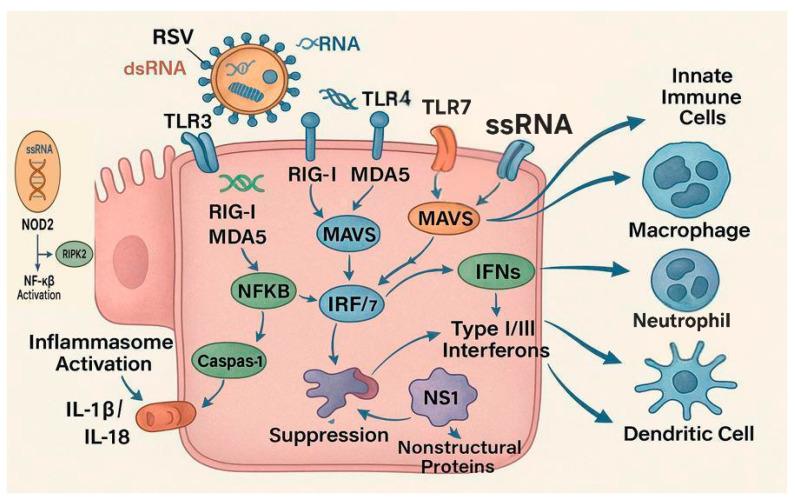
Respiratory syncytial virus (RSV) remains a leading cause of acute lower respiratory tract infections globally, particularly affecting infants, older adults, and immunocompromised individuals. While recent advances in prophylaxis, such as long-acting monoclonal antibodies and maternal immunization, offer promise for prevention, therapeutic options for active infection remain limited. Severe RSV disease is often driven not solely by viral replication but by dysregulated host immune responses, including excessive cytokine production, T helper type 2 (Th2) and T helper type 17 (Th17) cell polarization, and impaired interferon signaling. RSV has evolved sophisticated immune evasion strategies, such as inhibition of dendritic cell maturation, degradation of signal transducer and activator of transcription 2 (STAT2) via nonstructural proteins 1 and 2 (NS1/NS2), and interference with pattern recognition receptor signaling, particularly Toll-like receptors (TLRs) and retinoic acid-inducible gene I (RIG-I)-like receptors. These mechanisms result in attenuated innate immune responses and defective adaptive immunity, contributing to viral persistence, immunopathology, and recurrent infections. Moreover, age-dependent vulnerabilities, such as immune immaturity in infants and immunosenescence in older adults, exacerbate disease severity. Excessive immune activation leads to bronchiolitis, airway remodeling, and long-term sequelae including wheezing and asthma. Emerging immunomodulatory therapies aim to restore immune balance, targeting cytokines (e.g., interleukin-6 [IL-6], interleukin-1 beta [IL-1β]), the Janus kinase-signal transducer and activator of the transcription (JAK-STAT) pathway, or inflammasome activity. Host-directed therapies and direct-acting antivirals are also under investigation. A better understanding of RSV-host immune interactions is critical for optimizing therapeutic strategies and designing effective vaccines. This review synthesizes current knowledge on RSV immunopathogenesis and highlights immunomodulation as a promising frontier for therapeutic intervention.
呼吸道合胞病毒(RSV)仍然是全球急性下呼吸道感染的主要病因,尤其影响婴儿、老年人和免疫功能低下者。虽然预防方面的最新进展,如长效单克隆抗体和母体免疫,为预防带来了希望,但针对活动性感染的治疗选择仍然有限。严重的RSV疾病往往不仅由病毒复制驱动,还由失调的宿主免疫反应驱动,包括细胞因子过度产生、2型辅助性T细胞(Th2)和17型辅助性T细胞(Th17)极化以及干扰素信号传导受损。RSV已经进化出复杂的免疫逃避策略,如抑制树突状细胞成熟、通过非结构蛋白1和2(NS1/NS2)降解信号转导和转录激活因子2(STAT2)以及干扰模式识别受体信号传导,特别是Toll样受体(TLR)和视黄酸诱导基因I(RIG-I)样受体。这些机制导致先天性免疫反应减弱和适应性免疫缺陷,从而导致病毒持续存在、免疫病理和反复感染。此外,年龄依赖性的易感性,如婴儿的免疫不成熟和老年人的免疫衰老,会加剧疾病的严重程度。过度的免疫激活会导致细支气管炎、气道重塑以及包括喘息和哮喘在内的长期后遗症。新兴的免疫调节疗法旨在恢复免疫平衡,靶向细胞因子(如白细胞介素-6 [IL-6]、白细胞介素-1β [IL-1β])、Janus激酶-信号转导和转录激活因子(JAK-STAT)途径或炎性小体活性。针对宿主的疗法和直接作用的抗病毒药物也在研究中。更好地理解RSV与宿主的免疫相互作用对于优化治疗策略和设计有效的疫苗至关重要。本综述综合了关于RSV免疫发病机制的当前知识,并强调免疫调节是治疗干预的一个有前景的前沿领域。


 Zotero 插件