
橄榄叶蛋白水解物作为抗菌肽的新型来源:肽组学表征与计算机模拟评估
Olive Leaf Protein Hydrolysate as a Novel Source of Antimicrobial Peptides: Peptidomic Characterization and In Silico Evaluation.
作者信息
Gonzalez-de la Rosa Teresa, Herreros-Isidro Alonso, Marquez-Paradas Elvira, Barrera-Chamorro Luna, Leon Maria J, Montserrat-de la Paz Sergio
机构信息
Department of Medical Biochemistry, Molecular Biology, and Immunology, School of Medicine, University of Seville, Av. Sanchez Pizjuan s/n, 41009 Seville, Spain.
Instituto de Biomedicina de Sevilla, IBiS, Hospital Universitario Virgen del Rocío, CSIC, University of Seville, 41013 Seville, Spain.
出版信息
Molecules. 2025 Aug 14;30(16):3382. doi: 10.3390/molecules30163382.
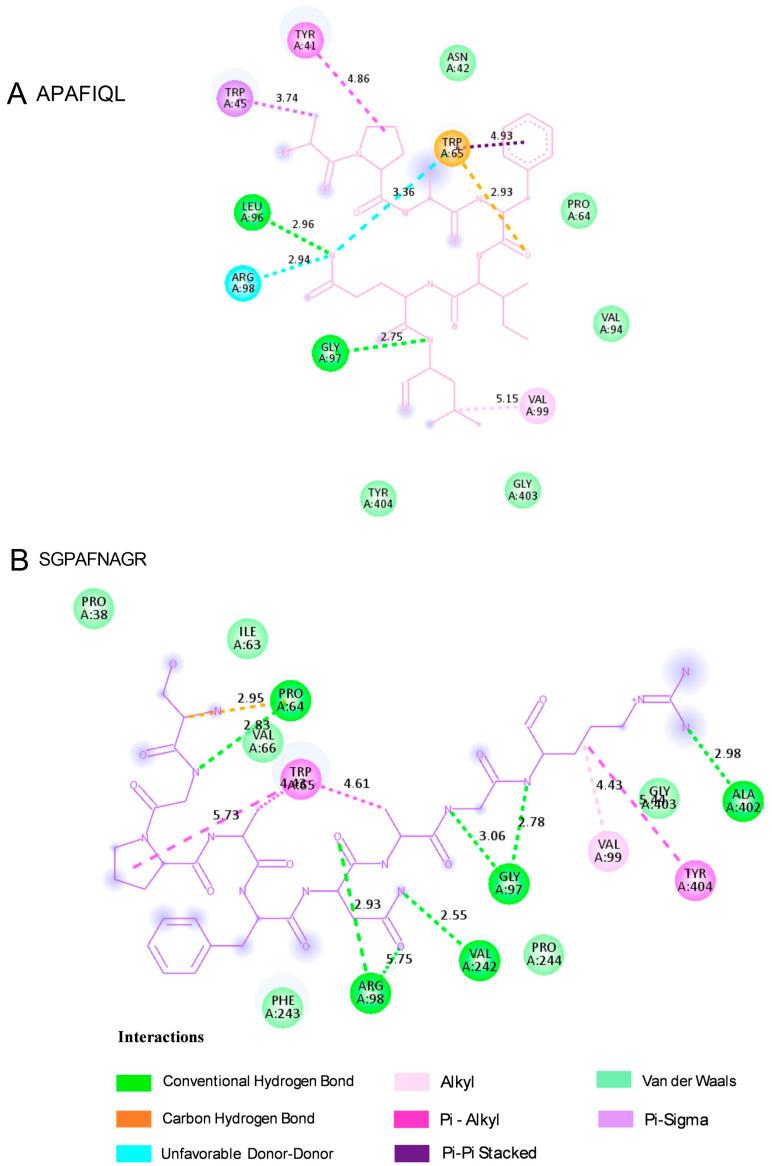
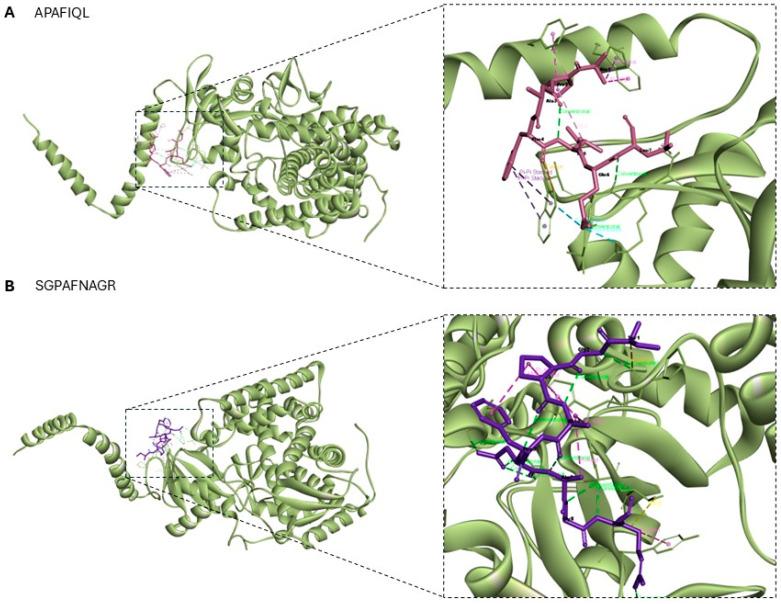
Olive () leaves, a by-product of olive oil production, represent a promising source of bioactive peptides. In this study, the peptidome of an olive leaf protein hydrolysate (OLPH) obtained via enzymatic hydrolysis with Alcalase was identified and analyzed for the first time. Liquid Chromatography coupled to Trapped Ion Mobility Spectrometry and Tandem Mass Spectrometry (LC-TIMS-MS/MS) analysis revealed over 7000 peptide sequences. Peptides with PeptideRanker scores above 0.79 were selected for in silico evaluation of antimicrobial potential, including physicochemical characterization and molecular docking. Several peptides-such as NYPAWGY, SSKGSLGGGF, QWDQGYF, and SGPAFNAGR-exhibited strong predicted antimicrobial potential, supported by favorable interactions with bacterial, viral, and fungal targets in docking simulations. Correlation analysis revealed that physicochemical features, such as net hydrogen, amphipathicity, and isoelectric point, were positively associated with predicted antimicrobial activity. These findings highlight the potential of olive leaf-derived peptides as natural antimicrobial agents and support the valorization of olive by-products as a sustainable source of functional ingredients for applications in food safety and health. Further experimental validation is needed to confirm the efficacy and mechanism of action of the identified peptides.
橄榄叶是橄榄油生产的副产品,是一种很有前景的生物活性肽来源。在本研究中,首次对通过用碱性蛋白酶进行酶解获得的橄榄叶蛋白水解物(OLPH)的肽组进行了鉴定和分析。液相色谱与阱式离子淌度质谱联用和串联质谱(LC-TIMS-MS/MS)分析揭示了7000多个肽序列。选择肽排名分数高于0.79的肽进行抗菌潜力的计算机模拟评估,包括物理化学表征和分子对接。几种肽,如NYPAWGY、SSKGSLGGGF、QWDQGYF和SGPAFNAGR,在对接模拟中与细菌、病毒和真菌靶点有良好的相互作用,显示出很强的预测抗菌潜力。相关性分析表明,净氢、两亲性和等电点等物理化学特征与预测的抗菌活性呈正相关。这些发现突出了橄榄叶衍生肽作为天然抗菌剂的潜力,并支持将橄榄副产品作为食品安全和健康应用中功能成分的可持续来源进行增值利用。需要进一步的实验验证来确认所鉴定肽的功效和作用机制。


 Zotero 插件