
评估无细胞百日咳疫苗的引入与美国百日咳疫情复发之间的关系。
Evaluating the Relationship Between the Introduction of the Acellular Pertussis Vaccine and Whooping Cough Resurgence in the United States.
作者信息
Parikh Jeegan, Hoare Ismael, Izurieta Ricardo
机构信息
College of Public Health, University of South Florida, Tampa, FL 33612, USA.
School of Public Health and Health Sciences, California State University, Dominguez Hills, Carson, CA 90747, USA.
出版信息
Vaccines (Basel). 2025 Aug 7;13(8):841. doi: 10.3390/vaccines13080841.
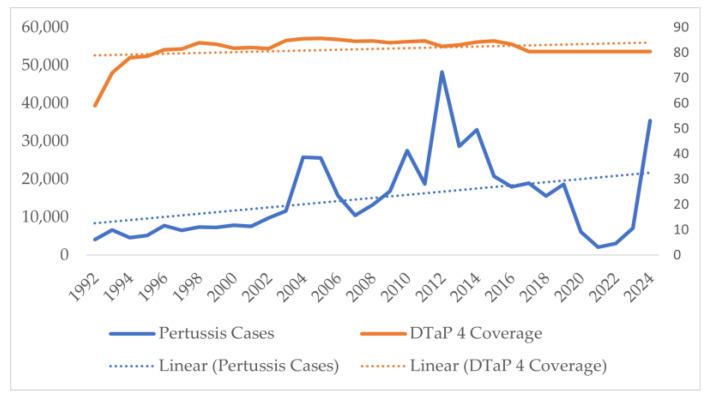
: The whole cell pertussis vaccine was introduced in the United States in the 1940s and switched to the acellular pertussis vaccine partially in 1992 and completely in 1997. This study examines the relationship between the resurgence of pertussis in the United States and the change in the type of pertussis vaccines. : Pertussis cases from 1922 to 2024 were obtained from the CDC's national notifiable disease surveillance system, and vaccination coverage was obtained from the WHO. A trend analysis and Pearson's correlation test were conducted between the incidence of cases and the coverage of the third and fourth doses of the pertussis vaccine. An ANOVA test and multivariable linear regression were performed to assess the association between the type of vaccine and the number of pertussis cases. : The number of cases increased from 4083 in 1992 to 35,435 in 2024, with cyclical outbreaks in 2010, 2012-2014, and 2024. The third and fourth doses of pertussis vaccine coverage had mild and moderate correlations with the number of pertussis cases. The vaccine type had a significant association with the number of pertussis cases and stayed significant after adjusting for vaccination coverage. : The switch in pertussis vaccine has impacted the epidemiology of pertussis outbreaks in the United States. A combination of factors, such as different types of immune response to vaccines, waning of immunity, and selection of non-vaccine bacterial strains, may explain the observed results. Further research on newer, improved vaccinations or alternative schedules in children needs to be conducted to address the resurgence of pertussis in this study.
全细胞百日咳疫苗于20世纪40年代在美国引入,1992年部分转换为无细胞百日咳疫苗,并于1997年完全转换。本研究探讨了美国百日咳疫情的复苏与百日咳疫苗类型变化之间的关系。:1922年至2024年的百日咳病例来自美国疾病控制与预防中心(CDC)的国家法定传染病监测系统,疫苗接种覆盖率来自世界卫生组织(WHO)。对病例发病率与百日咳疫苗第三剂和第四剂的接种覆盖率进行了趋势分析和Pearson相关性检验。进行了方差分析(ANOVA)检验和多变量线性回归,以评估疫苗类型与百日咳病例数之间的关联。:病例数从1992年的4083例增加到2024年的35435例,在2010年、2012 - 2014年和2024年出现周期性暴发。百日咳疫苗第三剂和第四剂的接种覆盖率与百日咳病例数存在轻度和中度相关性。疫苗类型与百日咳病例数存在显著关联,在调整疫苗接种覆盖率后仍具有显著性。:百日咳疫苗的转换影响了美国百日咳疫情的流行病学。疫苗免疫反应类型不同、免疫力下降以及非疫苗菌株的选择等多种因素可能解释了观察到的结果。需要对儿童新型、改进的疫苗接种或替代接种程序进行进一步研究,以应对本研究中百日咳疫情的复苏。



 Zotero 插件