
血浆致动脉粥样硬化指数与从血糖正常进展为糖尿病前期之间关联的性别差异:一项为期5年的大规模回顾性队列研究的证据
Sex differences in the association between atherogenic index of plasma and progression from normoglycemia to prediabetes: evidence from a 5-year large-scale retrospective cohort study.
作者信息
Yang Chufu, Chen Qiying, Li Weiyan, Gao Chuang, Han Yong, Zhu Jiaqian
机构信息
Department of General Practice, Affiliated Hospital Group of Guangdong Medical University Shenzhen Baoan Central Hospital (Baoan Central Hospital of Shenzhen), Shenzhen, Guangdong, China.
Department of Emergency, Shenzhen Dapeng New District Kuichong People's Hospital, Shenzhen, Guangdong, China.
出版信息
Front Endocrinol (Lausanne). 2025 Aug 12;16:1627337. doi: 10.3389/fendo.2025.1627337. eCollection 2025.
OBJECTIVE
Currently, there is limited research on the relationship between the atherogenic index of plasma (AIP) and the risk of prediabetes (pre-DM). This study aims to explore the potential link between AIP and the risk of progression from normoglycemia to pre-DM.
METHODS
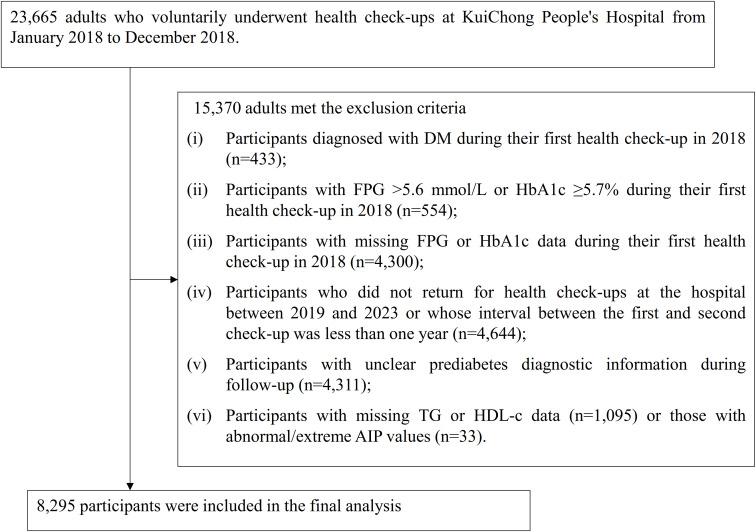
In this retrospective cohort analysis, a total of 8,295 individuals receiving routine medical examinations at Kuichong People's Hospital in Shenzhen between January 2018 and December 2023 were enrolled. The Cox proportional hazards regression model assessed the association between AIP and the risk of progression from normoglycemia to pre-DM, with restricted cubic splines functions used to assess non-linear relationships. Additionally, a competing risk Cox model was used, treating the progression from normoglycemia to diabetes (DM) as a competing event for pre-DM. Finally, the subgroup and sensitivity analyses confirmed the robustness of the findings.
RESULTS
After multivariable adjustment, each 0.1-unit increase in AIP was associated with an 11.5% increase in the risk of progression from normoglycemia to pre-DM [hazard ratio (HR) = 1.115; 95% confidence interval (CI): 1.065-1.167]. The competing risk Cox model showed that the sub-distribution hazard ratio for the association between AIP and the risk of pre-DM was 1.09 (95% CI: 1.04-1.14). Additionally, a non-linear association was observed in men, with an inflection point at 0.513. Below this threshold, each 0.1-unit increase in AIP was associated with an HR of 1.204 (95% CI: 1.098-1.321). In women, the relationship was linear.
CONCLUSION
This study demonstrated that elevated AIP was positively associated with the risk of progression from normoglycemia to pre-DM, with a significant sex difference in this relationship. This provides a reference for individualized risk stratification and management strategies for different sex populations and offers new perspectives for optimizing strategies to prevent pre-DM and DM.
目的
目前,关于血浆致动脉粥样硬化指数(AIP)与糖尿病前期(pre-DM)风险之间关系的研究有限。本研究旨在探讨AIP与血糖正常进展为糖尿病前期风险之间的潜在联系。
方法
在这项回顾性队列分析中,纳入了2018年1月至2023年12月期间在深圳葵涌人民医院接受常规体检的8295名个体。Cox比例风险回归模型评估AIP与血糖正常进展为糖尿病前期风险之间的关联,使用受限立方样条函数评估非线性关系。此外,使用竞争风险Cox模型,将血糖正常进展为糖尿病(DM)视为糖尿病前期的竞争事件。最后,亚组分析和敏感性分析证实了研究结果的稳健性。
结果
多变量调整后,AIP每增加0.1个单位,血糖正常进展为糖尿病前期的风险增加11.5%[风险比(HR)=1.115;95%置信区间(CI):1.065-1.167]。竞争风险Cox模型显示,AIP与糖尿病前期风险之间关联的亚分布风险比为1.09(95%CI:1.04-1.14)。此外,在男性中观察到非线性关联,拐点为0.513。低于此阈值,AIP每增加0.1个单位,HR为1.204(95%CI:1.098-1.321)。在女性中,这种关系是线性的。
结论
本研究表明,AIP升高与血糖正常进展为糖尿病前期的风险呈正相关,且这种关系存在显著的性别差异。这为不同性别群体的个体化风险分层和管理策略提供了参考,并为优化预防糖尿病前期和糖尿病的策略提供了新的视角。


 Zotero 插件