
重新审视用于在工业级电流密度下实现甲酰胺电合成的铂箔催化剂。
Revisiting Pt foil catalysts for formamide electrosynthesis achieved at industrial-level current densities.
作者信息
Wang Xinzhong, Su Yiwen, Chen Jiashu, Yan Edward Hengzhou, Xia Qing, Wu Jie, Gong Shanhe, Tang Mingcong, Yip Wai Sze, Mu Yongbiao, Yi Yuyang, Wu Jinjin, Xu Fujing, Yang Xianzhong, Zhang Xiao, Dou Shixue, Sun Jingyu, Zheng Guangping
机构信息
Department of Mechanical Engineering, The Hong Kong Polytechnic University, Hung Hom, Kowloon, Hong Kong, China.
Research Institute for Advanced Manufacturing, Hong Kong Polytechnic University, Kowloon, Hong Kong, China.
出版信息
Nat Commun. 2025 Aug 28;16(1):8040. doi: 10.1038/s41467-025-63313-5.
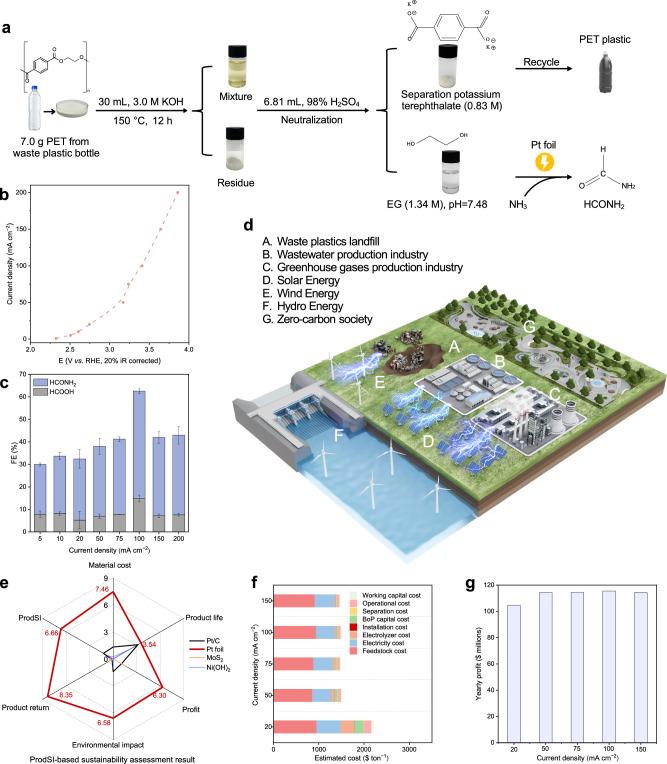
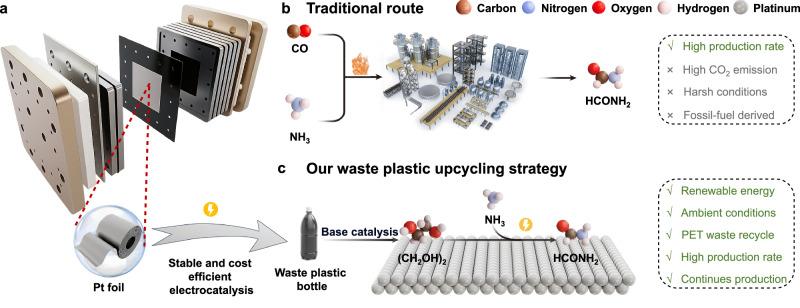
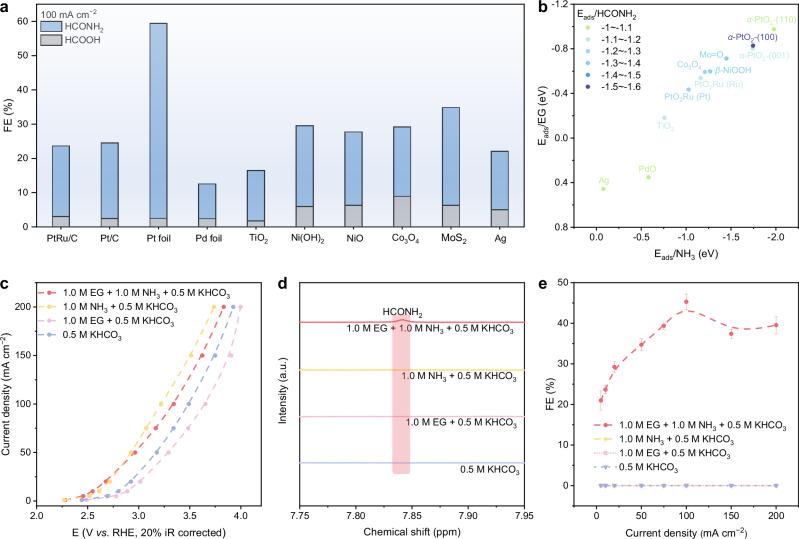
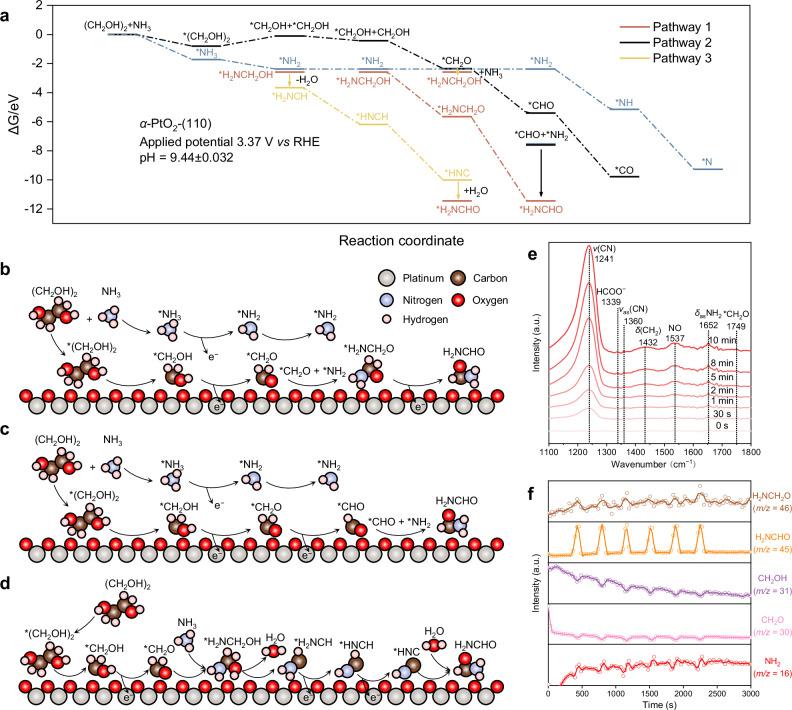
Current electrosynthesis catalysts typically rely on nanomaterial-based engineering with multi-dimensional structural modifications. However, such approaches may not always be necessary, especially for underexplored industrial electrochemical conversions. Here, we demonstrate that commercial platinum (Pt) foil catalysts excel in the electrochemical co-oxidation of waste polyethylene terephthalate (PET)-derived ethylene glycol (EG) and ammonia (NH) into formamide (HCONH), a process traditionally reliant on energy-intensive methods. This approach achieves a high Faradaic efficiency (FE) of 55.87 ± 1.4% and a productivity of 1003.63 ± 23.72 µmol cm h at industrially relevant current densities without any degradation for durable operation (more than 500 h and 300 h for H-cell and membrane electrode assembly (MEA) reactor, respectively). In situ spectroscopy, supported by theoretical calculations, suggests that *CHO and *NH are likely key intermediates. Furthermore, the product sustainability index (ProdSI) and techno-economic analysis (TEA) underscore the cost-effectiveness and sustainability of noble Pt foil in this scenario, challenging the conventional reliance on complex electrocatalysts. This work provides distinctive insights into catalyst screening and demonstrates a viable strategy for upcycling waste plastics.
当前的电合成催化剂通常依赖基于纳米材料的工程技术以及多维度结构修饰。然而,对于尚未充分探索的工业电化学转化而言,此类方法可能并非总是必要的。在此,我们证明,商业铂(Pt)箔催化剂在将废弃聚对苯二甲酸乙二酯(PET)衍生的乙二醇(EG)和氨(NH₃)电化学共氧化为甲酰胺(HCONH₂)的过程中表现出色,而该过程传统上依赖能源密集型方法。此方法在与工业相关的电流密度下实现了55.87±1.4%的高法拉第效率(FE)以及1003.63±23.72 μmol cm⁻² h⁻¹的产率,并且在持久运行过程中无任何降解(H型电解池和膜电极组件(MEA)反应器分别超过500小时和300小时)。理论计算支持的原位光谱表明,CHO和NH可能是关键中间体。此外,产品可持续性指数(ProdSI)和技术经济分析(TEA)强调了在此情况下贵金属Pt箔的成本效益和可持续性,对传统上依赖复杂电催化剂的做法提出了挑战。这项工作为催化剂筛选提供了独特见解,并展示了一种可行的废旧塑料升级回收策略。


 Zotero 插件