
TIGER:一种用于研究精准编辑器递送方法的tdTomato体内基因组编辑报告小鼠。
TIGER: A tdTomato in vivo genome-editing reporter mouse for investigating precision-editor delivery approaches.
作者信息
Du Samuel W, Palczewska Grazyna, Dong Zhiqian, Lauterborn Julie C, Kaipa Balasankara Reddy, Yan Alexander L, Hołubowicz Rafał, Ha Siyoung, Chen Paul Z, Gall Christine M, Zode Gulab, Liu David R, Palczewski Krzysztof
机构信息
Gavin Herbert Eye Institute-Robert M. Brunson Center for Translational Vision Research, Department of Ophthalmology and Visual Sciences, University of California Irvine, Irvine, CA 92697.
Department of Physiology and Biophysics, University of California Irvine, Irvine, CA 92697.
出版信息
Proc Natl Acad Sci U S A. 2025 Sep 2;122(35):e2506257122. doi: 10.1073/pnas.2506257122. Epub 2025 Aug 29.
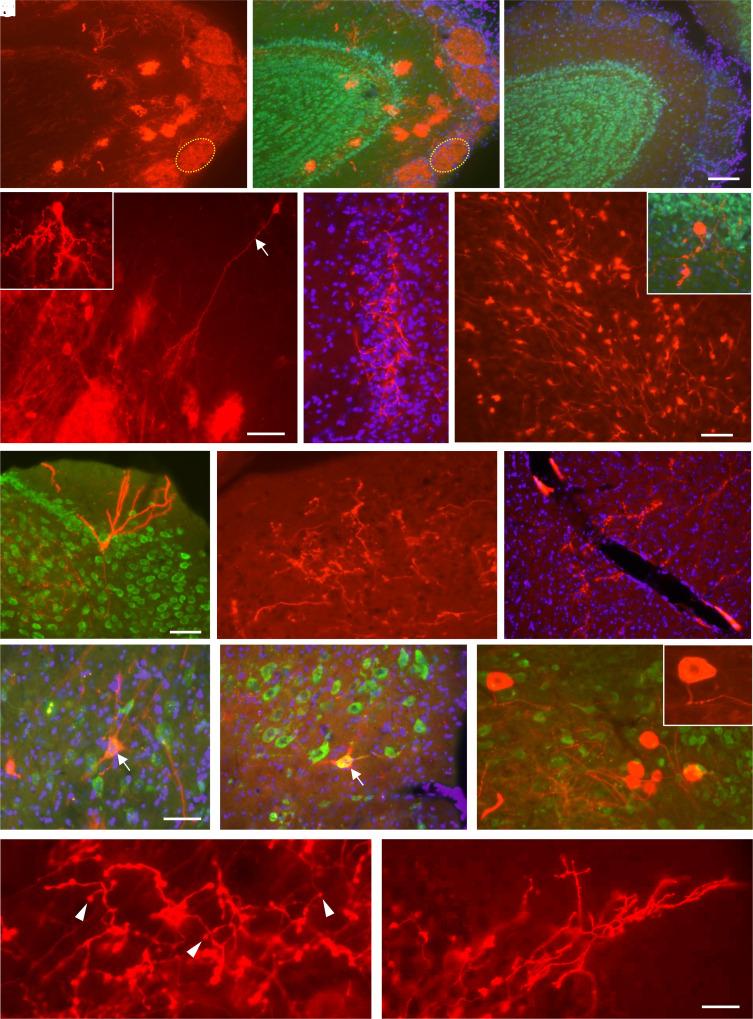
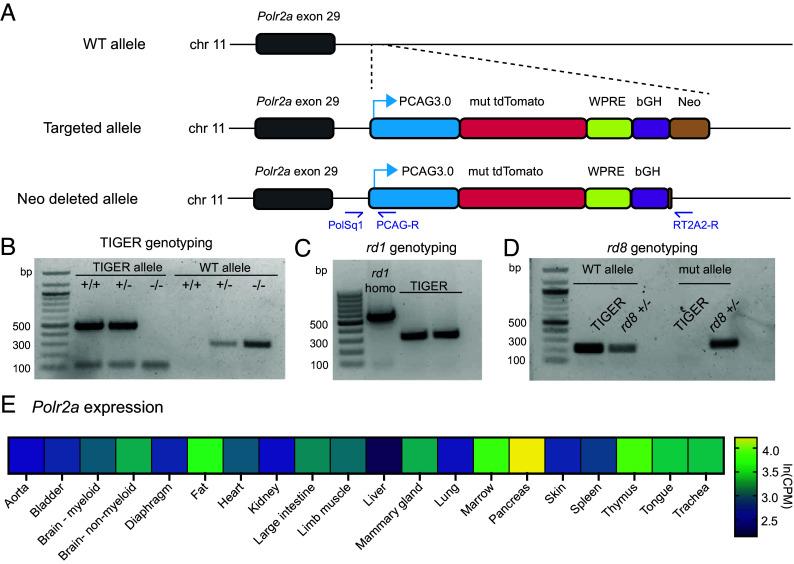
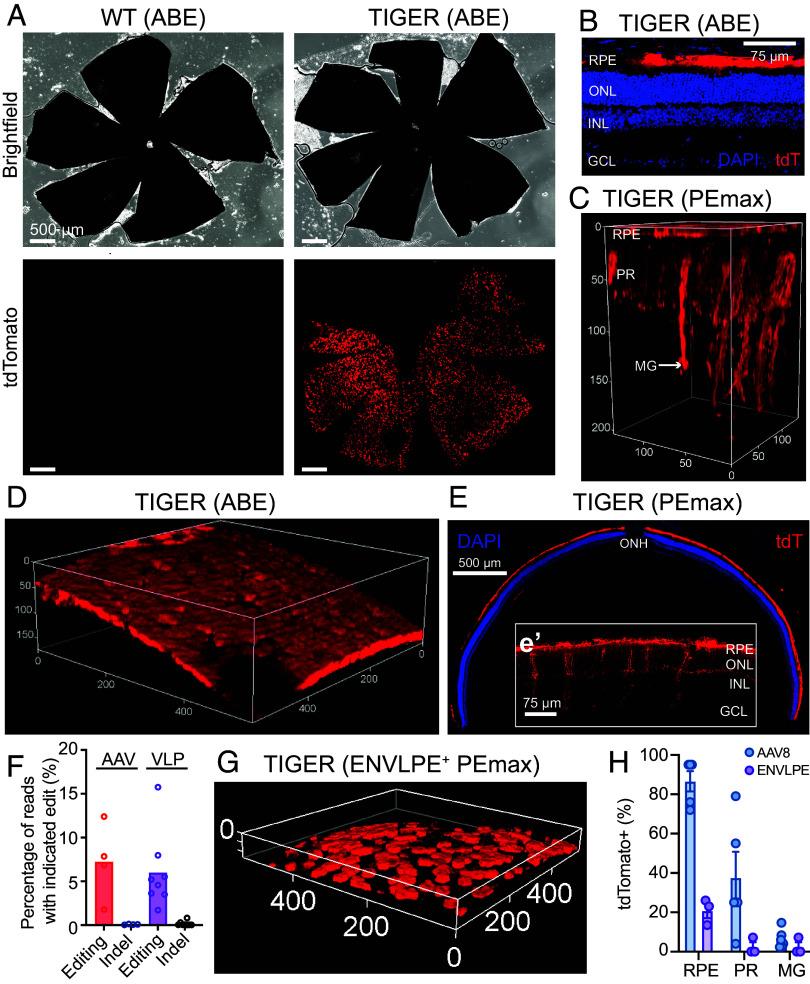
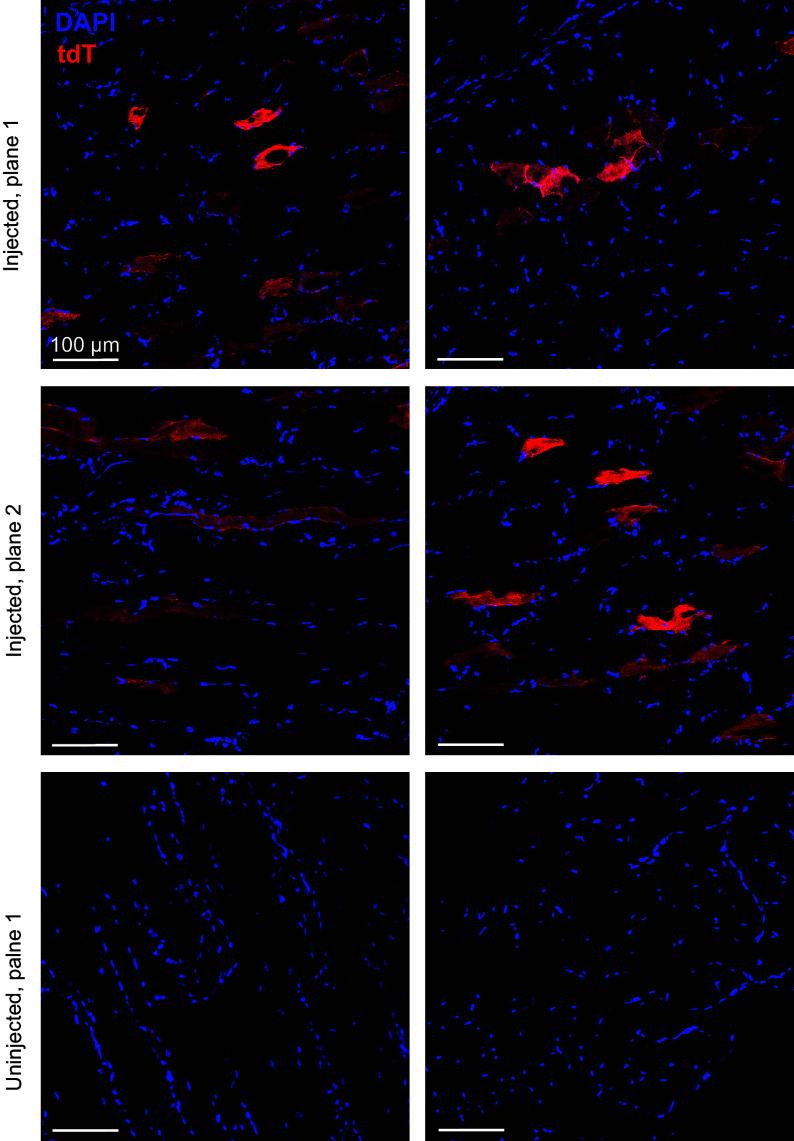
In vivo genome editing has the potential to address many inherited and environmental disorders. However, a major hurdle for the clinical translation of genome editing is safe, efficient delivery to disease-relevant tissues. A modality-agnostic reporter animal model that facilitates rapid, precise, and quantifiable assessment of functional delivery and editing could greatly enhance the evaluation and translation of delivery technologies. Here, we present the development of the tdTomato in vivo genome-editing reporter (TIGER) mouse, a reporter strain that harbors an integrated and constitutively expressed mutated tdTomato gene in the locus. The mutations (Q115X, Q357X) abolish fluorescence, but successful adenine base editing (ABE) or prime editing (PE) restores tdTomato fluorescence. This mouse model facilitates the tissue- and cell type-specific assessment of genome editing agent delivery. We describe several editing strategies validated in vitro and demonstrate efficient ABE and PE in vivo using viral and nonviral delivery vectors targeting four cell types within the mouse eye: the retinal pigment epithelium, photoreceptors, Müller glia, and the trabecular meshwork. We show direct editing characterization in the ocular tissues via in vivo and ex vivo two-photon confocal microscopy and verify the spectral and fluorescence lifetime properties of tdTomato reporter in other mouse tissues. Additionally, we demonstrate successful adeno-associated virus (AAV)-mediated PE of extraocular tissues, including hepatocytes, skeletal muscle, and brain neurons by intravenous injection. Thus, the TIGER mouse facilitates the direct development, comparison, and optimization of delivery platforms for efficient and productive ABE or PE broadly applicable in vivo across multiple tissues tested in this study.
体内基因组编辑有潜力解决许多遗传性和环境性疾病。然而,基因组编辑临床转化的一个主要障碍是安全、有效地递送至与疾病相关的组织。一种与模式无关的报告动物模型,能够促进对功能性递送和编辑进行快速、精确且可量化的评估,这将极大地提升递送技术的评估和转化。在此,我们展示了tdTomato体内基因组编辑报告基因(TIGER)小鼠的开发,这是一种报告品系,在 位点含有一个整合且组成型表达的突变tdTomato基因。这些突变(Q115X、Q357X)消除了荧光,但成功的腺嘌呤碱基编辑(ABE)或引导编辑(PE)可恢复tdTomato荧光。该小鼠模型有助于对基因组编辑试剂递送进行组织和细胞类型特异性评估。我们描述了几种在体外验证的编辑策略,并使用针对小鼠眼内四种细胞类型(视网膜色素上皮、光感受器、穆勒胶质细胞和小梁网)的病毒和非病毒递送载体,在体内证明了高效的ABE和PE。我们通过体内和体外双光子共聚焦显微镜展示了眼组织中的直接编辑特征,并在其他小鼠组织中验证了tdTomato报告基因的光谱和荧光寿命特性。此外,我们通过静脉注射证明了腺相关病毒(AAV)介导的眼外组织(包括肝细胞、骨骼肌和脑神经元)的PE成功。因此,TIGER小鼠有助于直接开发、比较和优化递送平台,以实现高效且有效的ABE或PE,广泛适用于本研究中测试的多种体内组织。




 Zotero 插件