
有创和无创颅内压监测下的颅内高压管理
Management of intracranial hypertension with and without invasive intracranial pressure monitoring.
作者信息
Bianchini Larissa, de Matos Paulo Marcelo Pontes Gomes, Roepke Roberta Muriel Longo, Besen Bruno Adler Maccagnan Pinheiro
机构信息
Medical Sciences Postgraduate Programme, Internal Medicine Department, Faculdade de Medicina, Universidade de São Paulo, Sao Paulo 05403-010, Brazil.
Intensive Care Unit, Department of Medicine, Hospital das Clinicas HCFMUSP, Faculdade de Medicina, Universidade de São Paulo, Sao Paulo 05403-010, Brazil.
出版信息
World J Crit Care Med. 2025 Sep 9;14(3):105645. doi: 10.5492/wjccm.v14.i3.105645.
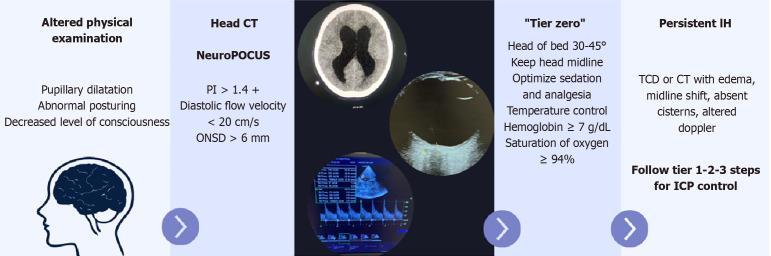
Management of intracranial hypertension (IH) has improved in the last decades driven by advancements in monitoring technologies and a deeper understanding of its pathophysiology. Although intracranial pressure (ICP) catheters are still recommended by current guidelines for monitoring patients at risk of IH, these methods are not without limitations. Challenges include procedural complications, availability of these devices in many healthcare settings and technical issues. In this context, management in the absence of ICP monitoring is common and now it can be augmented by intensivist-led point-of-care ultrasound, which includes tools such as transcranial doppler, optic nerve sheath measurement and brain ultrasound. These methods offer anatomic information that can sometimes withhold repeated head computed tomography (CT) scans, but they are also a window into ICP dynamics without the associated risks of invasive monitoring and are reasonable alternatives for guiding treatment, provided an integration between neurological examination, head CT anatomical findings and noninvasive monitors is considered. This manuscript synthesizes the evidence for using invasive ICP monitoring and methods for non-invasive monitoring, more focused on the role of ultrasound, given its wider availability. We also propose a practical approach of how to integrate this information at bedside to avoid both under and overtreatment, by embracing a clinical epidemiology paradigm to guide management decisions.
在过去几十年中,随着监测技术的进步以及对颅内高压(IH)病理生理学的更深入理解,颅内高压的管理有了改善。尽管目前的指南仍推荐使用颅内压(ICP)导管来监测有颅内高压风险的患者,但这些方法并非没有局限性。挑战包括操作并发症、许多医疗机构中这些设备的可及性以及技术问题。在此背景下,在没有ICP监测的情况下进行管理很常见,现在由重症监护医生主导的床旁超声可以对此进行补充,其中包括经颅多普勒、视神经鞘测量和脑超声等工具。这些方法提供的解剖学信息有时可以避免重复进行头部计算机断层扫描(CT),而且它们也是了解ICP动态变化的一个窗口,没有侵入性监测的相关风险,并且在考虑到神经学检查、头部CT解剖学发现和非侵入性监测之间的整合的情况下,是指导治疗的合理替代方法。本手稿综合了使用有创ICP监测和无创监测方法的证据,鉴于超声的可及性更高,更多地关注了超声的作用。我们还提出了一种实用方法,即如何通过采用临床流行病学范式来指导管理决策,在床边整合这些信息以避免治疗不足和过度治疗。
 Zotero 插件