
沉默信号:双特异性抗体治疗多发性骨髓瘤中出现的安全性问题
The silent signals: emerging safety concerns in bispecific antibody therapy for multiple myeloma.
作者信息
Zhou Xiaoling, Luo Erdan, Chen Wei, Deng Yi, Wu Bo, Jiang Xia, Zhang Kaili, Lai Fan
机构信息
Department of Pharmacy, Chengdu Women's and Children's Central Hospital, School of Medicine, University of Electronic Science and Technology of China, Chengdu, China.
Department of Good Clinical Practice, Chengdu Women's and Children's Central Hospital, School of Medicine, University of Electronic Science and Technology of China, Chengdu, China.
出版信息
Front Med (Lausanne). 2025 Aug 13;12:1593405. doi: 10.3389/fmed.2025.1593405. eCollection 2025.
BACKGROUND
Bispecific antibodies (BsAbs) are widely used for the treatment of multiple myeloma (MM), but their long-term safety still provokes concerns.
METHODS
Adverse event (AE) data on teclistamab, talquetamab, and elranatamab between 1 August 2022 and 30 September 2024 were retrieved from the Food and Drug Administration's AE Reporting System (FAERS) database by use of Open Vigil 2.1. AEs were categorized by preferred terms (PTs) and system organ classes (SOCs) as defined by MedDRA. As widely used statistical measures in pharmacovigilance, proportional reporting (PRR) and reporting odds ratios (ROR) were employed to identify potential safety signals.
RESULTS
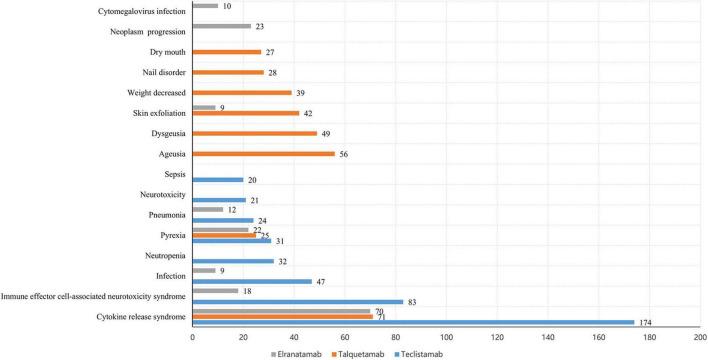
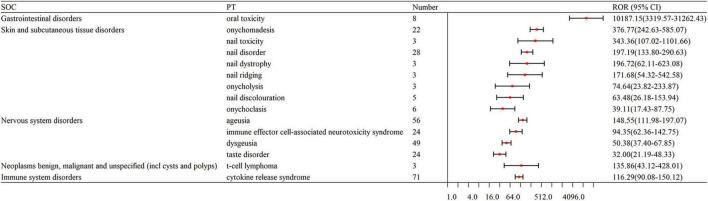
In total 2,789,182 reports on AEs were retrieved, including 811 for teclistamab, 446 for talquetamab and 302 for elranatamab. Significant associations with immune system disorders, nervous system disorders, benign, malignant and unspecified (incl cysts and polyps) neoplasms, and hepatobiliary disorders were found for all three BsAbs. Common PTs included cytokine release syndrome (CRS), neurotoxicity, immune effector cell-associated neurotoxicity syn-drome (ICANS), pyrexia, and neutropenia. Meanwhile, signal values varied among the three BsAbs. Notably, new safety signals numbered 14, 4, and 5 were identified for teclistamab, talquetamab, and elranatamab, respectively.
CONCLUSION
Adverse event signals were demonstrated to vary among the three BsAbs used in MM. Significant safety signals identified in the FAERS database which were consistent with previously reported clinical trial data. Furthermore, each BsAb exhibited several novel signals. These findings provide decision-makers and healthcare providers with valuable insights into clinical practice.
背景
双特异性抗体(BsAbs)被广泛用于治疗多发性骨髓瘤(MM),但其长期安全性仍引发关注。
方法
通过使用Open Vigil 2.1,从美国食品药品监督管理局不良事件报告系统(FAERS)数据库中检索2022年8月1日至2024年9月30日期间关于替雷利珠单抗、塔奎他单抗和埃拉纳单抗的不良事件(AE)数据。不良事件按照医学术语集(MedDRA)定义的首选术语(PTs)和系统器官分类(SOCs)进行分类。作为药物警戒中广泛使用的统计方法,采用比例报告(PRR)和报告比值比(ROR)来识别潜在的安全信号。
结果
共检索到2,789,182份不良事件报告,其中替雷利珠单抗811份、塔奎他单抗446份、埃拉纳单抗302份。发现所有三种双特异性抗体均与免疫系统疾病、神经系统疾病、良性、恶性及未特定(包括囊肿和息肉)肿瘤以及肝胆疾病存在显著关联。常见的首选术语包括细胞因子释放综合征(CRS)、神经毒性、免疫效应细胞相关神经毒性综合征(ICANS)、发热和中性粒细胞减少。同时,三种双特异性抗体的信号值各不相同。值得注意的是,替雷利珠单抗、塔奎他单抗和埃拉纳单抗分别识别出14个、4个和5个新的安全信号。
结论
已证明在治疗MM中使用的三种双特异性抗体的不良事件信号存在差异。在FAERS数据库中识别出的显著安全信号与先前报告的临床试验数据一致。此外,每种双特异性抗体都表现出一些新的信号。这些发现为决策者和医疗服务提供者在临床实践中提供了有价值的见解。



 Zotero 插件