
新辅助化疗后三阴性乳腺癌患者的辅助性卡培他滨治疗
Adjuvant capecitabine in patients with triple-negative breast cancer after neoadjuvant chemotherapy.
作者信息
Strahan A, Jin Q, Raghavendra A S, Zakon D B, Grimm M, Hughes M E, Cherian M, Vincuilla J, Parker T, Tarantino P, Johnson K C C, Mittendorf E A, King T A, Valero V, Tripathy D, Tolaney S M, Tayob N, Lin N U, Stover D G, Barcenas C H, Garrido-Castro A C
机构信息
The Ohio State University Comprehensive Cancer Center, Columbus, USA.
Department of Data Science, Dana-Farber Cancer Institute, Boston, USA.
出版信息
ESMO Open. 2025 Aug 28;10(9):105568. doi: 10.1016/j.esmoop.2025.105568.
BACKGROUND
For patients diagnosed with triple-negative breast cancer (TNBC), residual disease (RD) after neoadjuvant chemotherapy (NAC) is associated with increased rates of recurrence and poor prognosis. Adjuvant therapy with capecitabine is considered standard management for TNBC-RD based on the CREATE-X study, although real-world data are limited. Real-world utilization of adjuvant capecitabine for patients with TNBC-RD and the association of capecitabine with survival outcomes remains largely unknown.
PATIENTS AND METHODS
We evaluated survival outcomes in patients with stage I-III TNBC (including estrogen and progesterone receptor <10%) who received NAC and underwent breast surgery between January 2016 and June 2019 at three comprehensive cancer centers. Treatment in the adjuvant setting was categorized as capecitabine, other systemic therapy, or no adjuvant therapy. Propensity score methods were used to control potential confounding effects from baseline covariates. Survival outcomes were estimated using Kaplan-Meier and propensity weighted Cox proportional hazards models.
RESULTS
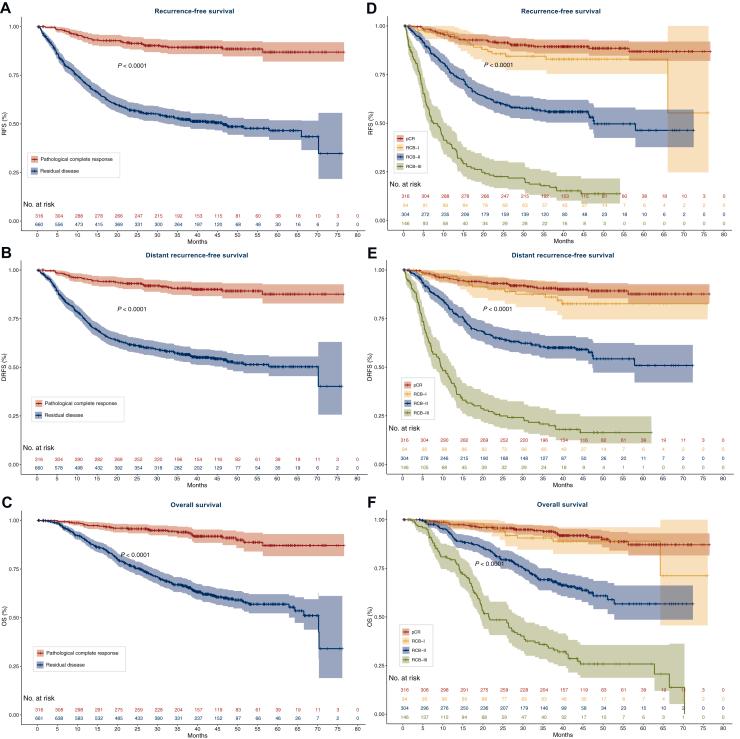
In the total population, 661/977 (67.7%) had RD after NAC; the NAC regimens were primarily anthracycline-taxane (n = 611; 62.5%), anthracycline-taxane-platinum (n = 180; 18.4%), or taxane-platinum (n = 39; 4.0%). Among patients with TNBC-RD, 45.1% (298/661) did not receive any adjuvant therapy. Among those who received adjuvant therapy, 202/363 (55.6%) received capecitabine, 115/363 (31.7%) other chemotherapy, and 46/363 (12.7%) endocrine or targeted therapy. At a median follow-up of 3.5 years, receipt of capecitabine was associated with significantly improved recurrence-free survival [RFS; propensity-adjusted hazard ratio (HR) 0.70, 95% confidence interval (CI) 0.54-0.91, P = 0.008], distant recurrence-free survival (DRFS; HR 0.71, 95% CI 0.54-0.93, P = 0.01), and overall survival (OS; HR 0.66, 95% CI 0.49-0.90, P = 0.009).
CONCLUSION
In this large cohort of patients with TNBC-RD after NAC, omission of adjuvant therapy was common, with less than one-third of patients receiving adjuvant capecitabine. Receipt of adjuvant capecitabine was associated with significantly improved RFS, DRFS, and OS.
背景
对于诊断为三阴性乳腺癌(TNBC)的患者,新辅助化疗(NAC)后的残留疾病(RD)与复发率增加和预后不良相关。基于CREATE-X研究,卡培他滨辅助治疗被认为是TNBC-RD的标准治疗方法,尽管真实世界的数据有限。TNBC-RD患者辅助卡培他滨的实际应用情况以及卡培他滨与生存结局的关联在很大程度上仍不清楚。
患者与方法
我们评估了2016年1月至2019年6月期间在三个综合癌症中心接受NAC并接受乳房手术的I-III期TNBC(包括雌激素和孕激素受体<10%)患者的生存结局。辅助治疗分为卡培他滨、其他全身治疗或无辅助治疗。采用倾向评分方法控制基线协变量的潜在混杂效应。使用Kaplan-Meier和倾向加权Cox比例风险模型估计生存结局。
结果
在总人群中,661/977(67.7%)在NAC后有RD;NAC方案主要是蒽环类-紫杉烷(n = 611;62.5%)、蒽环类-紫杉烷-铂(n = 180;18.4%)或紫杉烷-铂(n = 39;4.0%)。在TNBC-RD患者中,45.1%(298/661)未接受任何辅助治疗。在接受辅助治疗的患者中,202/363(55.6%)接受了卡培他滨,115/363(31.7%)接受了其他化疗,46/363(12.7%)接受了内分泌或靶向治疗。在中位随访3.5年时,接受卡培他滨与无复发生存期[RFS;倾向调整风险比(HR)0.70,95%置信区间(CI)0.54-0.91,P = 0.008]、远处无复发生存期(DRFS;HR 0.71,95%CI 0.54-0.93,P = 0.01)和总生存期(OS;HR 0.66,95%CI 0.49-0.90,P = 0.009)显著改善相关。
结论
在这个大型NAC后TNBC-RD患者队列中,省略辅助治疗很常见,接受辅助卡培他滨的患者不到三分之一。接受辅助卡培他滨与RFS、DRFS和OS显著改善相关。
 Zotero 插件