Peng Siyan, Yu Zhixin, Zhu Honglin, Liang Chuwen, Qiu Huijuan, Hong Shaodong, Zhou Yixin
State Key Laboratory of Oncology in South China, Collaborative Innovation Center for Cancer Medicine, Sun Yat-sen University Cancer Center, Guangzhou, China.
Department of VIP Region, Sun Yat-sen University Cancer Center, Guangzhou, China.
Front Pharmacol. 2025 Aug 14;16:1586332. doi: 10.3389/fphar.2025.1586332. eCollection 2025.
In advanced non-small cell lung cancer with EGFR mutations, third-generation EGFR TKIs (3-G TKIs) are currently the preferred first-line treatment. Previous studies have demonstrated that combining first-generation EGFR TKIs with chemotherapy (1-G TKIs + chemo) also significantly enhances efficacy compared to 1-G TKIs alone. This study aims to compare the effectiveness of 1-G TKIs + chemo against 3-G TKIs.
We conducted an indirect meta-analysis of randomized controlled trials comparing 1-G TKIs + chemo to 3-G TKIs. Randomized controlled trials (RCTs) were searched from the PubMed, Embase and Cochrane Library databases. Outcomes included progression-free survival (PFS), overall survival (OS), objective response rate (ORR), and grade ≥3 treatment-related adverse events (TRAEs). Data were analyzed using inverse variance and Mantel-Haenszel methods.
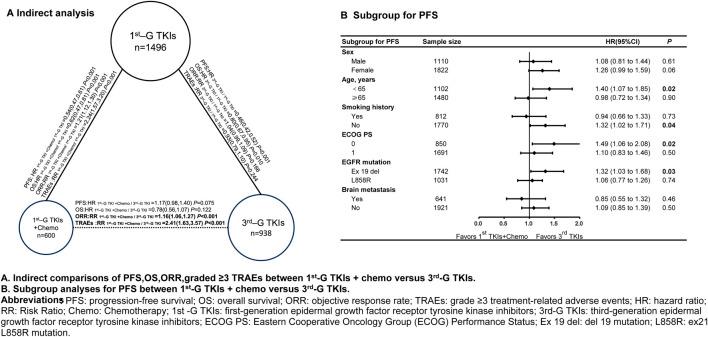
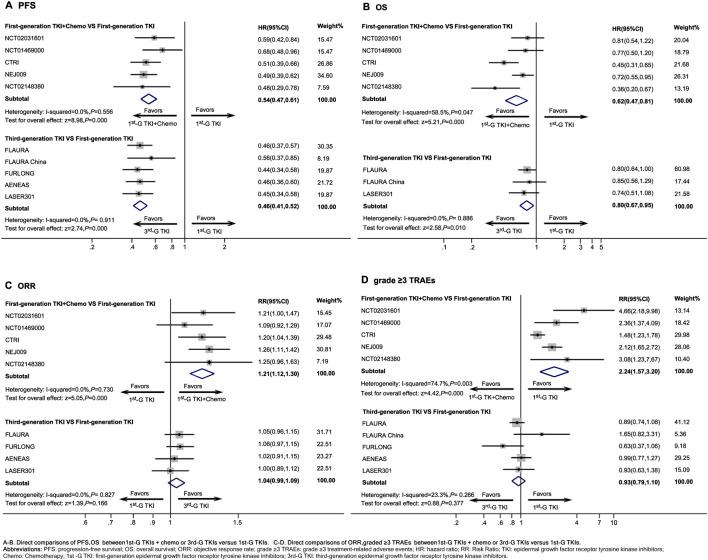
Ten RCTs with 3,014 patients met the inclusion criteria. Direct comparisons indicated that 1-G TKIs + chemo significantly improved PFS (HR 0.54, < 0.001), OS (HR 0.62, < 0.001), and ORR (RR 1.21, < 0.001) compared to 1-G TKIs alone. Indirect comparisons between 1-G TKIs + chemo and 3-G TKIs revealed no significant differences in PFS (HR 1.17; 95% CI, 0.98 to 1.40; = 0.075) or OS (HR 0.78; 95% CI, 0.56 to 1.07; = 0.122). Although 1-G TKIs + chemo showed a 16% improvement in ORR compared to 3-G TKIs (RR 1.16; 95% CI, 1.06 to 1.27; < 0.001), it was also associated with a notable increase in grade ≥3 TRAEs (RR 2.41; 95% CI, 1.63 to 3.57; < 0.001).
1-G TKIs + chemo demonstrated PFS and OS comparable to 3-G TKIs. Moreover, 1-G TKIs + chemo may be a viable option for patients who prioritize a higher response rate.
https://www.crd.york.ac.uk/PROSPERO/view/CRD42023461565 identifer, PROSPERO (CRD42023461565).
在伴有表皮生长因子受体(EGFR)突变的晚期非小细胞肺癌中,第三代EGFR酪氨酸激酶抑制剂(3-G TKIs)目前是首选的一线治疗方法。既往研究表明,与单独使用第一代EGFR酪氨酸激酶抑制剂(1-G TKIs)相比,第一代EGFR酪氨酸激酶抑制剂联合化疗(1-G TKIs + 化疗)也能显著提高疗效。本研究旨在比较1-G TKIs + 化疗与3-G TKIs的有效性。
我们对比较1-G TKIs + 化疗与3-G TKIs的随机对照试验进行了间接荟萃分析。从PubMed、Embase和Cochrane图书馆数据库中检索随机对照试验(RCT)。结局指标包括无进展生存期(PFS)、总生存期(OS)、客观缓解率(ORR)和≥3级治疗相关不良事件(TRAEs)。采用逆方差法和Mantel-Haenszel法分析数据。
10项随机对照试验共纳入3014例患者,符合纳入标准。直接比较表明,与单独使用1-G TKIs相比,1-G TKIs + 化疗显著改善了PFS(风险比[HR] 0.54,P < 0.001)、OS(HR 0.62,P < 0.001)和ORR(相对危险度[RR] 1.21,P < 0.001)。1-G TKIs + 化疗与3-G TKIs之间的间接比较显示,PFS(HR 1.17;95%置信区间[CI],0.98至1.40;P = 0.075)或OS(HR 0.78;95% CI,0.56至1.07;P = 0.122)无显著差异。虽然与3-G TKIs相比,1-G TKIs + 化疗的ORR提高了16%(RR 1.16;95% CI,1.06至1.27;P < 0.001),但它也与≥3级TRAEs的显著增加相关(RR 2.41;95% CI,1.63至3.57;P < 0.001)。
1-G TKIs + 化疗显示出与3-G TKIs相当的PFS和OS。此外,对于优先考虑更高缓解率的患者,1-G TKIs + 化疗可能是一个可行的选择。
https://www.crd.york.ac.uk/PROSPERO/view/CRD42023461565标识符,PROSPERO(CRD42023461565)


 Zotero 插件