
介入治疗、多纳非尼和抗PD-1抗体三联疗法治疗不可切除肝细胞癌:一项中国回顾性真实世界研究
Triple Therapy with Interventional Treatment, Donafenib, and Anti-PD-1 Antibodies in Unresectable Hepatocellular Carcinoma: A Retrospective Real-World Study in China.
作者信息
Ye Qiuwen, Song Zhengrui, Yu Tingdong, Li Yong, Ai Liang, Yang Guangjun, Su Kun, Chen Dong, Zhao Wentao, Ding Rong, Zha Yong, Li Gang
机构信息
Department of Hepatobiliary and Pancreatic Surgery, Yunnan Cancer Hospital, Kunming, Yunnan, People's Republic of China.
Department of Radiology, Yunnan Cancer Hospital, Kunming, Yunnan, People's Republic of China.
出版信息
J Hepatocell Carcinoma. 2025 Aug 24;12:1905-1919. doi: 10.2147/JHC.S532120. eCollection 2025.
BACKGROUND
Unresectable hepatocellular carcinoma (uHCC) remains a major clinical challenge with limited effective therapeutic options. Triple therapy combining interventional treatments, donafenib, and anti-PD-1 monoclonal antibodies has shown promise in recent studies, but real-world data remain limited.
OBJECTIVE
To evaluate the real-world efficacy and safety of triple therapy with interventional treatment, donafenib, and anti-PD-1 monoclonal antibodies in patients with uHCC.
METHODS
This retrospective study included 89 patients with uHCC who received donafenib, anti-PD-1 monoclonal antibodies (tislelizumab or sintilimab), and interventional therapies (TACE and/or HAIC) between March 2022 and December 2023. Outcomes included objective response rate (ORR), progression-free survival (PFS), overall survival (OS), and safety. Efficacy was assessed using modified RECIST (mRECIST) criteria; prognostic factors were analyzed using Cox regression models.
RESULTS
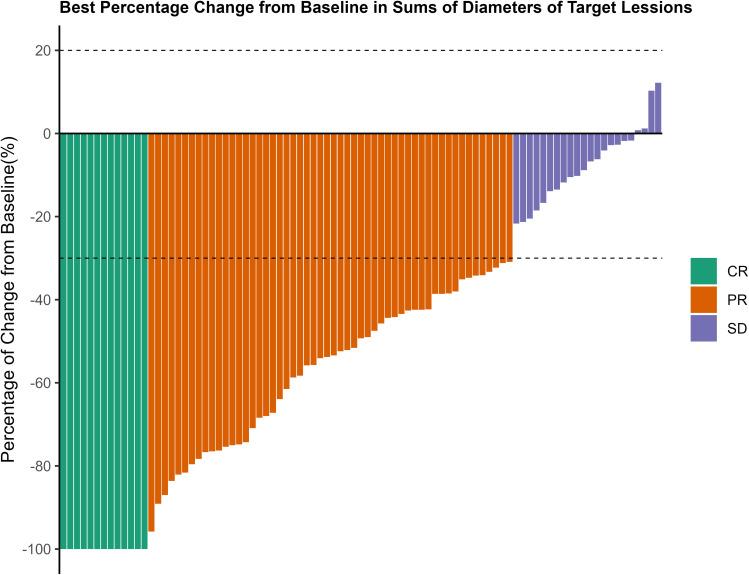
Among 89 patients, the ORR was 75.3% and the disease control rate was 100%. The median PFS was 18.5 months (95% CI: 15.0-NA); median OS was not reached after a median follow-up of 13.7 months. PFS rates at 6, 12, and 18 months were 87.6%, 72.4%, and 52.7%, and OS rates were 93.3%, 81.6%, and 72.4%, respectively. Conversion surgery was achieved in 15.7% of patients. Subgroup analysis indicated that ECOG PS 1, extrahepatic metastases, and high baseline AFP were associated with worse survival outcomes, while interventional modality did not significantly affect prognosis. Multivariate analysis confirmed ECOG PS 1 and extrahepatic metastases as independent predictors of shorter PFS, and ECOG PS 1 and elevated AFP as independent predictors of worse OS. Grade ≥3 treatment-related adverse events occurred in 30.3% of patients; no treatment-related deaths were reported.
CONCLUSION
The combination of interventional therapies, donafenib, and anti-PD-1 monoclonal antibodies demonstrated promising efficacy and manageable safety in uHCC, warranting further validation in prospective trials.
背景
不可切除肝细胞癌(uHCC)仍然是一项重大临床挑战,有效治疗选择有限。介入治疗、多纳非尼和抗PD-1单克隆抗体联合的三联疗法在近期研究中显示出前景,但真实世界数据仍然有限。
目的
评估介入治疗、多纳非尼和抗PD-1单克隆抗体三联疗法在uHCC患者中的真实世界疗效和安全性。
方法
这项回顾性研究纳入了89例uHCC患者,这些患者在2022年3月至2023年12月期间接受了多纳非尼、抗PD-1单克隆抗体(替雷利珠单抗或信迪利单抗)和介入治疗(经动脉化疗栓塞术和/或肝动脉灌注化疗)。观察指标包括客观缓解率(ORR)、无进展生存期(PFS)、总生存期(OS)和安全性。疗效采用改良RECIST(mRECIST)标准进行评估;使用Cox回归模型分析预后因素。
结果
89例患者中,ORR为75.3%,疾病控制率为100%。中位PFS为18.5个月(95%CI:15.0-未达到);中位随访13.7个月后,中位OS未达到。6个月、12个月和18个月时的PFS率分别为87.6%、72.4%和52.7%,OS率分别为93.3%、81.6%和72.4%。15.7%的患者实现了转化手术。亚组分析表明,东部肿瘤协作组(ECOG)体能状态评分为1、肝外转移和基线甲胎蛋白(AFP)水平高与较差的生存结果相关,而介入治疗方式对预后无显著影响。多变量分析证实,ECOG体能状态评分为1和肝外转移是PFS较短的独立预测因素,ECOG体能状态评分为1和AFP升高是OS较差的独立预测因素。30.3%的患者发生了≥3级治疗相关不良事件;未报告与治疗相关的死亡病例。
结论
介入治疗、多纳非尼和抗PD-1单克隆抗体联合在uHCC中显示出有前景的疗效和可控的安全性,值得在前瞻性试验中进一步验证。



 Zotero 插件