
早期游离轻链抑制作为接受靶向BCMA的嵌合抗原受体T细胞治疗的复发难治性骨髓瘤患者的预后标志物
Early Free Light-Chain Suppression as a Prognostic Marker in Relapsed and Refractory Myeloma Patients Treated With BCMA-Directed CAR-T Cells.
作者信息
Richardson Tim, Tharmaseelan Hishan, Kobbe Guido, Baermann Ben-Niklas, Holderried Tobias A W, Schmitz Friederike, Crysandt Martina, Gödel Philipp, Wolfensberger Nathan, Schütte Daniel, Hallek Michael, Scheid Christof, Holtick Udo
机构信息
Department I of Internal Medicine, Medical Faculty and University Hospital of Cologne University of Cologne Cologne Germany.
Center for Integrated Oncology Aachen Bonn Cologne Duesseldorf (CIO ABCD) Aachen Germany.
出版信息
EJHaem. 2025 Aug 30;6(5):e70139. doi: 10.1002/jha2.70139. eCollection 2025 Oct.
BACKGROUND
Relapsed/refractory multiple myeloma (RRMM) remains difficult to treat despite advances in therapy. B-cell maturation antigen (BCMA)-directed chimeric antigen receptor T-cell (CAR-T) therapies, such as idecabtagene vicleucel (ide-cel) and ciltacabtagene autoleucel (cilta-cel), have improved outcomes, yet many patients relapse within a year. Current International Myeloma Working Group (IMWG) criteria for deep response require prolonged observation. Early, practical biomarkers could enable timelier risk stratification and intervention.
OBJECTIVE
To evaluate whether serum free light-chain (FLC) suppression at Day +28 after BCMA-directed CAR-T infusion predicts progression-free survival (PFS) and overall survival (OS) in RRMM.
METHODS
We conducted a retrospective multicenter analysis of 80 consecutive RRMM patients treated with in-label ide-cel or cilta-cel between January 2022 and July 2024 at four tertiary centers. Patients with oligo-/non-secretory myeloma were excluded. FLC suppression-defined as undetectable or light chains using the Freelite assay-was assessed at Day +28 (window: Days 27-31) and at 3 months post-infusion. Survival analyses used a landmark approach from Day +28. Multivariate Cox regression adjusted for prior BCMA/T-cell-directed therapy, high-risk cytogenetics (HRC), extramedullary disease (EMD), and pre-CAR-T response status.
RESULTS
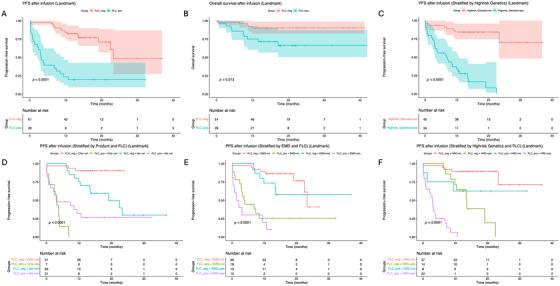
At Day +28, 51 patients (63.8%) achieved FLC suppression. Median follow-up was 11.8 months. FLC suppression correlated with markedly longer median PFS (23.4 vs. 4.1 months, < 0.001) and improved OS (12-month OS: 88.0% vs. 18.1%, = 0.013). Benefits were observed across CAR-T products, but suppression rates were higher with cilta-cel (81.6%) than ide-cel (45.2%). HRC remained an adverse factor even in suppressed patients, while EMD showed a less consistent effect. In multivariate analysis, absence of FLC suppression independently predicted inferior PFS.
CONCLUSIONS
FLC suppression at Day +28 post-CAR-T is an early, inexpensive biomarker associated with superior PFS and OS in RRMM. It often precedes IMWG-defined complete response and could support risk-adapted post-CAR-T management. Prospective validation is warranted to integrate FLC suppression into early response assessment strategies.
TRIAL REGISTRATION
The authors have confirmed clinical trial registration is not needed for this submission.
背景
尽管治疗取得了进展,但复发/难治性多发性骨髓瘤(RRMM)的治疗仍然困难。靶向B细胞成熟抗原(BCMA)的嵌合抗原受体T细胞(CAR-T)疗法,如idecabtagene vicleucel(ide-cel)和ciltacabtagene autoleucel(cilta-cel),改善了治疗结果,但许多患者在一年内复发。当前国际骨髓瘤工作组(IMWG)关于深度缓解的标准需要长时间观察。早期实用的生物标志物可以实现更及时的风险分层和干预。
目的
评估在接受靶向BCMA的CAR-T输注后第28天血清游离轻链(FLC)抑制是否能预测RRMM患者的无进展生存期(PFS)和总生存期(OS)。
方法
我们对2022年1月至2024年7月期间在四个三级中心接受标准剂量ide-cel或cilta-cel治疗的80例连续RRMM患者进行了回顾性多中心分析。排除寡分泌/无分泌型骨髓瘤患者。使用Freelite检测法将FLC抑制定义为检测不到κ或λ轻链,在输注后第28天(窗口期:第27 - 31天)和输注后3个月进行评估。生存分析采用从第28天开始的标志性方法。多变量Cox回归模型校正了既往BCMA/T细胞靶向治疗、高危细胞遗传学(HRC)、髓外疾病(EMD)和CAR-T治疗前反应状态。
结果
在第28天,51例患者(63.8%)实现了FLC抑制。中位随访时间为11.8个月。FLC抑制与显著更长的中位PFS(23.4个月对4.1个月,P < 0.001)和改善的OS(12个月OS:88.0%对18.1%,P = 0.013)相关。在所有CAR-T产品中均观察到了益处,但cilta-cel的抑制率(81.6%)高于ide-cel(45.2%)。即使在实现抑制的患者中,HRC仍然是一个不利因素,而EMD的影响不太一致。在多变量分析中,未实现FLC抑制独立预测较差的PFS。
结论
CAR-T治疗后第28天的FLC抑制是一种早期、低成本的生物标志物,与RRMM患者更好的PFS和OS相关。它通常先于IMWG定义的完全缓解出现,并可支持CAR-T治疗后的风险适应性管理。需要进行前瞻性验证,以将FLC抑制纳入早期反应评估策略。
试验注册
作者已确认本研究无需进行临床试验注册。
 Zotero 插件