
基于机器学习的胸腔镜肺叶切除术患者术中低体温风险预测模型:SHAP分析
Machine learning-based prediction model for intraoperative hypothermia risk in thoracoscopic lobectomy patients: A SHAP analysis.
作者信息
Chen Rui, Ma Xiaomin, Liu Min, Deng Xiaosha, Wei Fangyuan, Li Gui, Luo Sha
机构信息
Operating Room, The Central Hospital of Wuhan, Tongji Medical College, Huazhong University of Science and Technology, Wuhan, China.
出版信息
Medicine (Baltimore). 2025 Aug 29;104(35):e44202. doi: 10.1097/MD.0000000000044202.
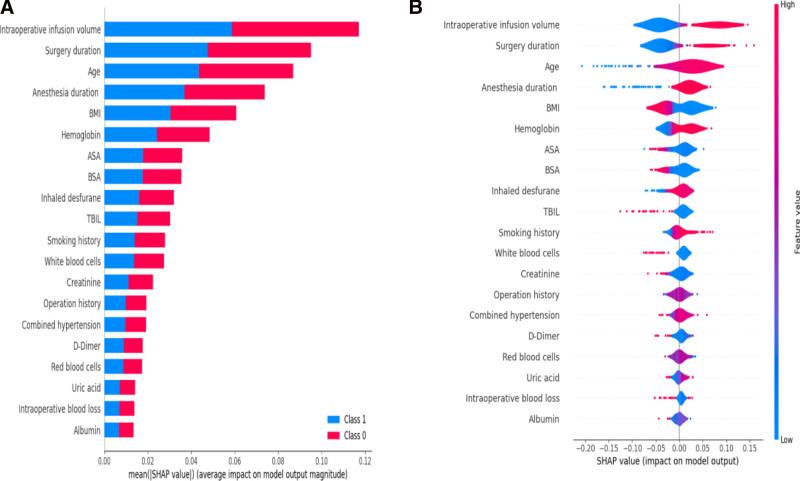
This study aimed to develop and evaluate a machine learning based risk prediction model for intraoperative hypothermia (IOH) in patients undergoing thoracoscopic lung cancer surgery and interpret the model using the SHapley Additive exPlanations (SHAP) method to assess the contribution of specific features to the prediction results. A retrospective analysis was conducted on 717 patients who underwent thoracoscopic lung cancer surgery at a tertiary hospital in Wuhan from January 2022 to December 2023. The dataset was randomly divided into a training set (n = 502) and a testing set (n = 215) at a 7:3 ratio. A random forest (RF) algorithm was used to build the prediction model. Model performance was assessed using accuracy, precision, recall, F1 score, and area under the receiver operating characteristic curve. The Brier score of the calibration curve was used to evaluate model fit, and decision curve analysis (DCA) was used to assess clinical utility. The SHAP method was applied to interpret the importance and influence of each predictive feature. The area under the receiver operating characteristic curve of the random forest-based prediction model in the testing set was 0.753, the F1 score was 0.80, the recall rate was 0.87, the accuracy rate was 0.732, the precision rate was 0.74, 95% CI (0.69-0.82), the sensitivity was 0.789, the specificity was 0.614, and the Brier score was 0.196. Decision curve analysis results confirmed the model's good clinical practicability. The SHAP diagram visually displayed that intraoperative infusion volume, surgery duration, age, anesthesia duration, body mass index, and hemoglobin were the 6 most important features influencing IOH risk, and there were also interaction effects between features. The SHAP method enhanced the interpretability of the machine learning model, identifying key risk factors for IOH in thoracoscopic lung cancer surgery. This approach can assist medical staff in screening high-risk factors and developing personalized hypothermia prevention programs for lung cancer patients.
本研究旨在开发并评估一种基于机器学习的预测模型,用于预测接受胸腔镜肺癌手术患者的术中低体温(IOH),并使用SHapley加性解释(SHAP)方法解释该模型,以评估特定特征对预测结果的贡献。对2022年1月至2023年12月在武汉一家三级医院接受胸腔镜肺癌手术的717例患者进行回顾性分析。数据集以7:3的比例随机分为训练集(n = 502)和测试集(n = 215)。使用随机森林(RF)算法构建预测模型。使用准确性、精确性、召回率、F1分数和受试者工作特征曲线下面积评估模型性能。校准曲线的Brier分数用于评估模型拟合度,决策曲线分析(DCA)用于评估临床实用性。应用SHAP方法解释每个预测特征的重要性和影响。基于随机森林的预测模型在测试集中的受试者工作特征曲线下面积为0.753,F1分数为0.80,召回率为0.87,准确率为0.732,精确率为0.74,95%CI(0.69 - 0.82),灵敏度为0.789,特异性为0.614,Brier分数为0.196。决策曲线分析结果证实了该模型具有良好的临床实用性。SHAP图直观显示术中输液量、手术时长、年龄、麻醉时长、体重指数和血红蛋白是影响IOH风险的6个最重要特征,且特征之间还存在交互作用。SHAP方法增强了机器学习模型的可解释性,识别出胸腔镜肺癌手术中IOH的关键风险因素。该方法可协助医务人员筛查高危因素,为肺癌患者制定个性化的低体温预防方案。


 Zotero 插件