
提高患有肌肉减少症或骨质疏松症的老年人对阻力训练的依从性:一项关于转诊成功率的研究。
Enhancing resistance training adherence in older adults with sarcopenia or osteoporosis: a study on referral success rates.
作者信息
Lin Ching-Huang, Cheng Yun-Ju, Hsu Ching-Ping, Hu Gwo-Chi, Hsu Hsin-Yin, Chien Yu-Ning, Lin Hsin-Hui, Hwang Lee-Ching, Ma Hsiao-Chi, Lin Fang-An, Tsou Meng-Ting, Wu Tung-Ke
机构信息
Department of Family Medicine, Taipei MacKay Memorial Hospital, Taipei, Taiwan.
Institute of Long-Term Care, MacKay Medical University, New Taipei, Taiwan.
出版信息
Front Public Health. 2025 Aug 18;13:1632960. doi: 10.3389/fpubh.2025.1632960. eCollection 2025.
BACKGROUND
Sarcopenia and osteoporosis increase the likelihood of disability and caregiving burden. While progressive resistance training (PRT) is effective in mitigating these outcomes, patients often struggle to find suitable, long-term training facilities, making it difficult to adhere to exercise prescriptions.
OBJECTIVES
This feasibility study aimed to familiarize patients with PRT through educational training by a geriatrician, enabling them to identify a suitable long-term community-based training program.
PARTICIPANTS AND METHODS
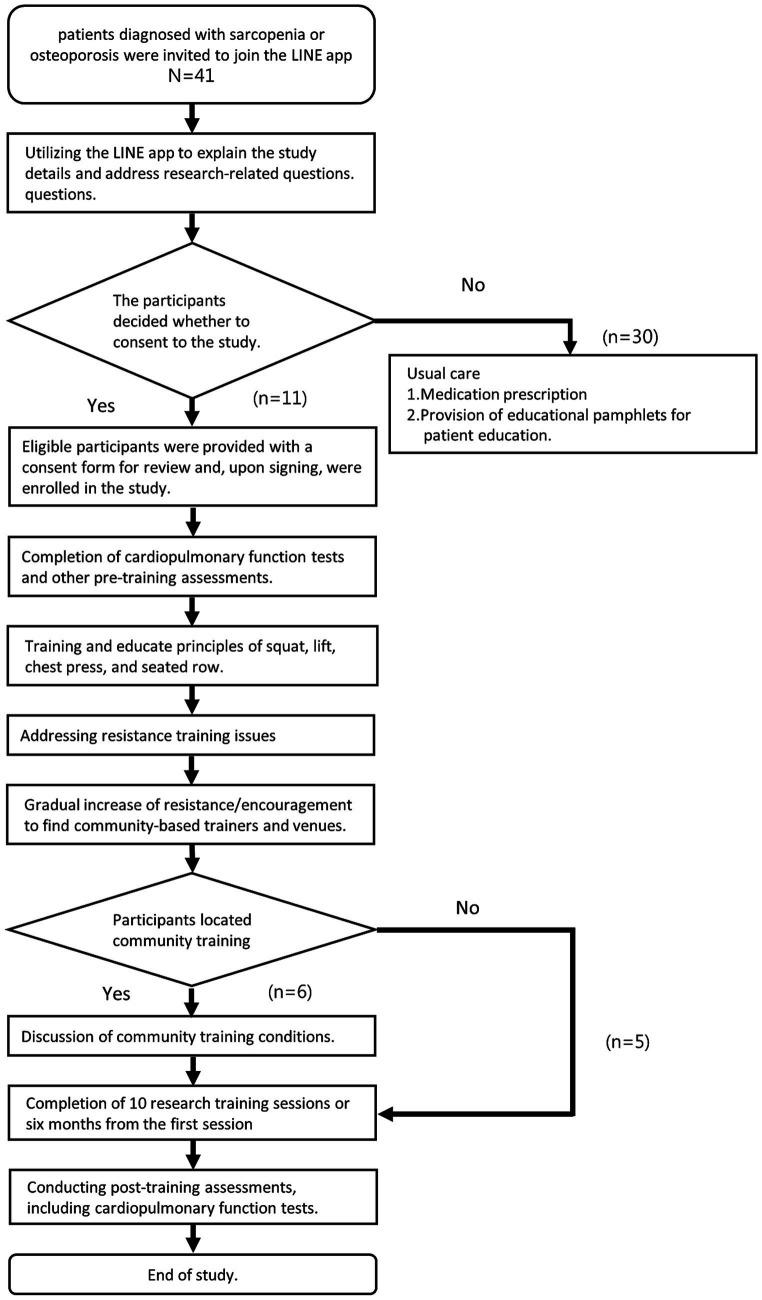
Forty-one patients diagnosed with osteoporosis or sarcopenia at a medical center in Taiwan were enrolled via the researchers' LINE app platform. Finally, 11 participants with osteoporosis were recruited. Among them, four had vertebral compression fractures and two also met the diagnostic criteria for sarcopenia. The median age was 68 (range 63-69) years, DXA femoral neck T-score was -3.3 (-3.5--2.2), and grip strength was 22.4 (20.3-26.7) kg. After cardiopulmonary exercise testing (CPET), participants received up to 10 PRT sessions, with vital signs monitored. In each session, researchers focused on six key learning points of free-weight PRT, addressed difficulties hindering progress, encouraged participants to find community-based training courses, and provided training summaries to external trainers. Descriptive statistics summarized patient data and referral rates. The primary outcome was the success of referrals to community-based training. Secondary outcomes, to be reported later, included changes in grip strength, DXA bone mineral density, DXA muscle mass, CPET results after 6 months, and sustainability of long-term resistance training (RT) in older people with osteoporosis or sarcopenia.
RESULTS
The recruitment success rate was 26.8%. Baseline characteristics did not correlate to successful referrals. A total of 67 physician-guided PRT sessions were conducted for the 11 participants. On average, after 4.5 in-hospital sessions, five participants secured self-paid one-on-one RT in the community, and one joined group training, resulting in a referral success rate of 54.5%.
CONCLUSION
This feasibility study aimed at achieving successful referral for long-term community-based RT. It provides valuable insights for future research on RT for patients with osteoporosis or sarcopenia, making exercise a sustainable and quantifiable intervention.
背景
肌肉减少症和骨质疏松症会增加残疾和护理负担的可能性。虽然渐进性抗阻训练(PRT)在减轻这些后果方面有效,但患者往往难以找到合适的长期训练场所,难以坚持运动处方。
目的
这项可行性研究旨在通过老年医学专家的教育培训,让患者熟悉PRT,使他们能够找到合适的基于社区的长期训练项目。
参与者与方法
通过研究人员的LINE应用程序平台,招募了台湾某医疗中心41名被诊断患有骨质疏松症或肌肉减少症的患者。最终,招募了11名骨质疏松症患者。其中,4人有椎体压缩性骨折,2人也符合肌肉减少症的诊断标准。年龄中位数为68岁(范围63 - 69岁),双能X线吸收法(DXA)测量的股骨颈T值为-3.3(-3.5至-2.2),握力为22.4(20.3至26.7)千克。在进行心肺运动测试(CPET)后,参与者接受了多达10次PRT训练,并监测生命体征。在每次训练中,研究人员专注于自由重量PRT的六个关键学习要点,解决阻碍进展的困难问题,鼓励参与者寻找基于社区的训练课程,并向外部培训师提供训练总结。描述性统计总结了患者数据和转诊率。主要结局是成功转诊至基于社区的训练。次要结局将在以后报告,包括握力、DXA骨密度、DXA肌肉量的变化,6个月后的CPET结果,以及骨质疏松症或肌肉减少症老年人长期抗阻训练(RT)的可持续性。
结果
招募成功率为26.8%。基线特征与成功转诊无关。为11名参与者共进行了67次医生指导的PRT训练。平均而言,在4.5次院内训练后,5名参与者在社区获得了自费的一对一RT训练,1人参加了团体训练,转诊成功率为54.5%。
结论
这项可行性研究旨在实现向基于社区的长期RT的成功转诊。它为未来针对骨质疏松症或肌肉减少症患者的RT研究提供了有价值的见解,使运动成为一种可持续且可量化的干预措施。
 Zotero 插件