
肌肉减少症对接受免疫检查点抑制剂治疗的复发性和/或转移性头颈部鳞状细胞癌患者临床结局的预后影响。
Prognostic Impact of Sarcopenia on Clinical Outcomes in Patients With Recurrent and/or Metastatic Head and Neck Squamous Cell Carcinoma Treated With Immune Checkpoint Inhibitors.
作者信息
Kimura Takayuki, Abe Daisuke, Kitano Mutsukazu, Koike Satoru, Umemoto Masahiro, Miyamoto Kazuhiro, Sato Mitsuo, Wakasaki Takahiro, Yasumatsu Ryuji
机构信息
Department of Otolaryngology-Head and Neck Surgery, Kindai University, Faculty of Medicine, Osaka-Sayama, Japan.
出版信息
Cancer Diagn Progn. 2025 Sep 1;5(5):597-605. doi: 10.21873/cdp.10474. eCollection 2025 Sep-Oct.
BACKGROUND/AIM: Poor nutritional status is one of the key contributing factors to sarcopenia, which negatively influences postoperative complications and clinical outcomes in patients with head and neck squamous cell carcinoma (HNSCC). This study aimed to investigate the potential association between sarcopenia and clinical outcomes in patients with recurrent and/or metastatic HNSCC treated with immune checkpoint inhibitors (ICIs).
PATIENTS AND METHODS
A retrospective review was conducted on the medical records of 119 patients with recurrent and/or metastatic HNSCC who received ICI therapy.
RESULTS
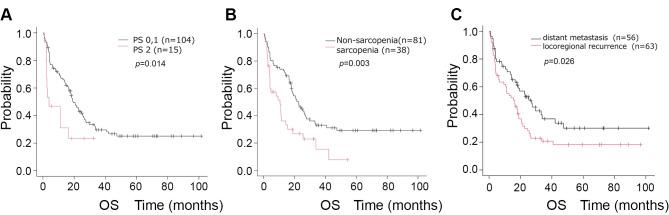
The objective response rates (ORRs) were 30.7% in the non-sarcopenia group and 15.8% in the sarcopenia group, showing a statistically significant difference between the two groups (=0.048). Patients with good performance status (PS), absence of sarcopenia, and distant metastasis exhibited significantly longer overall survival (OS) compared to those with poor PS, sarcopenia, and locoregional recurrence, respectively (=0.014, =0.003, =0.026). Multivariate analysis identified sarcopenia and locoregional recurrence as independent prognostic factors for OS. The incidence of immune-related adverse events (irAEs) did not significantly differ between patients with and without sarcopenia.
CONCLUSION
These findings underscore the detrimental impact of sarcopenia on the efficacy of immune checkpoint inhibitor therapy in patients with recurrent and/or metastatic HNSCC. Careful consideration of sarcopenia is warranted in the clinical management of these patients.
背景/目的:营养状况不佳是肌肉减少症的关键促成因素之一,对头颈鳞状细胞癌(HNSCC)患者的术后并发症和临床结局产生负面影响。本研究旨在探讨肌肉减少症与接受免疫检查点抑制剂(ICI)治疗的复发和/或转移性HNSCC患者临床结局之间的潜在关联。
患者与方法
对119例接受ICI治疗的复发和/或转移性HNSCC患者的病历进行回顾性分析。
结果
非肌肉减少症组的客观缓解率(ORR)为30.7%,肌肉减少症组为15.8%,两组间差异有统计学意义(=0.048)。与体能状态(PS)差、有肌肉减少症和局部区域复发的患者相比,PS良好、无肌肉减少症和远处转移的患者总生存期(OS)显著更长(分别为=0.014、=0.003、=0.026)。多因素分析确定肌肉减少症和局部区域复发是OS的独立预后因素。有和无肌肉减少症的患者免疫相关不良事件(irAE)的发生率无显著差异。
结论
这些发现强调了肌肉减少症对复发和/或转移性HNSCC患者免疫检查点抑制剂治疗疗效的不利影响。在这些患者的临床管理中,有必要仔细考虑肌肉减少症。

 Zotero 插件