
靶向二代测序对儿童社区获得性肺炎鼻咽拭子的诊断效能评估
Evaluation of Diagnostic Efficacy of Targeted Next-Generation Sequencing on Nasopharyngeal Swabs in Pediatric Community-Acquired Pneumonia.
作者信息
Shi Cheng, Zhang Juan
机构信息
Department of Pediatrics, Tongling Maternal and Child Health Hospital, Tongling City, Anhui Province, 244000, People's Republic of China.
The Fourth People's Hospital of Tongling City, The Fourth People's Hospital of Tongling City, Tongling City, Anhui Province, 244000, People's Republic of China.
出版信息
Int J Gen Med. 2025 Aug 27;18:4803-4810. doi: 10.2147/IJGM.S531908. eCollection 2025.
OBJECTIVE
The objective of this study is to evaluate diagnostic efficacy of targeted next-generation sequencing (tNGS) on nasopharyngeal (NP) swabs in pediatric community-acquired pneumonia (CAP).
METHODS
We conducted a retrospective analysis, compiling nasal and bronchoalveolar lavage fluid (BALF) specimens from a cohort of 147 children diagnosed with CAP at Tongling Maternal and Child Health Hospital from May 2023 to October 2024. The diagnostic accuracy of nasal tNGS was evaluated and compared against BALF tNGS and conventional microbiological tests (CMT), which included microbial culture and targeted polymerase chain reaction assays.
RESULTS
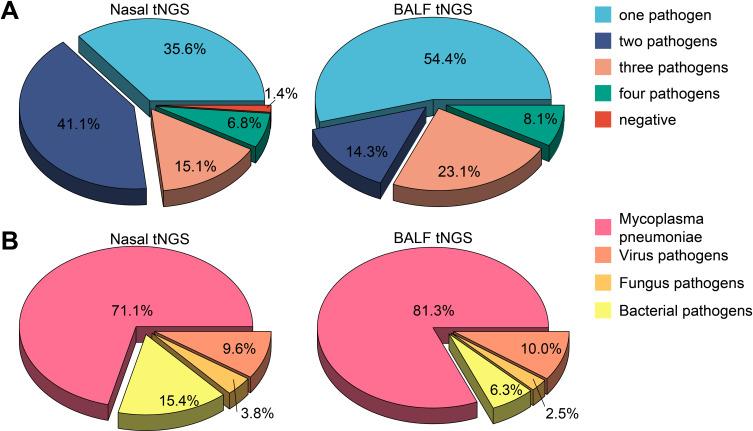
Nasal tNGS detected a broader range of 25 pathogens, while CMT identified 17, and BALF tNGS identified 21, with significant differences in detection rates favoring tNGS methods (P<0.001). Single pathogen detection rates were 35.6% for nasal tNGS and 54.4% for BALF tNGS, with being the most prevalent. Concordance in pathogen detection between nasal swabs and BALF using tNGS was highest for (Cohen's kappa, 0.92; 95% CI, 0.81-1), indicating almost perfect agreement.
CONCLUSION
NP swab-based tNGS technique offers valuable insights for the early etiological diagnosis and treatment of pneumonia, particularly in identifying viral pneumonia.
目的
本研究旨在评估靶向二代测序(tNGS)对儿科社区获得性肺炎(CAP)鼻咽拭子的诊断效能。
方法
我们进行了一项回顾性分析,收集了2023年5月至2024年10月在铜陵市妇幼保健院被诊断为CAP的147名儿童的鼻腔和支气管肺泡灌洗液(BALF)样本。评估鼻腔tNGS的诊断准确性,并与BALF tNGS和传统微生物学检测(CMT,包括微生物培养和靶向聚合酶链反应检测)进行比较。
结果
鼻腔tNGS检测到25种范围更广的病原体,而CMT鉴定出17种,BALF tNGS鉴定出21种,检测率存在显著差异,tNGS方法更具优势(P<0.001)。单一病原体检测率在鼻腔tNGS中为35.6%,在BALF tNGS中为54.4%, 最为常见。使用tNGS时,鼻腔拭子和BALF之间病原体检测的一致性在 方面最高(科恩kappa系数,0.92;95%CI,0.81 - 1),表明几乎完全一致。
结论
基于鼻咽拭子的tNGS技术为肺炎的早期病因诊断和治疗提供了有价值的见解,特别是在识别病毒性肺炎方面。

 Zotero 插件