
NUTM2A-AS1作为癌症中的潜在关键调节因子:揭示其ceRNA网络及其对肿瘤生物学的影响
NUTM2A-AS1 as a potential key regulator in cancer: unraveling its ceRNA networks and impact on tumor biology.
作者信息
Pourianazar Negar Taghavi, Radmehr Safa, Ourang Zahra, Jaseb Kaveh, Asadi Alireza
机构信息
Medical Laboratory Techniques, Istanbul Aydin University, Istanbul, Turkey.
Thalassemia & Hemoglobinopathy Research Center/ Health Research Institute/Ahvaz, , Ahvaz, Iran.
出版信息
Eur J Med Res. 2025 Sep 3;30(1):840. doi: 10.1186/s40001-025-03019-y.
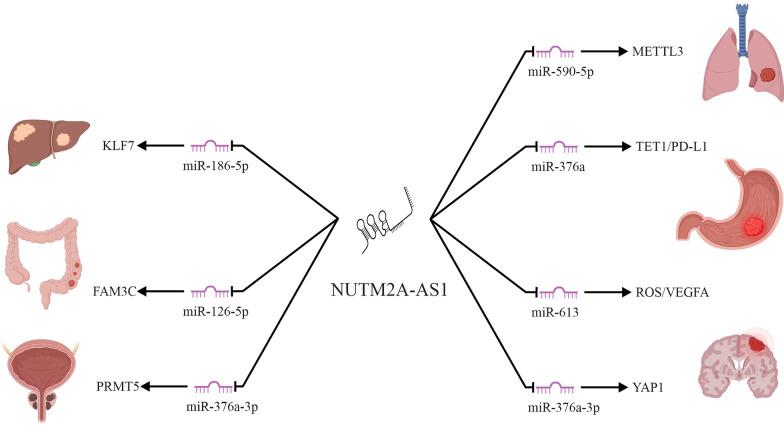
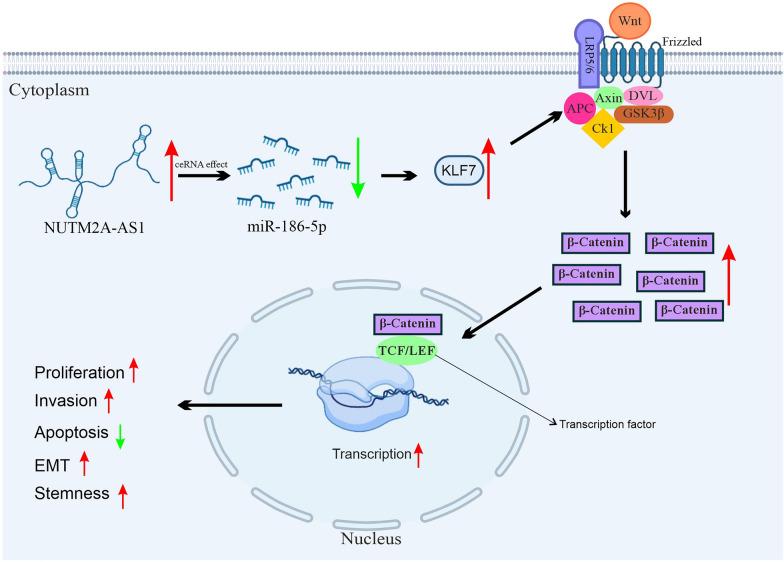
NUTM2A-AS1 is an emerging long noncoding RNA (lncRNA) that has garnered significant attention due to its multifaceted roles in cancer biology. As a member of the ceRNA network, NUTM2A-AS1 modulates gene expression by sequestering microRNAs, thereby influencing key oncogenic pathways. This review aims to provide a comprehensive overview of the current understanding of NUTM2A-AS1 in the development, progression, and metastasis of various cancers, including gastric cancer, hepatocellular carcinoma, neuroblastoma, colorectal cancer, glioma, lung adenocarcinoma, prostate cancer, and renal cell carcinoma. A systematic evaluation of experimental, clinical, and bioinformatics studies was conducted, with an emphasis on studies reporting expression patterns, mechanistic insights, and clinical correlations. Key findings reveal that in gastric cancer, NUTM2A-AS1 functions as a ceRNA for miR‑376a, leading to upregulation of TET1 and HIF-1A and subsequent increase in PD-L1 expression, while also modulating matrine resistance via the miR‑613/ROS/VEGFA axis. In hepatocellular carcinoma, it sponges miR‑186‑5p, thereby derepressing KLF7 and activating the Wnt/β catenin pathway. Neuroblastoma studies demonstrate that NUTM2A-AS1 enhances chemoresistance and metastasis through stabilization of B7-H3, mediated by NR1D1. In colorectal cancer, its transcriptional activation by H3K27 acetylation enables it to sequester miR-126-5p and upregulate FAM3C. Similar ceRNA-driven mechanisms involving miR-376a-3p/YAP1 in glioma, miR-590-5p/METTL3 in lung adenocarcinoma, and miR-376a-3p/PRMT5 in prostate cancer further underscore its oncogenic potential. In addition, NUTM2A-AS1 is incorporated into prognostic lncRNA signatures for renal cell carcinoma. The clinical implications of these findings are significant, as NUTM2A-AS1 holds promise as a biomarker for cancer diagnosis and prognosis and as a target for novel therapeutic strategies. Future research should prioritize in vivo studies and clinical trials, leveraging emerging technologies such as CRISPR and single-cell RNA sequencing, to fully elucidate the therapeutic potential of targeting NUTM2A-AS1 in personalized cancer treatment.
NUTM2A-AS1是一种新出现的长链非编码RNA(lncRNA),因其在癌症生物学中的多方面作用而备受关注。作为ceRNA网络的一员,NUTM2A-AS1通过隔离微小RNA来调节基因表达,从而影响关键的致癌途径。本综述旨在全面概述目前对NUTM2A-AS1在各种癌症(包括胃癌、肝细胞癌、神经母细胞瘤、结直肠癌、胶质瘤、肺腺癌、前列腺癌和肾细胞癌)的发生、发展和转移中的认识。对实验、临床和生物信息学研究进行了系统评估,重点是报告表达模式、机制见解和临床相关性的研究。主要发现表明,在胃癌中,NUTM2A-AS1作为miR-376a的ceRNA发挥作用,导致TET1和HIF-1A上调以及随后PD-L1表达增加,同时还通过miR-613/ROS/VEGFA轴调节苦参碱耐药性。在肝细胞癌中,它吸附miR-186-5p,从而解除对KLF7的抑制并激活Wnt/β连环蛋白途径。神经母细胞瘤研究表明,NUTM2A-AS1通过由NR1D1介导的B7-H3稳定化增强化疗耐药性和转移。在结直肠癌中,其由H3K27乙酰化介导的转录激活使其能够隔离miR-126-5p并上调FAM3C。在胶质瘤中涉及miR-376a-3p/YAP1、肺腺癌中涉及miR-590-5p/METTL3以及前列腺癌中涉及miR-376a-3p/PRMT5的类似ceRNA驱动机制进一步强调了其致癌潜力。此外,NUTM2A-AS1被纳入肾细胞癌的预后lncRNA特征中。这些发现的临床意义重大,因为NUTM2A-AS1有望作为癌症诊断和预后的生物标志物以及新型治疗策略的靶点。未来的研究应优先进行体内研究和临床试验,利用CRISPR和单细胞RNA测序等新兴技术,以充分阐明在个性化癌症治疗中靶向NUTM2A-AS1的治疗潜力。
 Zotero 插件