
可穿戴式电子视觉增强系统对年龄相关性黄斑变性患者的效用:一项随机交叉试验
The Usefulness of a Wearable Electronic Vision Enhancement System for People With Age-Related Macular Degeneration: A Randomized Crossover Trial.
作者信息
Miller Andrew, Crossland Michael D, Macnaughton Jane, Latham Keziah
机构信息
Vision and Hearing Sciences Research Centre, Anglia Ruskin University, Cambridge, UK.
College of Health and Life Sciences, Aston University, Birmingham, UK.
出版信息
Transl Vis Sci Technol. 2025 Sep 2;14(9):8. doi: 10.1167/tvst.14.9.8.
PURPOSE
To determine the usefulness of a wearable electronic vision enhancement system (wEVES) for people with age-related macular degeneration (AMD).
METHODS
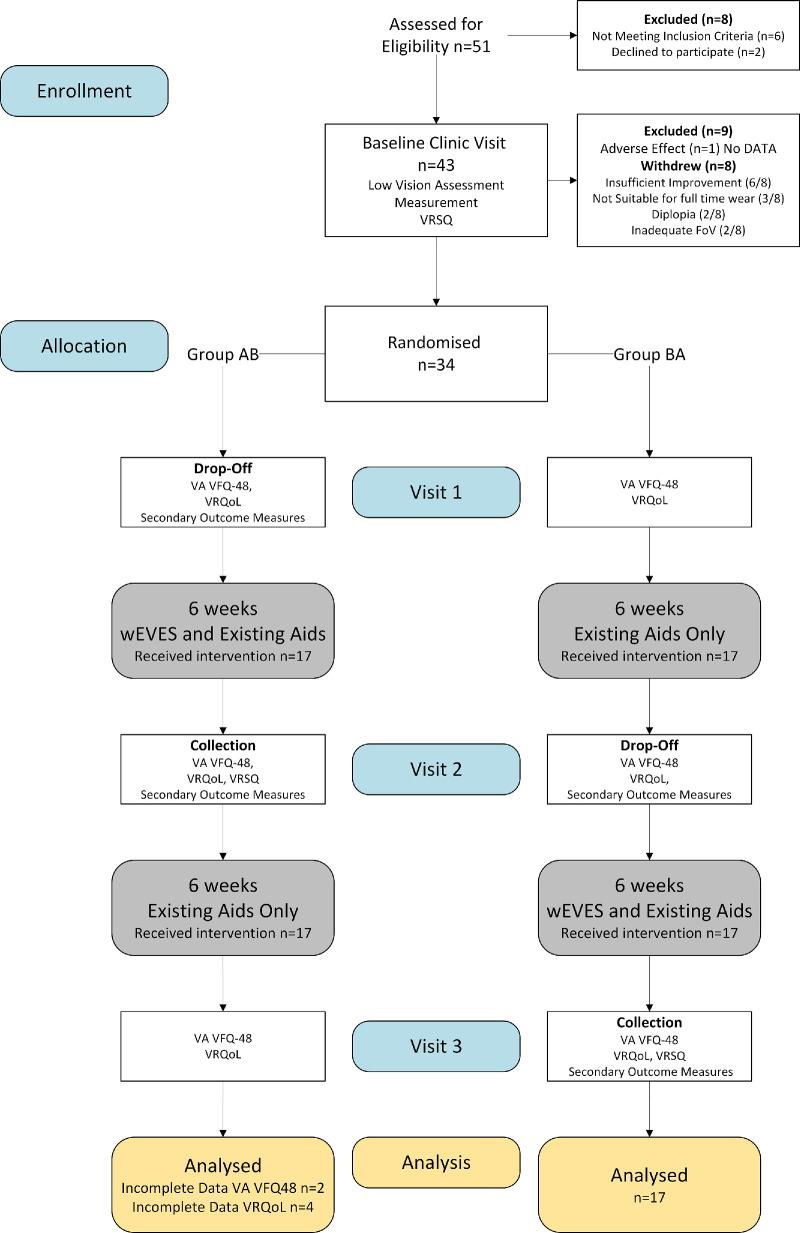
Thirty-four adults with AMD, 64.7% female, mean age 80.2(±6.0), were recruited from a UK low vision service. A 12-week non-masked randomized crossover trial compared wEVES usefulness with participants' existing low vision solutions. Primary outcome measures were visual ability, vision-related quality of life (VRQoL), device usage, and user-reported preferred device. Secondary outcomes were adverse effects, willingness to purchase, and qualitative reactions.
RESULTS
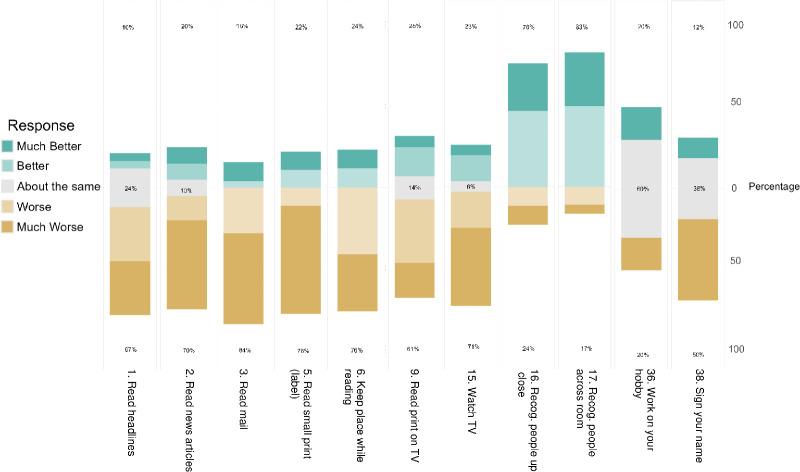
Overall visual ability improved with wEVES compared to existing solutions alone (mean difference -0.26; 95% confidence interval [CI], -0.48 to -0.04; P = 0.02). The wEVES were used for varied activities, including distance tasks, with few reported alternative strategies. However, these findings did not translate into changes in VRQoL (mean difference 0.10; 95% CI, -0.27 to 0.46; P = 0.59) or sustained device use. The wEVES were not the most preferred device for any task or individual, even when self-reported performance surpassed existing solutions. Adverse effects were minor, but participants' satisfaction and willingness to use wEVES declined significantly from trial baseline to end.
CONCLUSIONS
The wEVES improved self-reported visual ability, indicating their potential to support vision rehabilitation for people with AMD, albeit in a device that was largely not preferred over existing solutions. A user-led home trial evaluated using mixed methods is more indicative of the usefulness of wEVES for people with AMD than a short clinical demonstration.
TRANSLATIONAL RELEVANCE
To understand the usefulness of wEVES for people with AMD, broader measures than visual function and visual ability should be applied within longer user-led assessments.
目的
确定可穿戴式电子视觉增强系统(wEVES)对年龄相关性黄斑变性(AMD)患者的有效性。
方法
从英国低视力服务机构招募了34名AMD成人患者,其中64.7%为女性,平均年龄80.2(±6.0)岁。一项为期12周的非盲随机交叉试验将wEVES的有效性与参与者现有的低视力解决方案进行了比较。主要结局指标为视觉能力、视力相关生活质量(VRQoL)、设备使用情况以及用户报告的首选设备。次要结局指标为不良反应、购买意愿和定性反应。
结果
与单独使用现有解决方案相比,使用wEVES后总体视觉能力有所改善(平均差异-0.26;95%置信区间[CI],-0.48至-0.04;P = 0.02)。wEVES被用于各种活动,包括远距离任务,很少有报告称使用了替代策略。然而,这些结果并未转化为VRQoL的变化(平均差异0.10;95%CI,-0.27至0.46;P = 0.59)或设备的持续使用。即使自我报告的性能超过现有解决方案,wEVES也不是任何任务或个人的首选设备。不良反应较小,但从试验基线到结束,参与者对wEVES的满意度和使用意愿显著下降。
结论
wEVES改善了自我报告的视觉能力,表明其有潜力支持AMD患者的视力康复,尽管该设备在很大程度上不如现有解决方案受欢迎。与短期临床演示相比,采用混合方法进行的用户主导的家庭试验更能表明wEVES对AMD患者的有效性。
转化相关性
为了解wEVES对AMD患者的有效性,应在更长时间的用户主导评估中应用比视觉功能和视觉能力更广泛的测量方法。





 Zotero 插件