
天然免疫细胞和细胞因子在塑造乳腺癌微环境中的双重作用。
Dual roles of innate immune cells and cytokines in shaping the breast cancer microenvironment.
作者信息
Zhang Chen, Liu Wei, Yang Ping, Lin Rubing, Pu Lulan, Zhang Hongying
机构信息
Department of General Surgery, Wusheng County People's Hospital (Wusheng Hospital Affiliated Hospital of North Sichuan Medical College), Guangan, China.
Department of Clinical Medicine, North Sichuan Medical College, Nanchong, China.
出版信息
Front Immunol. 2025 Aug 20;16:1654947. doi: 10.3389/fimmu.2025.1654947. eCollection 2025.
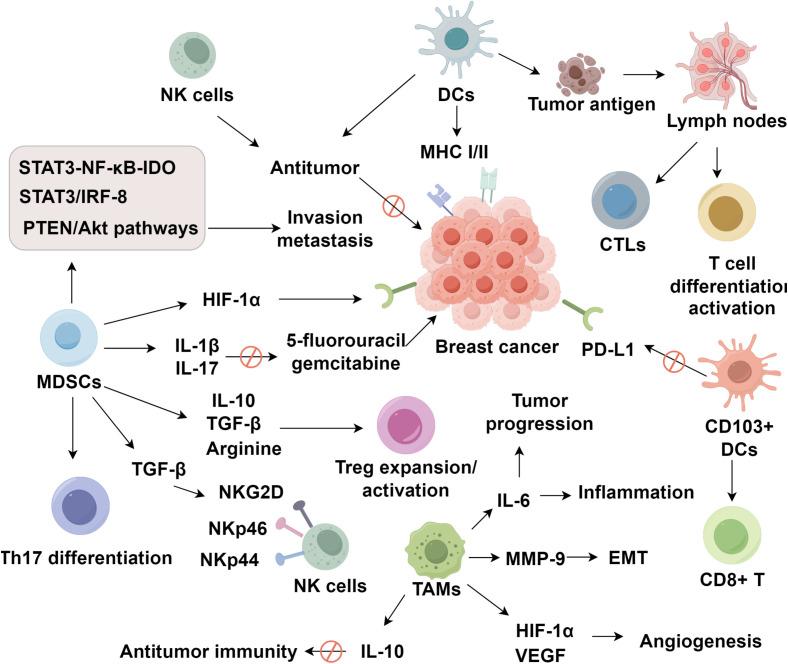
Breast cancer remains the most frequently diagnosed malignancy and a leading cause of cancer-related mortality among women worldwide. Increasing evidence underscores the pivotal yet paradoxical roles of innate immune cells and their associated cytokines in orchestrating the dynamic landscape of the breast tumor immune microenvironment (TIME). Innate immune effectors, including tumor-associated macrophages (TAMs) and natural killer (NK) cells, exert dual functions by either initiating robust antitumor responses or facilitating immune evasion, metastatic dissemination, and therapeutic resistance. For instance, MDSCs suppress T and NK cell activity via STAT3/NF-κB signaling and modulate the cytokine milieu through IL-10 and TGF-β. Similarly, M2-polarized TAMs promote angiogenesis, epithelial-mesenchymal transition, and chemoresistance via IL-10/STAT3/Bcl-2 pathways. In contrast, NK cells and CD103 DCs mediate tumor cell cytolysis and prime antigen-specific immunity, though their activity is frequently compromised in advanced disease. Moreover, key cytokines and chemokines, including IL-6, IL-10, IL-8, TNF-α, TGF-β, and CCL2/5, demonstrate subtype-specific and context-dependent effects, acting as both tumor-promoting and tumor-suppressing agents through complex signaling networks. This review highlights the dualistic nature of innate immune components in breast cancer, discusses their prognostic and therapeutic implications, and proposes novel intervention strategies, such as TAM repolarization, and cytokine modulation, to reprogram the TIME and restore effective immune surveillance, particularly in aggressive subtypes like triple-negative breast cancer.
乳腺癌仍然是全球女性中最常被诊断出的恶性肿瘤,也是癌症相关死亡的主要原因。越来越多的证据强调了先天免疫细胞及其相关细胞因子在构建乳腺肿瘤免疫微环境(TIME)动态格局中所起的关键但又矛盾的作用。先天免疫效应细胞,包括肿瘤相关巨噬细胞(TAM)和自然杀伤(NK)细胞,通过启动强大的抗肿瘤反应或促进免疫逃逸、转移扩散和治疗抵抗发挥双重作用。例如,髓系来源的抑制细胞(MDSC)通过STAT3/NF-κB信号通路抑制T细胞和NK细胞活性,并通过白细胞介素-10(IL-10)和转化生长因子-β(TGF-β)调节细胞因子环境。同样,M2极化的TAM通过IL-10/STAT3/Bcl-2途径促进血管生成、上皮-间质转化和化疗耐药。相比之下,NK细胞和CD103树突状细胞(DC)介导肿瘤细胞溶解并启动抗原特异性免疫,尽管它们的活性在晚期疾病中经常受损。此外,关键细胞因子和趋化因子,包括IL-6、IL-10、IL-8、肿瘤坏死因子-α(TNF-α)、TGF-β和CCL2/5,表现出亚型特异性和背景依赖性效应,通过复杂的信号网络既作为肿瘤促进剂又作为肿瘤抑制剂发挥作用。本综述强调了乳腺癌中先天免疫成分的二元性,讨论了它们的预后和治疗意义,并提出了新的干预策略,如TAM重极化和细胞因子调节,以重新编程TIME并恢复有效的免疫监视,特别是在三阴性乳腺癌等侵袭性亚型中。
 Zotero 插件