
微生物群在炎症相关精神疾病中的作用。 (注:原文中“inflammation-related related”表述有误,多了一个“related”)
Role of the microbiota in inflammation-related related psychiatric disorders.
作者信息
Zhou Liying, Wu Qunhua, Jiang Lin, Rao Jiaoyu, Gao Jianlin, Zhao Fang, Wang Xiaokang
机构信息
Department of Obstetrics and Gynecology, Shenzhen Longhua District Central Hospital, Shenzhen, China.
Department of Pharmacy, Shenzhen Longhua District Central Hospital, Shenzhen, China.
出版信息
Front Immunol. 2025 Aug 20;16:1613027. doi: 10.3389/fimmu.2025.1613027. eCollection 2025.
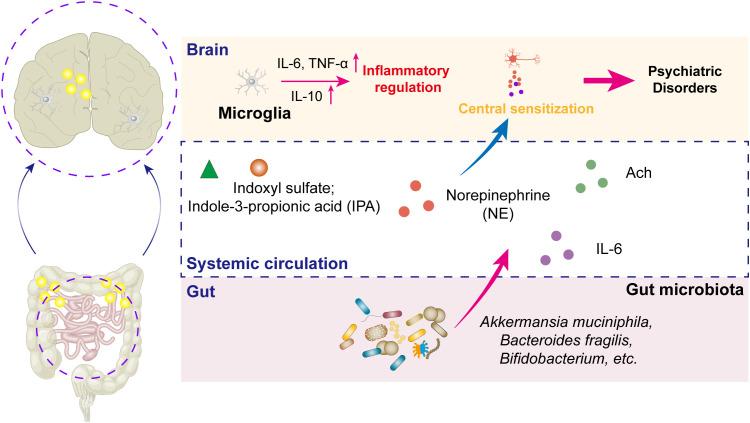
The immune interactions within the gut-brain axis represent a critical etiological factor in psychiatric disorders. The gut microbiota and their metabolites serve as biological mediators that regulate neuroimmune activation and suppression in the central nervous system (CNS). During intestinal immune activation, pro-inflammatory cytokines (, IL-6, TNF-α) propagate to the CNS compromised blood-brain barrier (BBB) integrity or vagal afferent fibers, disrupting neurotransmitter metabolism and inducing microglial hyperactivation, thereby exacerbating neuroinflammation. Microglia, the principal immune sentinels of the CNS, adopt a pro-inflammatory phenotype upon peripheral inflammatory signaling characterized by morphological transformations, excessive chemokine/cytokine production (, IL-1β, IL-6), and dysregulated neurotransmitter dynamics. These mechanisms are strongly implicated in neuropsychiatric conditions such as major depressive disorder, anxiety disorders, autism spectrum disorder, and schizophrenia. Emerging microbiota-targeted therapies, including probiotic interventions and fecal microbiota transplantation, demonstrate therapeutic potential by restoring tryptophan homeostasis and modulating systemic inflammation. This review synthesizes current evidence on the regulatory role of the gut microbiota in inflammation-related psychiatric disorders, specifically emphasizing the microbial modulation of neuroimmune crosstalk and neurotransmitter synthesis (, serotonin, dopamine). Mechanistic insights into microbial metabolites, such as short-chain fatty acids and tryptophan derivatives, are critically evaluated for their dual roles in psychiatric disorders. These findings advance a unified framework for managing psychiatric comorbidities through precision modulation of the gut-brain axis.
肠-脑轴内的免疫相互作用是精神疾病的一个关键病因。肠道微生物群及其代谢产物作为生物介质,调节中枢神经系统(CNS)中的神经免疫激活和抑制。在肠道免疫激活过程中,促炎细胞因子(如IL-6、TNF-α)通过受损的血脑屏障(BBB)完整性或迷走神经传入纤维传播到CNS,破坏神经递质代谢并诱导小胶质细胞过度激活,从而加剧神经炎症。小胶质细胞是CNS的主要免疫哨兵,在周围炎症信号作用下会呈现促炎表型,其特征包括形态转变、趋化因子/细胞因子过度产生(如IL-1β、IL-6)以及神经递质动力学失调。这些机制与重度抑郁症、焦虑症、自闭症谱系障碍和精神分裂症等神经精神疾病密切相关。新兴的针对微生物群的疗法,包括益生菌干预和粪便微生物群移植,通过恢复色氨酸稳态和调节全身炎症显示出治疗潜力。本综述综合了关于肠道微生物群在炎症相关精神疾病中调节作用的现有证据,特别强调了微生物对神经免疫串扰和神经递质合成(如血清素、多巴胺)的调节。对微生物代谢产物,如短链脂肪酸和色氨酸衍生物的作用机制进行了批判性评估,以探讨它们在精神疾病中的双重作用。这些发现为通过精准调节肠-脑轴来管理精神疾病共病提出了一个统一框架。
 Zotero 插件