
注射用与局部应用富血小板血浆治疗糖尿病足溃疡的有效性:一项具有临床和组织病理学评估的随机对照试验。
Effectiveness of injected versus topically applied platelet-rich plasma in diabetic foot ulcers: A randomized controlled trial with clinical and histopathological assessment.
作者信息
Nasr Mohamed, El-Nawasany Moustafa Ah, Ali Haytham E, El Nagar Ahmed E, Elsharawy Ayman F, Mirdad Dahlia Soleman A, Baloush Razan Abed A, Majrashi Mohammed Ali, Elkaseer Mohamed Hassan, Abdel-Maksoud Mohammed A, Mahmoud Mohammad Omar, Mohammed Zahraa Futooh, Ibrahim Hany Sabry A, Mohammed Tahseen S, Hasan Abdulkarim, Hegab Ashraf Yahia, Alaghbari Khaldon Abdulrahman A, Abbas Mohammed, Abood Hashem Bark A, Hablas Mohamad Ghazy A
机构信息
Histology Department, Faculty of Medicine, Al-Azhar University, Cairo, Egypt.
Histology Department, Faculty of Medicine, Shaqra University, Saudi Arabia.
出版信息
JPRAS Open. 2025 Aug 6;46:22-32. doi: 10.1016/j.jpra.2025.08.008. eCollection 2025 Dec.
BACKGROUND
Diabetic foot ulcers (DFUs) are a serious complication of diabetes that can lead to significant morbidity. Autologous platelet-rich plasma (PRP), rich in growth factors and cytokines, has emerged as a promising treatment to enhance ulcer healing. This study aimed to compare the clinical and histological efficacy of injected PRP versus topically applied PRP and traditional wound care in the management of DFUs.
METHODS
Sixty patients with DFUs were randomly assigned to three equal groups ( = 20 each). Group A received locally injected autologous PRP; Group B received topically applied autologous PRP; and Group C received standard wound care. All patients were followed twice weekly for 12 weeks or until complete healing. Skin biopsies were obtained at baseline and after 12 weeks (or upon completion for unhealed ulcers) for histopathological evaluation.
RESULTS
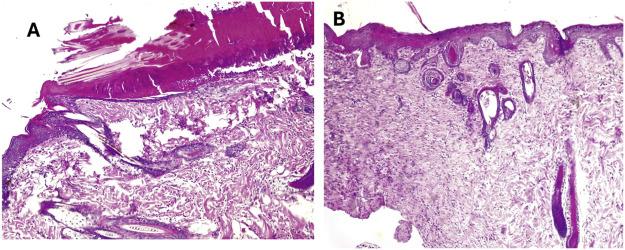
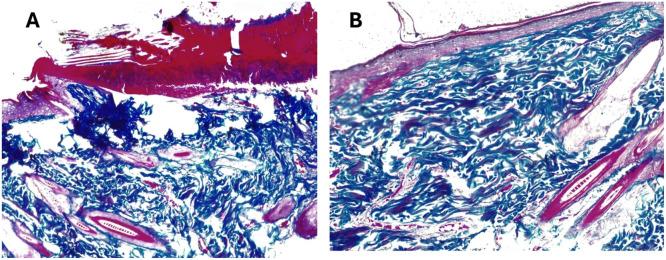
By the end of the 12-week follow-up, 87.5 % of patients treated with PRP (35 out of 40 in Groups A and B) achieved complete ulcer healing, compared to a significantly lower healing rate in the traditional care group (Group C). Histological findings supported the clinical outcomes. No significant difference was found between injected and topically applied PRP in terms of clinical effectiveness. Conclusion: PRP treatment, whether injected or topically applied, significantly enhances the healing of DFUs compared to traditional wound care. Both methods of PRP application demonstrated comparable clinical efficacy.
背景
糖尿病足溃疡(DFUs)是糖尿病的一种严重并发症,可导致显著的发病率。富含生长因子和细胞因子的自体富血小板血浆(PRP)已成为一种有前景的促进溃疡愈合的治疗方法。本研究旨在比较注射用PRP与局部应用PRP及传统伤口护理在糖尿病足溃疡治疗中的临床和组织学疗效。
方法
60例糖尿病足溃疡患者被随机分为三组,每组20例。A组接受局部注射自体PRP;B组接受局部应用自体PRP;C组接受标准伤口护理。所有患者每周随访两次,共12周或直至完全愈合。在基线和12周后(或未愈合溃疡完成治疗时)取皮肤活检进行组织病理学评估。
结果
在12周随访结束时,接受PRP治疗的患者中有87.5%(A组和B组共40例中的35例)实现了溃疡完全愈合,而传统护理组(C组)的愈合率明显较低。组织学结果支持临床结果。在临床疗效方面,注射用PRP和局部应用PRP之间未发现显著差异。结论:与传统伤口护理相比,PRP治疗(无论是注射还是局部应用)均能显著促进糖尿病足溃疡的愈合。两种PRP应用方法显示出相当的临床疗效。


 Zotero 插件