
1990年至2021年早发性胃肠道癌症的流行病学趋势及2036年预测:来自2021年全球疾病负担研究的分析
Epidemiological trends of early-onset gastrointestinal cancers from 1990 to 2021 and predictions for 2036: analysis from the global burden of disease study 2021.
作者信息
Gong Yu-Qing, Lu Chun-Jing, Xiao Yan-Ru, Zhang Jin-Yan, Xu Zhong, Li Ji, Huang Wei-Feng
机构信息
Department of Gastroenterology and Hepatology, The First Affiliated Hospital of Xiamen University, School of Medicine, Xiamen University, Xiamen, China.
Department of Blood Transfusion, Women and Children's Hospital, School of Medicine, Xiamen University, Xiamen, China.
出版信息
Ann Med. 2025 Dec;57(1):2555518. doi: 10.1080/07853890.2025.2555518. Epub 2025 Sep 5.
BACKGROUND
Gastrointestinal cancers account for 39.0% of global cancer-related deaths. The rising incidence of early-onset gastrointestinal cancers poses a substantial public health challenge due to their aggressive nature and poor prognosis.
METHODS
Using the Global Burden of Disease (GBD) 2021 database, we analyzed temporal trends (1990-2021) in age-standardized incidence (ASIR), mortality (ASMR), and disability-adjusted life years (ASDR) rates for early-onset gastrointestinal cancers among individuals aged 15-49 years. Analyses included burden by age, sex, region, and socio-demographic index (SDI). Joinpoint regression estimated average annual percentage changes (AAPC), and future trends (2022-2036) were projected using the Bayesian Age-Period-Cohort model.
RESULTS
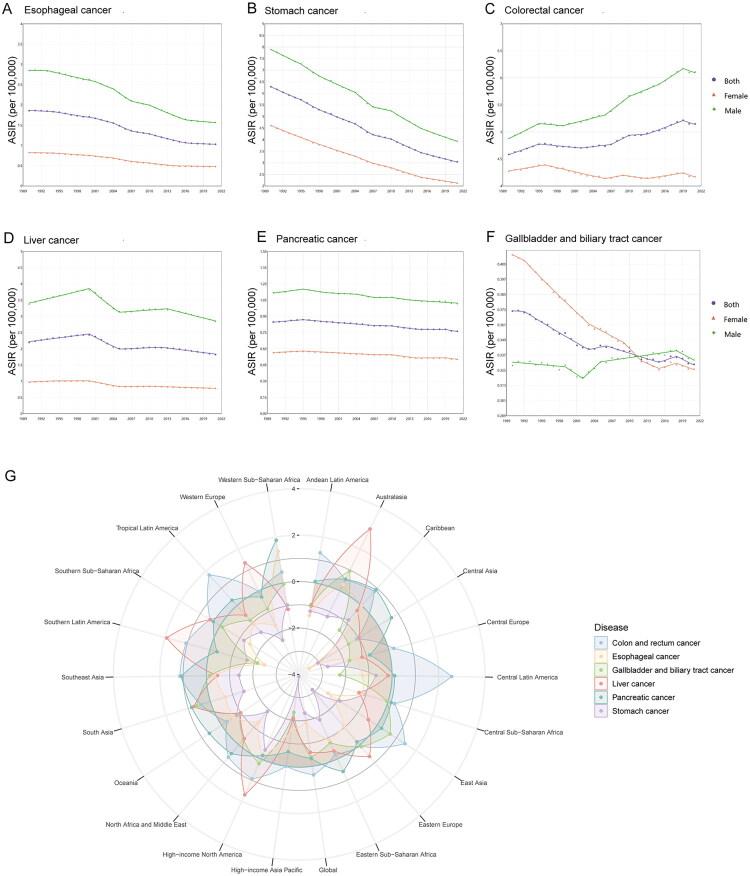
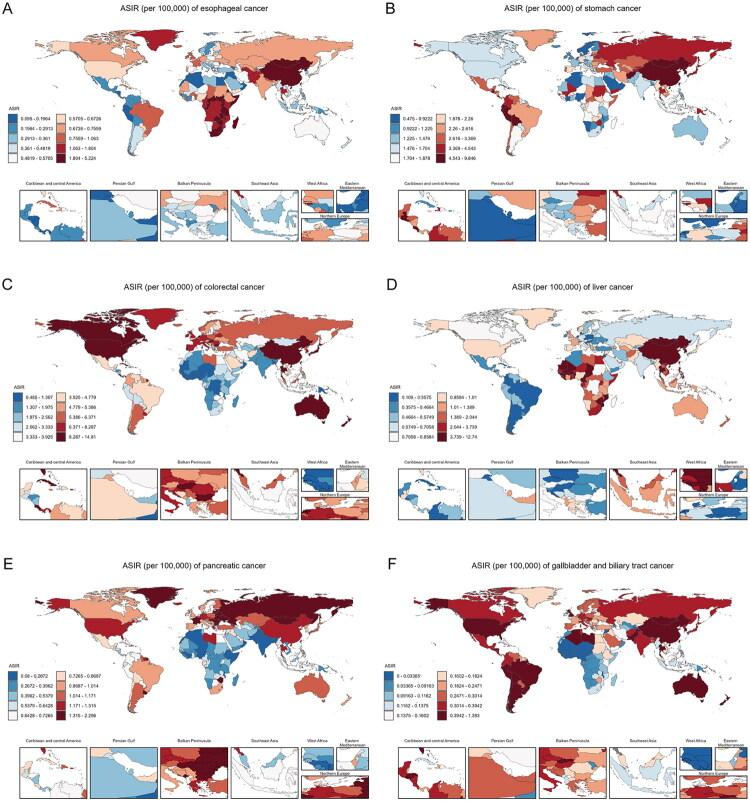
In 2021, there were 499,800 new cases of early-onset gastrointestinal cancers globally. Colorectal and stomach cancers were most prevalent. From 1990-2021, ASIR increased only for colorectal cancer (AAPC: 0.37, 95%CI: 0.24-0.50), while declines occurred in esophageal, stomach, liver, pancreatic, and gallbladder/biliary tract cancers. Males bore a higher burden except for gallbladder/biliary tract cancer. Significant disparities existed across regions, genders, and SDI levels. Smoking and high body-mass index were leading risk factors. Projections indicate rising ASIRs for early-onset colorectal and esophageal cancers, stable liver cancer incidence, and diminishing incidence, mortality, and DALYs rates for stomach, pancreatic, and gallbladder and biliary tract cancers.
CONCLUSIONS
Early-onset gastrointestinal cancers represent a substantial and evolving global burden, with notable variations by cancer type, age, sex, region, and SDI. Targeted prevention and healthcare strategies are urgently needed to address modifiable risk factors and reduce disparities.
背景
胃肠道癌症占全球癌症相关死亡人数的39.0%。早发性胃肠道癌症发病率的上升因其侵袭性和预后不良,对公共卫生构成了重大挑战。
方法
我们使用全球疾病负担(GBD)2021数据库,分析了15至49岁个体早发性胃肠道癌症的年龄标准化发病率(ASIR)、死亡率(ASMR)和伤残调整生命年(ASDR)率的时间趋势(1990 - 2021年)。分析包括年龄、性别、地区和社会人口指数(SDI)的负担情况。Joinpoint回归估计平均年度百分比变化(AAPC),并使用贝叶斯年龄 - 时期 - 队列模型预测未来趋势(2022 - 2036年)。
结果
2021年,全球有499,800例早发性胃肠道癌症新病例。结直肠癌和胃癌最为常见。从1990年到2021年,仅结直肠癌的ASIR有所上升(AAPC:0.37,95%CI:0.24 - 0.50),而食管癌、胃癌、肝癌、胰腺癌和胆囊/胆道癌的发病率则有所下降。除胆囊/胆道癌外,男性的负担更高。不同地区、性别和SDI水平存在显著差异。吸烟和高体重指数是主要危险因素。预测表明,早发性结直肠癌和食管癌的ASIR将上升,肝癌发病率将稳定,胃癌、胰腺癌以及胆囊和胆道癌的发病率、死亡率和伤残调整生命年率将下降。
结论
早发性胃肠道癌症是一个重大且不断演变的全球负担,在癌症类型、年龄、性别、地区和SDI方面存在显著差异。迫切需要有针对性的预防和医疗保健策略来应对可改变的风险因素并减少差异。



 Zotero 插件