
斑马鱼早期发育过程中致畸剂诱导的畸形与基因表达在不同品系间的比较分析。
Comparative analysis of teratogen-induced malformations and gene expression across zebrafish strains in early development.
作者信息
Taya Chitose, Ujibe Kota, Shimodaira Shinnosuke, Sakamoto Aoto, Wada Seiji, Kashima Makoto, Hirata Hiromi
机构信息
Department of Chemistry and Biological Science, College of Science and Engineering, Aoyama Gakuin University, Sagamihara 252-5258, Japan.
Faculty of Science, Toho University, Funabashi 274-8510, Japan.
出版信息
Toxicol Rep. 2025 Aug 21;15:102117. doi: 10.1016/j.toxrep.2025.102117. eCollection 2025 Dec.
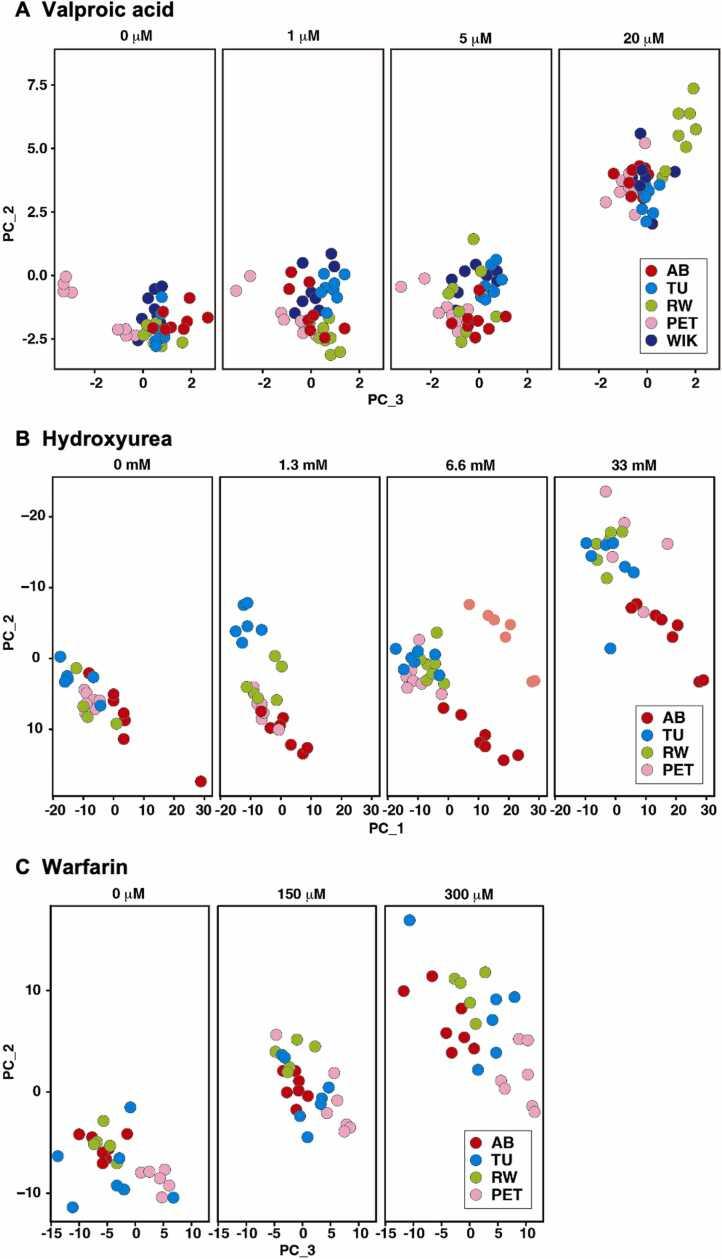
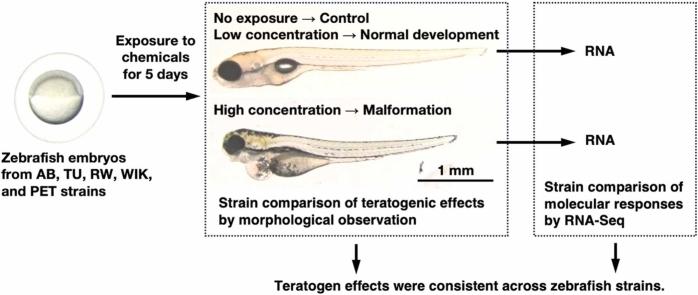
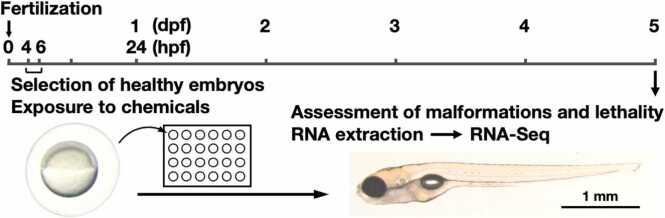
Zebrafish embryos are widely used in developmental toxicity testing. However, the extent to which genetic background influences susceptibility to teratogenic compounds remains incompletely understood. We here evaluated inter-strain variability in both phenotypic and transcriptomic responses to six model teratogens using five commonly utilized zebrafish strains, AB, TU, RW, WIK, and PET. All test compounds, valproic acid, hydroxyurea, methotrexate, acitretin, topiramate, and ibuprofen, elicited concentration-dependent developmental toxicity characterized by malformations at moderate doses and lethality at higher concentrations. Despite distinct toxicodynamic profiles, the incidence and severity of phenotypic outcomes were highly consistent across strains. Transcriptomic analysis was performed following exposure to valproic acid, hydroxyurea, and warfarin, revealing strong, dose-dependent gene expression changes that were largely conserved among strains. Principal component analysis demonstrated that chemical concentration, rather than strain, was the dominant driver of transcriptional variation. Minor strain-specific differences were observed at baseline or low-dose levels but did not alter the overall direction or magnitude of response. These findings demonstrate that zebrafish embryos from diverse genetic backgrounds exhibit broadly conserved developmental and molecular responses to teratogens. The minimal inter-strain variability supports the use of any wild-type strain, transgenic line, or even outbred population in developmental toxicity testing without compromising sensitivity or reproducibility. Our study reinforces the suitability of zebrafish as a robust vertebrate model in regulatory toxicology.
斑马鱼胚胎被广泛用于发育毒性测试。然而,遗传背景对致畸化合物易感性的影响程度仍未完全了解。我们在此使用五种常用的斑马鱼品系AB、TU、RW、WIK和PET,评估了对六种模型致畸剂的表型和转录组反应中的品系间变异性。所有测试化合物,丙戊酸、羟基脲、甲氨蝶呤、阿维A、托吡酯和布洛芬,均引发浓度依赖性发育毒性,其特征为中等剂量时出现畸形,高浓度时出现致死性。尽管有不同的毒理学特征,但表型结果的发生率和严重程度在各品系间高度一致。在暴露于丙戊酸、羟基脲和华法林后进行了转录组分析,结果显示基因表达有强烈的剂量依赖性变化,且在各品系间基本保守。主成分分析表明,化学物质浓度而非品系是转录变异的主要驱动因素。在基线或低剂量水平观察到了微小的品系特异性差异,但并未改变反应的总体方向或幅度。这些发现表明,来自不同遗传背景的斑马鱼胚胎对致畸剂表现出广泛保守的发育和分子反应。最小的品系间变异性支持在发育毒性测试中使用任何野生型品系、转基因品系,甚至远交群体,而不会影响敏感性或可重复性。我们的研究强化了斑马鱼作为监管毒理学中强大的脊椎动物模型的适用性。

 Zotero 插件