
调节剂对囊性纤维化急性加重期住院治疗后肺功能的影响。
The effect of modulators on lung function following inpatient treatment for CF exacerbations.
作者信息
Stone Anne, Haag Meredith B, Muirhead Corinne A, Markwardt Sheila, MacDonald Kelvin D
机构信息
Division of Pediatric Pulmonology, Department of Pediatrics, Oregon Health & Science University, Portland, OR, United States.
Division of Neonatology, Department of Pediatrics, Oregon Health & Science University, Portland, OR, United States.
出版信息
Front Pediatr. 2025 Aug 21;13:1654122. doi: 10.3389/fped.2025.1654122. eCollection 2025.
BACKGROUND
Modulator therapy restores CFTR function and has led to health benefits for persons with cystic fibrosis (CF) (PwCF), including lower rates of pulmonary exacerbations. It is unknown if modulators affect lung function trajectories after inpatient treatment of pulmonary exacerbations (PEx).
METHODS
We conducted a retrospective review of hospital encounters for PEx for subjects 6-25 years old with mild to moderate lung disease admitted to a large tertiary care center from 2014 to 2021 to capture hospitalizations of PwCF before and after starting modulators. Descriptive analyses were used to characterize the population and lung function findings. Logistic regression analyses were conducted to assess the association between modulators and FEV1pp outcomes.
RESULTS
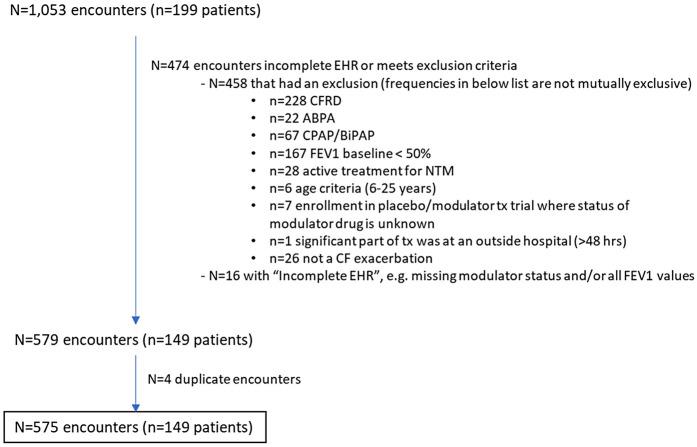
The study sample included 575 encounters representing 149 unique PwCF. Hospital encounters of PwCF taking modulator were associated with higher mean FEV1pp at baseline, midway, discharge, and follow-up assessments. Mean FEV1pp increased during inpatient treatment of PEx with loss of lung function at follow-up, regardless of modulator use. Hospital encounters of PwCF not taking modulators were associated with less significant improvements in mean FEV1pp from admission at both midway and discharge (15.6% vs. 18.3%, 19.9% vs. 22.5%, no modulator vs. modulator groups, respectively). At follow-up, hospitalizations of PwCF taking modulators were associated with a significantly higher probability of sustained improvement in FEV1pp from discharge (difference in probabilities 0.119, < 0.05) and a lower probability of loss of lung function from baseline (difference in probabilities -0.123, < 0.05).
CONCLUSIONS
Hospitalizations for PwCF taking modulators were associated with higher lung function at all assessments. Hospitalizations of PwCF taking modulators were associated with a significantly higher probability of sustained improvement in FEV1pp following discharge and a lower probability of loss of lung function from baseline.
背景
调节剂疗法可恢复囊性纤维化跨膜传导调节因子(CFTR)的功能,并已给囊性纤维化(CF)患者(PwCF)带来健康益处,包括降低肺部急性加重的发生率。目前尚不清楚调节剂在肺部急性加重(PEx)住院治疗后是否会影响肺功能轨迹。
方法
我们对2014年至2021年期间入住一家大型三级医疗中心的6至25岁患有轻至中度肺部疾病的PEx患者的医院就诊情况进行了回顾性分析,以记录开始使用调节剂前后PwCF的住院情况。采用描述性分析来描述人群和肺功能结果。进行逻辑回归分析以评估调节剂与第一秒用力呼气容积百分比预计值(FEV1pp)结果之间的关联。
结果
研究样本包括575次就诊,代表149名独特的PwCF。使用调节剂的PwCF的医院就诊在基线、中途、出院和随访评估时的平均FEV1pp较高。在PEx住院治疗期间,无论是否使用调节剂,平均FEV1pp均增加,但在随访时肺功能有所下降。未使用调节剂的PwCF的医院就诊在中途和出院时平均FEV1pp较入院时的改善幅度较小(分别为15.6%对18.3%,19.9%对22.5%,未使用调节剂组对使用调节剂组)。在随访时,使用调节剂的PwCF住院后FEV1pp持续改善的概率显著更高(概率差异为0.119,<0.05),且肺功能从基线下降的概率更低(概率差异为-0.123,<0.05)。
结论
使用调节剂的PwCF住院在所有评估中肺功能均较高。使用调节剂的PwCF住院后FEV1pp持续改善的概率显著更高,且肺功能从基线下降的概率更低。
 Zotero 插件