
从通量分析到自包含细胞模型。
From flux analysis to self contained cellular models.
作者信息
Kremling Andreas
机构信息
Systems Biotechnology, School of Engineering and Design, Technical University of Munich, Munich, Germany.
出版信息
Front Syst Biol. 2025 Aug 22;5:1546072. doi: 10.3389/fsysb.2025.1546072. eCollection 2025.
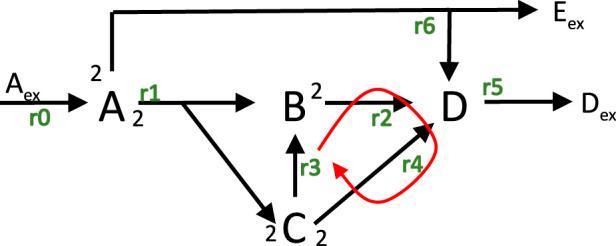
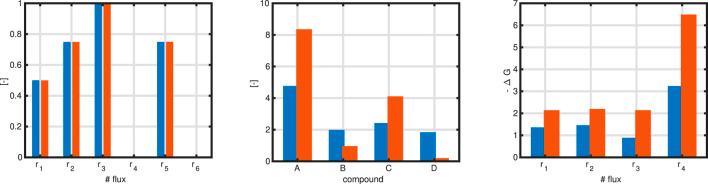
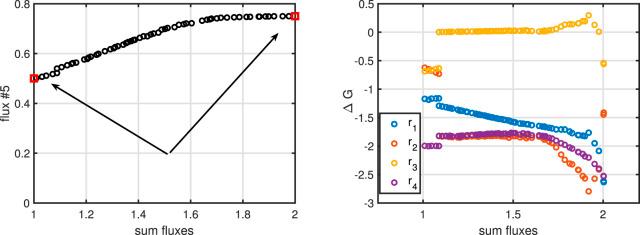
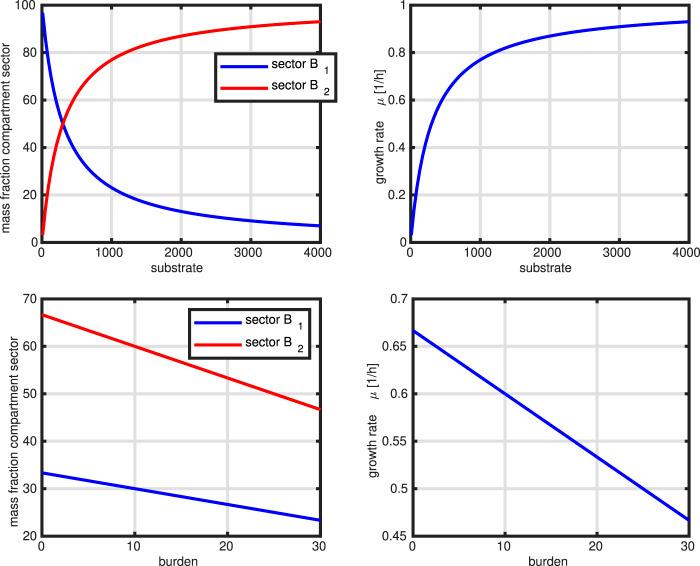
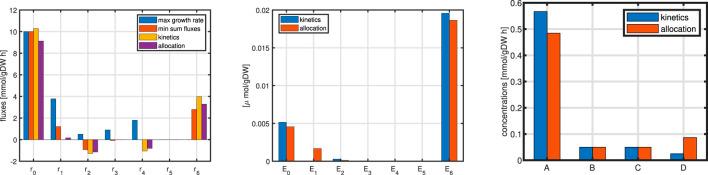
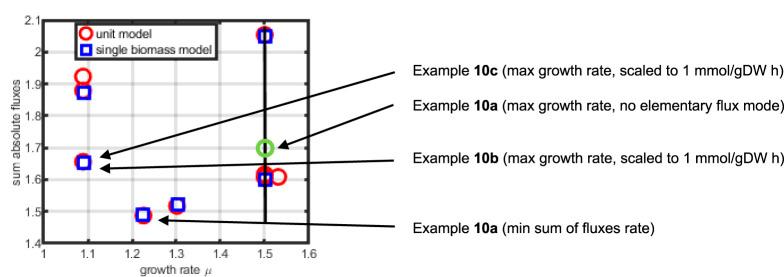
Mathematical models for cellular systems have become more and more important for understanding the complex interplay between metabolism, signalling, and gene expression.In this manuscript, starting from the well-known flux balance analysis, tools and methods are summarised and illustrated by various examples that describe the way to models with kinetics for individual reactions steps that are finally self-contained. While flux analysis requires known (measured) input fluxes, self-contained (or self-sustained) models only get information on concentrations of environmental components. Kinetic reaction laws, feedback structures, and protein allocation then determine the temporal output of all intracellular metabolites and macromolecules. Emphasis is placed on (i) mass conservation, a crucial system property frequently overlooked in models incorporating cellular structures like macromolecular structures like proteins, RNA, and DNA, and (ii) thermodynamic constraints which further limit the solution space. Matlab Live Scripts are provided for all simulation studies shown and additional reading material is given in the appendix.
细胞系统的数学模型对于理解新陈代谢、信号传导和基因表达之间复杂的相互作用变得越来越重要。在本手稿中,从著名的通量平衡分析出发,总结了工具和方法,并通过各种示例进行说明,这些示例描述了构建最终自包含的单个反应步骤动力学模型的方法。虽然通量分析需要已知(测量)的输入通量,但自包含(或自维持)模型仅获取有关环境成分浓度的信息。动力学反应定律、反馈结构和蛋白质分配随后决定了所有细胞内代谢物和大分子的时间输出。重点在于:(i)质量守恒,这是一个在包含蛋白质、RNA和DNA等大分子结构的细胞结构模型中经常被忽视的关键系统属性;(ii)热力学约束,这进一步限制了解决方案空间。为所示的所有模拟研究提供了Matlab实时脚本,并在附录中给出了额外的阅读材料。








 Zotero 插件