
依列卡福妥/替扎卡福妥/依伐卡托对骨密度和身体成分的影响:一项回顾性分析
Elexacaftor/Tezacaftor/Ivacaftor Effect on Bone Density and Body Composition: A Retrospective Analysis.
作者信息
Trost Susanne Ursula, Harindhanavudhi Tasma, Wang Qi, Ankireddypalli Anvitha, Simrah Azmi, Avula Sreekant, Moheet Amir
机构信息
Department of Medicine, Division of Diabetes, Endocrinology and Metabolism, University of Minnesota, Minneapolis, Minnesota, USA.
Clinical and Transitional Science Institute, University of Minnesota, Minneapolis, Minnesota, USA.
出版信息
Pediatr Pulmonol. 2025 Sep;60(9):e71280. doi: 10.1002/ppul.71280.
BACKGROUND
The approval of cystic fibrosis transmembrane conductance regulator modulators elexacaftor/tezacaftor/ivacaftor (ETI), has significantly improved pulmonary function for people with cystic fibrosis (pwCF). However, the effects on CF-related bone disease and body composition remain unclear.
METHODS
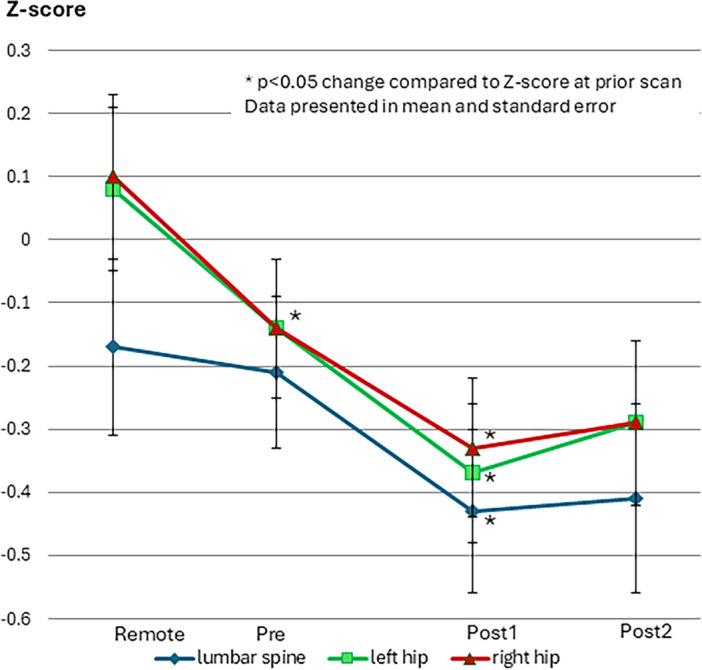
This retrospective real-world study examined adults with CF who received ETI treatment. Bone density and body composition were measured via dual-energy X-ray absorptiometry (DXA) 1.8 (SD 0.7) years before (preDXA) and 1.5 (SD 0.4) years after ETI initiation (postDXA1). In a subgroup, measurements were also available 4 (SD 0.6) years after initiation (postDXA2).
RESULTS
The study included 74 pwCF, of whom 42% were female, with an average age of 38.9 (SD 9.3) years at ETI initiation. Bone density decreased significantly at the spine (p = 0.02), left hip (p < 0.01), and right hip (p < 0.01) from pre- to postDXA1. No significant change in bone density was observed when comparing postDXA1 to postDXA2. Body composition analysis revealed significant increases in weight in both females (p < 0.01) and males (p < 0.01), as well as increases in fat mass in females (p < 0.01) and males (p < 0.01), without significant changes in lean mass (p = 0.4).
CONCLUSIONS
Bone density declined significantly during the study period, with the most pronounced decline occurring in the first 1.5 years after ETI initiation. However, this decline appeared to stabilize in participants with longer follow-up at 4 years post-ETI treatment, suggesting potential bone-protective effects with prolonged therapy. Body weight and fat mass increased early after ETI initiation, suggesting metabolic changes accompanying CFTR modulation.
背景
囊性纤维化跨膜传导调节因子调节剂依列卡福/替扎卡福/艾伐卡福(ETI)的获批显著改善了囊性纤维化患者(pwCF)的肺功能。然而,其对囊性纤维化相关骨病和身体成分的影响仍不明确。
方法
这项回顾性真实世界研究考察了接受ETI治疗的成年囊性纤维化患者。在开始ETI治疗前1.8(标准差0.7)年(DXA前)和开始ETI治疗后1.5(标准差0.4)年(DXA后1),通过双能X线吸收法(DXA)测量骨密度和身体成分。在一个亚组中,开始治疗后4(标准差0.6)年(DXA后2)也有测量数据。
结果
该研究纳入了74例pwCF患者,其中42%为女性,开始ETI治疗时的平均年龄为38.9(标准差9.3)岁。从DXA前到DXA后1,脊柱(p = 0.02)、左髋(p < 0.01)和右髋(p < 0.01)的骨密度显著下降。比较DXA后1和DXA后2时,未观察到骨密度有显著变化。身体成分分析显示,女性(p < 0.01)和男性(p < 0.01)的体重均显著增加,女性(p < 0.01)和男性(p < 0.01)的脂肪量也增加,而瘦体重无显著变化(p = 0.4)。
结论
在研究期间骨密度显著下降,最明显的下降发生在开始ETI治疗后的前1.5年。然而,在ETI治疗后4年随访时间更长的参与者中,这种下降似乎趋于稳定,提示长期治疗可能具有骨保护作用。开始ETI治疗后早期体重和脂肪量增加,提示CFTR调节伴随代谢变化。
 Zotero 插件