
免疫反应亚分型预测脓毒症死亡率:资源有限环境下的一项前瞻性研究
Immune Response Subphenotyping to Predict Mortality in Sepsis: A Prospective Study in Resource-Limited Setting.
作者信息
Herwanto Velma, Sinto Robert, Nainggolan Leonard, Susilo Adityo, Yunihastuti Evy, Pitoyo Ceva Wicaksono, Shatri Hamzah, Lie Khie Chen
机构信息
Division of Internal Medicine, Faculty of Medicine Universitas Tarumanagara, Jakarta, Indonesia; Siloam Hospitals Kebon Jeruk, Jakarta, Indonesia.
Division of Tropical Medicine and Infectious Diseases, Department of Internal Medicine, Dr. Cipto Mangunkusumo National General Hospital, Faculty of Medicine Universitas Indonesia, Jakarta, Indonesia.
出版信息
Crit Care Explor. 2025 Sep 9;7(9):e1315. doi: 10.1097/CCE.0000000000001315. eCollection 2025 Sep 1.
IMPORTANCE
Sepsis remains a leading cause of death in infectious cases. The heterogeneity of immune responses is a major challenge in the management and prognostication of patients with sepsis. Identifying distinct immune response subphenotypes using parsimonious classifiers may improve outcome prediction, particularly in resource-limited settings.
OBJECTIVES
This study aimed to evaluate whether classification of the immune response can serve as a predictor of mortality.
DESIGN, SETTING, AND PARTICIPANTS: This prospective cohort study was conducted in the emergency department, inpatient wards, and ICU of a tertiary hospital. Adult patients diagnosed with sepsis within the previous 24 hours were included. Exclusion criteria were history of RBC transfusion, major thalassemia, decompensated cirrhosis, hematologic malignancy, or use of immunosuppressive or chronic corticosteroid therapy. Demographic, clinical, and laboratory data-including serum ferritin and monocyte human leukocyte antigen-DR/Human Leukocyte Antigen-DR) (mHLA-DR) levels-were collected.
MAIN OUTCOMES AND MEASURES
Subjects were classified into the following immune subphenotypes: macrophage activation-like syndrome (MALS) (if ferritin > 4420 ng/mL), immunoparalysis (if mHLA-DR < 10,000 receptors/cell and ferritin ≤ 4420 ng/mL), and unclassified (if they did not meet the criteria for either MALS or immunoparalysis). The primary outcome was in-hospital mortality.
RESULTS
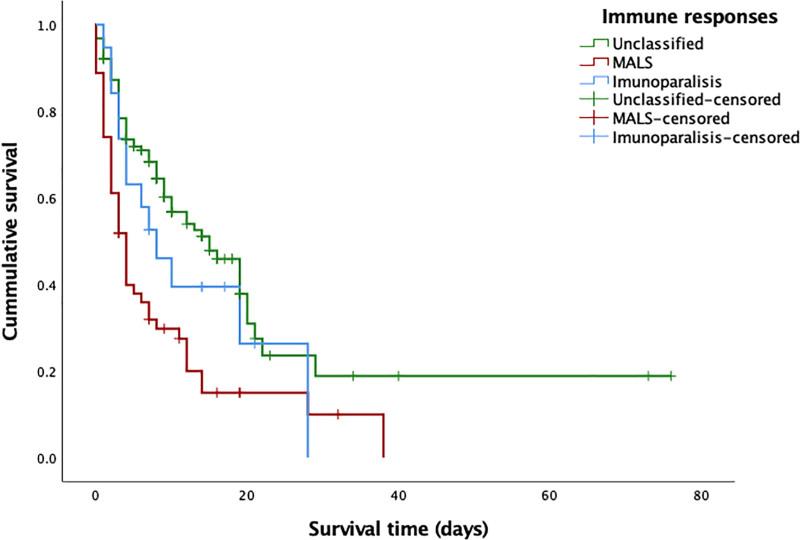
Of the 200 subjects recruited, 54 (27%) were classified into the MALS group, 19 (9.5%) into the immunoparalysis group, and the remainder into the unclassified group. The in-hospital mortality rates for the MALS, immune paralysis, and unclassified groups were 83.3%, 68.4%, and 51.1%, respectively. The proportional hazards assumption was met between the MALS and unclassified groups (crude hazard ratio [HR] 2.3; 95% CI, 1.56-3.35) but not between the immunoparalysis and unclassified groups (crude HR 1.4; 95% CI, 0.76-2.50). After adjusting for confounding variables, MALS's adjusted HR was 1.7 (95% CI, 1.13-2.49; p = 0.01).
CONCLUSIONS AND RELEVANCE
The MALS subphenotype is an independent predictor of in-hospital mortality in sepsis.
重要性
脓毒症仍然是感染性病例中的主要死因。免疫反应的异质性是脓毒症患者管理和预后评估的一项重大挑战。使用简约分类器识别不同的免疫反应亚表型可能会改善预后预测,尤其是在资源有限的环境中。
目的
本研究旨在评估免疫反应分类是否可作为死亡率的预测指标。
设计、设置和参与者:这项前瞻性队列研究在一家三级医院的急诊科、住院病房和重症监护室进行。纳入在过去24小时内被诊断为脓毒症的成年患者。排除标准包括红细胞输血史、重型地中海贫血、失代偿期肝硬化、血液系统恶性肿瘤或使用免疫抑制或慢性皮质类固醇治疗。收集人口统计学、临床和实验室数据,包括血清铁蛋白和单核细胞人类白细胞抗原-DR/人类白细胞抗原-DR(mHLA-DR)水平。
主要结局和指标
受试者被分为以下免疫亚表型:巨噬细胞活化样综合征(MALS)(如果铁蛋白>4420 ng/mL)、免疫麻痹(如果mHLA-DR<10,000个受体/细胞且铁蛋白≤4420 ng/mL)以及未分类(如果他们不符合MALS或免疫麻痹的标准)。主要结局是住院死亡率。
结果
在招募的200名受试者中,54名(27%)被分类到MALS组,19名(9.5%)被分类到免疫麻痹组,其余的被分类到未分类组。MALS组、免疫麻痹组和未分类组的住院死亡率分别为83.3%、68.4%和51.1%。MALS组和未分类组之间满足比例风险假设(粗风险比[HR] 2.3;95%置信区间,1.56 - 3.35),但免疫麻痹组和未分类组之间不满足(粗HR 1.4;95%置信区间,0.76 - 2.50)。在对混杂变量进行调整后,MALS的调整后HR为1.7(95%置信区间,1.13 - 2.49;p = 0.01)。
结论及相关性
MALS亚表型是脓毒症住院死亡率的独立预测指标。

 Zotero 插件