
美国白人和黑人的心脏代谢紊乱与轻度认知障碍。
Cardiometabolic disorders and mild cognitive impairment in White and Black Americans.
作者信息
Kavcic Voyko, Turaani Mohammad, Pal Subhamoy, Reader Jonathan M, Giordani Bruno
机构信息
Institute of Gerontology, Wayne State University, Detroit, Michigan, USA.
School of Medicine, Wayne State University, Detroit, Michigan, USA.
出版信息
Alzheimers Dement. 2025 Sep;21(9):e70642. doi: 10.1002/alz.70642.
INTRODUCTION
Mild cognitive impairment (MCI) represents a transitional stage between normal aging and dementia. We investigate associations among cardiovascular and metabolic disorders (hypertension, diabetes mellitus, and hyperlipidemia) and diagnosis (normal; amnestic [aMCI]; and non-amnestic [naMCI]).
METHODS
Multinomial logistic regressions of participant data (N = 8737; age = 70.9 ± 7.5 years) from the National Alzheimer's Coordinating Center Uniform Dataset Version 3 protocol cohort were used.
RESULTS
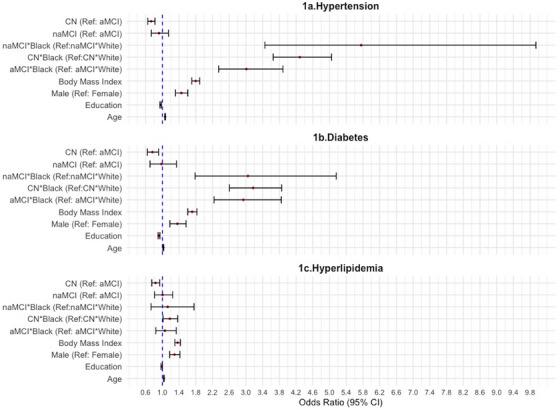
Controlling for demographic/health variables, individuals with aMCI, though not naMCI, showed a higher likelihood of hypertension, diabetes, and hyperlipidemia compared to cognitively normal counterparts, though no differences between aMCI/naMCI. Black Americans, regardless of cognitive status, were more likely to fall into hypertension and diabetes groups compared to White Americans.
DISCUSSION
These findings underscore the critical role of diagnosis and race in MCI diagnosis and care, emphasizing the need for tailored interventions to address inequities and reduce the risk of progression to dementia.
HIGHLIGHTS
The study leverages a large, racially diverse cohort from the NACC database. Black Americans with non-amnestic mild cognitive impairment(naMCI) show highest comorbidity burden. No significant differences in comorbidity burden between amnestic MCI (aMCI) and naMCI subtypes. Education is protective, but less so for Black American individuals. Older age, male sex, body mass index (BMI), and low education associate with increased risk for comorbidities.
引言
轻度认知障碍(MCI)是正常衰老与痴呆之间的过渡阶段。我们研究心血管和代谢紊乱(高血压、糖尿病和高脂血症)与诊断(正常;遗忘型[aMCI];非遗忘型[naMCI])之间的关联。
方法
使用来自国家阿尔茨海默病协调中心统一数据集第3版协议队列的参与者数据(N = 8737;年龄 = 70.9 ± 7.5岁)进行多项逻辑回归分析。
结果
在控制人口统计学/健康变量后,与认知正常的同龄人相比,aMCI患者(而非naMCI患者)患高血压、糖尿病和高脂血症的可能性更高,尽管aMCI/naMCI之间无差异。与美国白人相比,无论认知状态如何,美国黑人更有可能属于高血压和糖尿病组。
讨论
这些发现强调了诊断和种族在MCI诊断和护理中的关键作用,强调需要采取针对性干预措施来解决不平等问题并降低进展为痴呆的风险。
要点
该研究利用了来自NACC数据库的一个大型、种族多样的队列。患有非遗忘型轻度认知障碍(naMCI)的美国黑人合并症负担最高。遗忘型MCI(aMCI)和非遗忘型MCI(naMCI)亚型之间的合并症负担无显著差异。教育具有保护作用,但对美国黑人个体的保护作用较小。年龄较大、男性、体重指数(BMI)和低教育水平与合并症风险增加相关。
 Zotero 插件