
预测非小细胞肺癌患者脑转移发生的列线图:一项使用常规可用医疗记录的回顾性分析
A nomogram to predict development of brain metastasis in non-small cell lung cancer patients: a retrospective analysis using routinely available medical records.
作者信息
Wilding Hannah, Mikolajewicz Nicholas, Bhanja Debarati, Moeckel Camille, Ozair Ahmad, de Macedo Filho Leonardo, Tuohy Kyle, Hamidi Nima, Trifoi Mara, Snyder Brianna, Kuechenmeister Bailey, Salmanian Schahin, Ahluwalia Manmeet, Mansouri Alireza
机构信息
Penn State College of Medicine, Hershey, PA, USA.
Peter Gilgan Centre for Research and Learning, Hospital for Sick Children, Toronto, Canada.
出版信息
Lancet Reg Health Am. 2025 Aug 29;50:101213. doi: 10.1016/j.lana.2025.101213. eCollection 2025 Oct.
BACKGROUND
Brain metastases (BrM) are a frequent complication among patients with non-small cell lung cancer (NSCLC). While guidelines exist for baseline CNS screening in advanced NSCLC, surveillance strategies for early-stage disease remain limited. This study aimed to develop a time-dependent BrM risk prediction nomogram using readily available clinical information.
METHODS
We analyzed a retrospective cohort of NSCLC patients at Penn State Health. Our objectives were to (1) systematically evaluate the performance of existing BrM risk prediction algorithms and (2) construct novel nomograms for BrM risk prediction in NSCLC. Using Cox-proportional hazard models with L1-regularization, we predicted BrM risk at 6-month, 1-year, and 2-year follow-up intervals.
FINDINGS
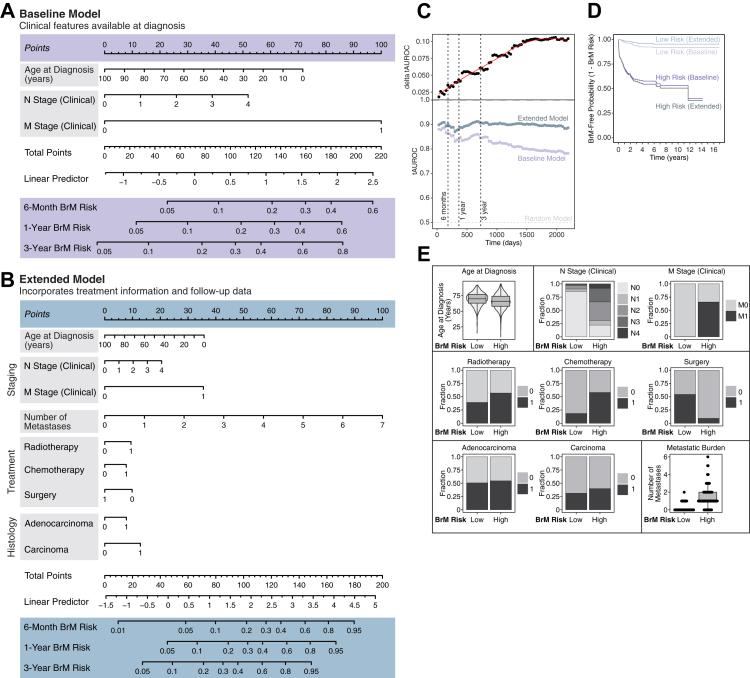
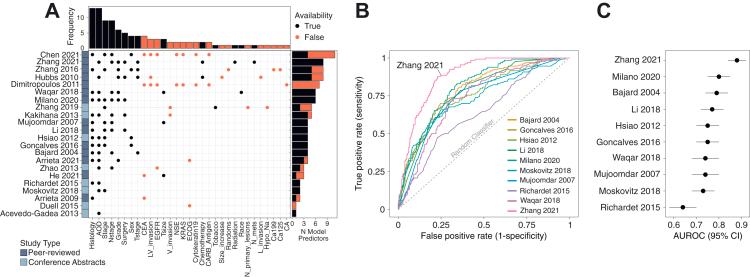
The patient cohort included 1904 patients (median age 68 years, range 38-94 years, BrM incidence 22.8%). The cohort included 1059 males (55.6%) and 845 females (44.4%). Of the cohort, 92.8% of patients identified as White (n = 1766), 1.0% as Asian (n = 19), 4.0% as Black (n = 77), and 2.2% as another race (n = 42). The Zhang 2021 model demonstrated the highest performance in predicting BrM incidence in our cohort, achieving an AUROC of 0.91 (95% CI: 0.87, 0.95). Two novel models were developed: a baseline model incorporating clinical and imaging data at diagnosis (cTNM stage, age at diagnosis), and an extended model including additional clinical and treatment data (number of extracranial metastatic sites, prior radiotherapy, chemotherapy, surgery, and histology) (https://nmikolajewicz.shinyapps.io/nomogram_wilding2024/). While both models showed similar short-term performance, the extended model demonstrated superior predictive capacity (AUROC 0.91 at 3-years) for longer-term outcomes. Our nomograms rely exclusively on clinical features routinely documented in patient records, thereby requiring no additional investigations.
INTERPRETATION
These clinically accessible nomograms for BrM prediction will facilitate prognostic modeling, risk stratification, refinement of CNS screening guidelines, and patient counseling.
FUNDING
None.
背景
脑转移(BrM)是非小细胞肺癌(NSCLC)患者常见的并发症。虽然存在晚期NSCLC基线中枢神经系统筛查的指南,但早期疾病的监测策略仍然有限。本研究旨在利用现成的临床信息开发一种时间依赖性BrM风险预测列线图。
方法
我们分析了宾夕法尼亚州立大学医疗中心的NSCLC患者回顾性队列。我们的目标是:(1)系统评估现有BrM风险预测算法的性能;(2)构建NSCLC中BrM风险预测的新型列线图。使用带有L1正则化的Cox比例风险模型,我们预测了6个月、1年和2年随访间隔的BrM风险。
结果
患者队列包括1904例患者(中位年龄68岁,范围38 - 94岁,BrM发病率22.8%)。该队列包括1059名男性(55.6%)和845名女性(44.4%)。在该队列中,92.8%的患者为白人(n = 1766),1.0%为亚洲人(n = 19),4.0%为黑人(n = 77),2.2%为其他种族(n = 42)。Zhang 2021模型在预测我们队列中的BrM发病率方面表现最佳,AUROC为0.91(95% CI:0.87,0.95)。开发了两个新模型:一个基线模型,纳入诊断时的临床和影像数据(cTNM分期、诊断时年龄),以及一个扩展模型,包括额外的临床和治疗数据(颅外转移部位数量、既往放疗、化疗、手术和组织学)(https://nmikolajewicz.shinyapps.io/nomogram_wilding2024/)。虽然两个模型在短期表现上相似,但扩展模型在长期结局方面显示出更高的预测能力(3年时AUROC为0.91)。我们的列线图完全依赖于患者记录中常规记录的临床特征,因此无需额外检查。
解读
这些用于BrM预测的临床可用列线图将有助于预后建模、风险分层、完善中枢神经系统筛查指南以及患者咨询。
资金
无。

 Zotero 插件