
癌症相关成纤维细胞介导的免疫逃逸:肿瘤微环境中基质 - 免疫相互作用的分子机制
Cancer-associated fibroblast-mediated immune evasion: molecular mechanisms of stromal-immune crosstalk in the tumor microenvironment.
作者信息
Luo Junling, Xiang Xuehua, Gong Guangyuan, Jiang Lang
机构信息
Department of Medical Laboratory, Jiangsu Provincial People's Hospital Chongqing Hospital, Chongqing, China.
Department of Medical Laboratory, Qijiang District People's Hospital, Chongqing, China.
出版信息
Front Immunol. 2025 Aug 26;16:1617662. doi: 10.3389/fimmu.2025.1617662. eCollection 2025.
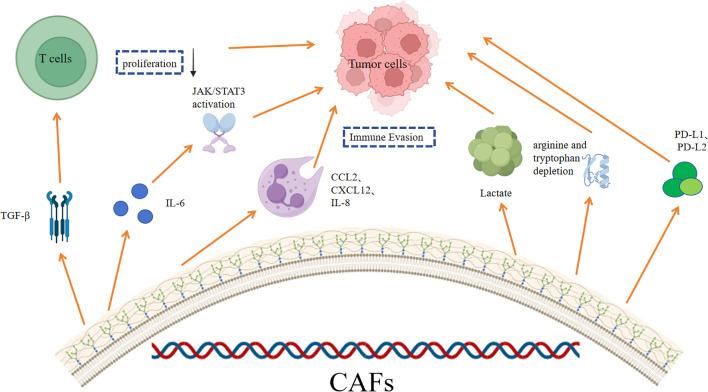
The tumor microenvironment (TME) is a complex ecosystem and cancer-associated fibroblasts (CAFs) are critical drivers of the immunosuppressive TME. The dynamic interactions between CAFs and immune cells play a crucial role in tumor progression and immune evasion. This review systematically investigates the interactions between CAFs and different immune cells and elaborates on the molecular mechanisms of CAF-mediated immune suppression, with a focus on their multifaceted interactions with various immune cell populations. The present study discusses how CAFs utilize cytokine networks, metabolic reprogramming and immune checkpoint regulation to establish an immunosuppressive TME. Clinical translation should prioritize FAP-directed therapies alongside αPD-1 to concurrently target CAF-immune crosstalk and metabolic competition in the TME.
肿瘤微环境(TME)是一个复杂的生态系统,癌症相关成纤维细胞(CAFs)是免疫抑制性TME的关键驱动因素。CAFs与免疫细胞之间的动态相互作用在肿瘤进展和免疫逃逸中起着至关重要的作用。本综述系统地研究了CAFs与不同免疫细胞之间的相互作用,并阐述了CAF介导的免疫抑制的分子机制,重点关注它们与各种免疫细胞群体的多方面相互作用。本研究讨论了CAFs如何利用细胞因子网络、代谢重编程和免疫检查点调节来建立免疫抑制性TME。临床转化应优先考虑针对FAP的疗法以及αPD-1,以同时靶向TME中的CAF-免疫串扰和代谢竞争。

 Zotero 插件