
人类微生物群相关动物模型综述
Human microbiota-associated animal models: a review.
作者信息
Huang Xiangning, Yu Yunfeng, Tian Na, Huang Jiawang, Zhang Xiaoqin, Yu Rong
机构信息
School of Traditional Chinese Medicine, Hunan University of Chinese Medicine, Changsha, China.
Department of Endocrine, The First Hospital of Hunan University of Chinese Medicine, Changsha, China.
出版信息
Front Cell Infect Microbiol. 2025 Aug 27;15:1644187. doi: 10.3389/fcimb.2025.1644187. eCollection 2025.
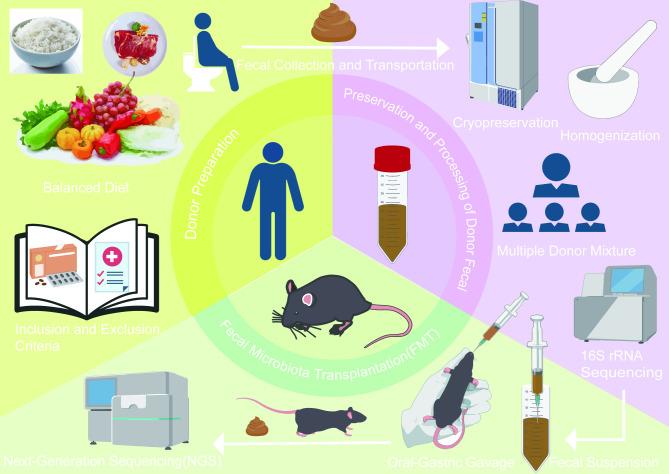
Human microbiota-associated (HMA) animal models have become indispensable tools for investigating microbe-host interactions and disease pathogenesis. However, standardization challenges persist across different research groups when such models are used in fecal microbiota transplantation (FMT) protocols. Establishing a successful HMA model involves multiple stages, including donor screening, fecal suspension preparation, recipient preparation, and FMT. The outcomes of these stages are influenced by donor characteristics, recipient type, microbial viability, and dietary factors. This review examined the critical components of HMA model production, including the inclusion and exclusion criteria for human donors, collection time and processing methodology for fecal samples, recipient animal preparation strategies, and FMT regimens with engraftment validation. The key findings revealed that short-term antibiotic, probiotic, or laxative use constitutes an essential donor exclusion criterion. The time and method of fecal collection should be standardized as much as possible. Fecal samples should be processed as soon as possible, in anaerobic environments, with the addition of suitable protectants if they must be preserved at low temperatures. Microbial community profiling via 16S rRNA gene sequencing represents the primary method for analyzing microbiome composition and verifying microbiota engraftment efficacy throughout FMT procedures. The most commonly used recipients for HMA modeling included germ-free and pseudo-germ-free animals generated through antibiotic-mediated microbiota depletion. Although FMT with a single gavage of fecal suspension proved sufficient for model establishment, multiple frequencies and longer FMT durations significantly improved the efficiency of donor microbiota colonization. Overall, these findings are expected to aid the establishment of a standardized and reproducible protocol for preparing HMA models.
人类微生物群相关(HMA)动物模型已成为研究微生物与宿主相互作用及疾病发病机制不可或缺的工具。然而,当在粪便微生物群移植(FMT)方案中使用此类模型时,不同研究团队在标准化方面仍面临挑战。建立成功的HMA模型涉及多个阶段,包括供体筛选、粪便悬液制备、受体准备和FMT。这些阶段的结果受供体特征、受体类型、微生物活力和饮食因素影响。本综述探讨了HMA模型构建的关键组成部分,包括人类供体的纳入和排除标准、粪便样本的采集时间和处理方法、受体动物准备策略以及具有植入验证的FMT方案。关键发现表明,短期使用抗生素、益生菌或泻药是供体排除的重要标准。粪便采集的时间和方法应尽可能标准化。粪便样本应尽快处理,在厌氧环境中进行,若必须低温保存则需添加合适的保护剂。通过16S rRNA基因测序进行微生物群落分析是分析微生物组组成及在整个FMT过程中验证微生物群植入效果的主要方法。HMA建模最常用的受体包括通过抗生素介导的微生物群耗竭产生的无菌和伪无菌动物。虽然单次灌胃粪便悬液的FMT被证明足以建立模型,但多次给药频率和更长的FMT持续时间显著提高了供体微生物群定植的效率。总体而言,这些发现有望有助于建立一个标准化且可重复的HMA模型制备方案。

 Zotero 插件