
脑微结构改变作为新冠后状况的一种影像生物标志物
Cerebral microstructural alterations as an imaging biomarker for Post-COVID-condition.
作者信息
Rau Alexander, Arnold Philipp G, Frase Sibylle, Schröter Nils, Mast Hansjörg, Weiller Cornelius, Reisert Marco, Urbach Horst, Hosp Jonas A
机构信息
Department of Neuroradiology, Faculty of Medicine, Medical Center-University of Freiburg, University of Freiburg, Freiburg, Germany.
Department of Diagnostic and Interventional Radiology, Faculty of Medicine, Medical Center-University of Freiburg, University of Freiburg, Freiburg, Germany.
出版信息
Sci Rep. 2025 Sep 12;15(1):32483. doi: 10.1038/s41598-025-18962-3.
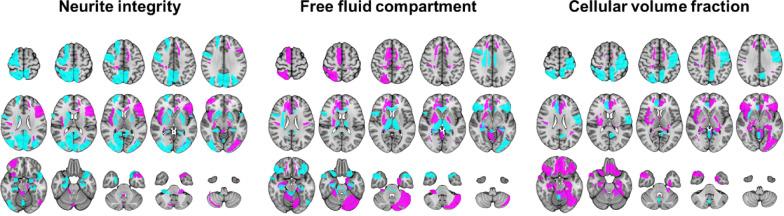
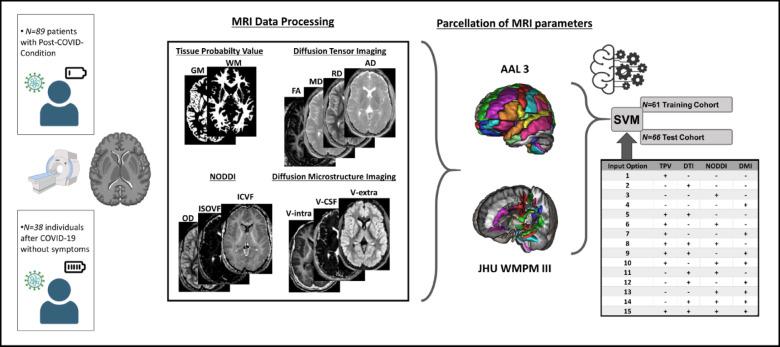
To develop an imaging biomarker-based approach for the diagnosis of Post-COVID-condition (PCC) at the individual patient level. Magnetic resonance imaging (MRI) data from a prospective cohort of PCC patients (n = 89) were compared with a control group of unimpaired individuals who had contracted coronavirus disease 2019 (COVID-19) in the past (n = 38). Participants were divided into two groups: a training and a test cohort. The macrostructure, diffusion tensor imaging, and multi-shell-based microstructure imaging metrics were extracted using an atlas-based approach. These data were subsequently utilized to train a linear support vector machine (SVM). The efficacy of discrimination between the groups was evaluated for various combinations of input parameters. Upon comparison of the different input combinations, we found the highest area under the receiver operating characteristic curve (AUROC) for microstructural parameters. For the optimal combination of input parameters, an AUROC value of 0.95 with a sensitivity of 94% and a specificity of 85% was achieved, indicating high discriminatory potential but also underscoring the need for further validation given the non-negligible false-positive rate. The atlas regions with the highest discriminatory power include both gray (including multiple cortical areas, putamen and left thalamus) and white matter (including corpus callosum and frontal white matter). The use of a SVM allowed for the differentiation between PCC patients and UPC participants with high sensitivity using microstructural MRI data. While these findings mark a significant step toward a biomarker-based diagnosis of PCC, the moderate specificity and the monocentric design emphasize the need for confirmation in larger and multicentric cohorts before clinical application.
为了开发一种基于成像生物标志物的方法,用于在个体患者层面诊断新冠后状况(PCC)。将来自PCC患者前瞻性队列(n = 89)的磁共振成像(MRI)数据与过去感染过2019冠状病毒病(COVID-19)的未受损个体对照组(n = 38)进行比较。参与者被分为两组:训练组和测试组。使用基于图谱的方法提取宏观结构、扩散张量成像和基于多壳的微观结构成像指标。这些数据随后被用于训练线性支持向量机(SVM)。针对输入参数的各种组合评估两组之间的区分效果。在比较不同的输入组合时,我们发现微观结构参数在受试者工作特征曲线(AUROC)下的面积最大。对于输入参数的最佳组合,AUROC值为0.95,灵敏度为94%,特异性为85%,这表明具有较高的区分潜力,但也强调了鉴于不可忽视的假阳性率,需要进一步验证。具有最高区分能力的图谱区域包括灰质(包括多个皮质区域、壳核和左侧丘脑)和白质(包括胼胝体和额叶白质)。使用SVM能够利用微观结构MRI数据以高灵敏度区分PCC患者和未感染COVID-19的参与者。虽然这些发现标志着在基于生物标志物诊断PCC方面迈出了重要一步,但中等的特异性和单中心设计强调在临床应用前需要在更大的多中心队列中进行确认。
 Zotero 插件