
代谢物介导的神经毒性的检测策略
Testing Strategies for Metabolite-Mediated Neurotoxicity.
作者信息
Suess Julian, Reinmoeller Moritz, Magel Viktoria, Gukalova Baiba, Liepinsh Edgars, Gardner Iain, Dreser Nadine, Holzer Anna-Katharina, Leist Marcel
机构信息
In Vitro Toxicology and Biomedicine, Dept Inaugurated by the Doerenkamp-Zbinden Foundation, University of Konstanz, 78457 Konstanz, Germany.
Latvian Institute of Organic Synthesis, LV-1006 Riga, Latvia.
出版信息
Int J Mol Sci. 2025 Aug 28;26(17):8338. doi: 10.3390/ijms26178338.
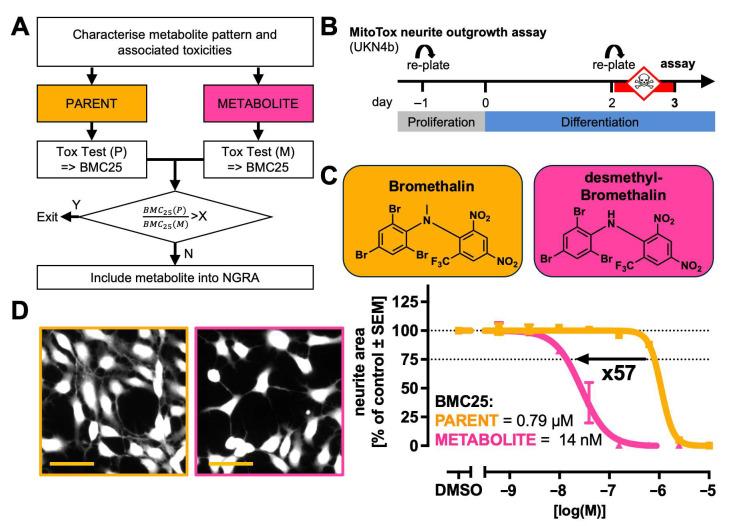
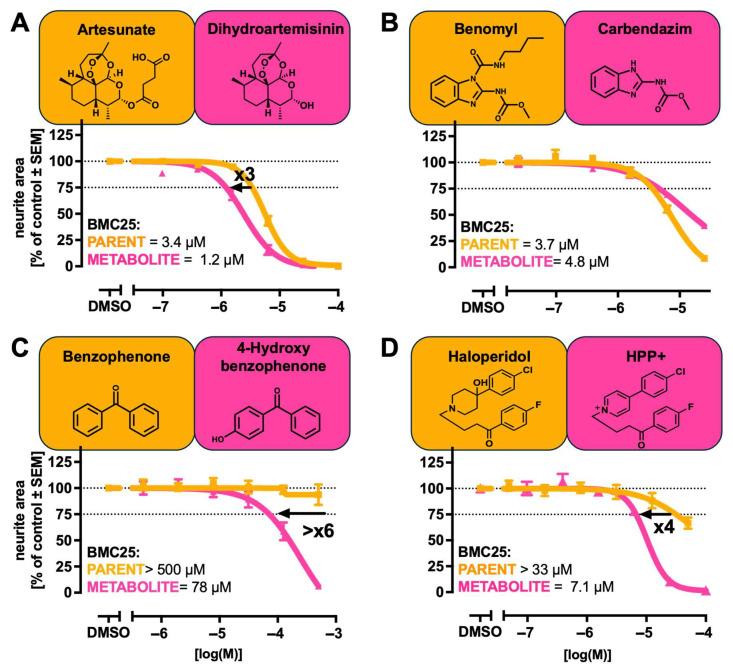
Compounds, which rely on metabolism to exhibit toxicity, pose a challenge for next-generation risk assessment (NGRA). Since many of the currently available non-animal new approach methods (NAMs) lack metabolic activity, their use may lead to an underestimation of the true hazard to humans (false negative predictions). We explored here strategies to deal with metabolite-mediated toxicity in assays for developmental neurotoxicity. First, we present an overview of substances that may serve as potential positive controls for metabolite-related neurotoxicity. Then, we demonstrate, using the MitoMet (UKN4b) assay, which assesses the adverse effects of chemicals on neurites of human neurons, that some metabolites have a higher toxic potency than their parent compound. Next, we designed a strategy to integrate elements of xenobiotic metabolism into assays used for (developmental) neurotoxicity testing. In the first step of this approach, hepatic post-mitochondrial fractions (S9) were used to generate metabolite mixtures ("metabolisation module"). In the second step, these were applied to a NAM (exemplified by the UKN4b assay) to identify metabolite-mediated toxicity. We demonstrate the applicability and transferability of these approaches to other assays, by an exemplary study on the basis of the cMINC (UKN2) assay, another NAM of the developmental neurotoxicity in vitro battery. Based on the experience gained from these experiments, we discuss key issues to be addressed if this approach is to be used more broadly for NAM in the NGRA context.
依赖代谢来表现出毒性的化合物,对下一代风险评估(NGRA)构成了挑战。由于目前许多可用的非动物新方法(NAMs)缺乏代谢活性,使用它们可能会导致对人类真实危害的低估(假阴性预测)。我们在此探索了在发育神经毒性检测中应对代谢物介导毒性的策略。首先,我们概述了可能用作代谢物相关神经毒性潜在阳性对照的物质。然后,我们使用评估化学物质对人类神经元神经突不良反应的MitoMet(UKN4b)检测方法,证明了一些代谢物的毒性效力高于其母体化合物。接下来,我们设计了一种策略,将外源性代谢元素整合到用于(发育)神经毒性测试的检测方法中。在该方法的第一步中,使用肝脏线粒体后上清液(S9)生成代谢物混合物(“代谢模块”)。在第二步中,将这些代谢物混合物应用于一种NAM(以UKN4b检测为例),以识别代谢物介导的毒性。我们通过基于cMINC(UKN2)检测的示例研究,证明了这些方法对其他检测方法的适用性和可转移性,cMINC(UKN2)检测是体外发育神经毒性检测电池组中的另一种NAM。基于从这些实验中获得的经验,我们讨论了如果要在NGRA背景下更广泛地将此方法用于NAM,需要解决的关键问题。




 Zotero 插件