
心血管疾病中的线粒体转运蛋白:代谢守门人、致病介质和治疗靶点
Mitochondrial Transport Proteins in Cardiovascular Diseases: Metabolic Gatekeepers, Pathogenic Mediators and Therapeutic Targets.
作者信息
Pei Yue, Wan Sitong, Qi Jingyi, Xi Xueyao, Zhu Yinhua, An Peng, Luo Junjie, Luo Yongting
机构信息
Department of Nutrition and Health, China Agricultural University, Beijing 100193, China.
College of Biological Sciences, China Agricultural University, Beijing 100193, China.
出版信息
Int J Mol Sci. 2025 Aug 31;26(17):8475. doi: 10.3390/ijms26178475.
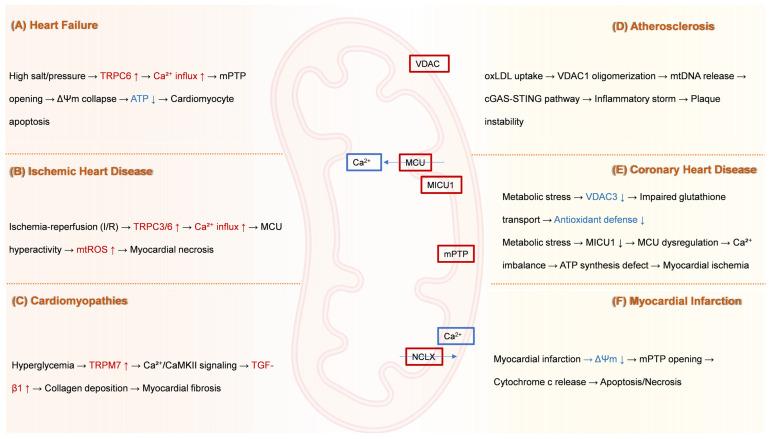
Mitochondria, as the metabolic hubs of cells, play a pivotal role in maintaining cardiovascular homeostasis through dynamic regulation of energy metabolism, redox balance, and calcium signaling. Cardiovascular diseases (CVDs), including heart failure, ischemic heart disease, cardiomyopathies, and myocardial infarction, remain the leading cause of global mortality, with mitochondrial dysfunction emerging as a unifying pathological mechanism across these conditions. Emerging evidence suggests that impaired mitochondrial transport systems-critical gatekeepers of metabolite flux, ion exchange, and organelle communication-drive disease progression by disrupting bioenergetic efficiency and exacerbating oxidative stress. This review synthesizes current knowledge on mitochondrial transport proteins, such as the voltage-dependent anion channels, transient receptor potential channels, mitochondrial calcium uniporter, and adenine nucleotide translocator, focusing on their structural-functional relationships and dysregulation in CVD pathogenesis. We highlight how aberrant activity of these transporters contributes to hallmark features of cardiac pathology, including metabolic inflexibility, mitochondrial permeability transition pore destabilization, and programmed cell death. Furthermore, we critically evaluate preclinical advances in targeting mitochondrial transport systems through pharmacological modulation, gene editing, and nanoparticle-based delivery strategies. By elucidating the mechanistic interplay between transport protein dysfunction and cardiac metabolic reprogramming, we address a critical knowledge gap in cardiovascular biology and provide a roadmap for developing precision therapies. Our insights underscore the translational potential of mitochondrial transport machinery as both diagnostic biomarkers and therapeutic targets, offering new avenues to combat the growing burden of CVDs in aging populations.
线粒体作为细胞的代谢中心,通过对能量代谢、氧化还原平衡和钙信号的动态调节,在维持心血管稳态中发挥关键作用。心血管疾病(CVDs),包括心力衰竭、缺血性心脏病、心肌病和心肌梗死,仍然是全球死亡的主要原因,线粒体功能障碍已成为这些疾病共同的病理机制。新出现的证据表明,线粒体转运系统受损——代谢物通量、离子交换和细胞器通讯的关键守门人——通过破坏生物能效率和加剧氧化应激来推动疾病进展。本综述综合了目前关于线粒体转运蛋白的知识,如电压依赖性阴离子通道、瞬时受体电位通道、线粒体钙单向转运体和腺嘌呤核苷酸转位酶,重点关注它们的结构-功能关系以及在CVD发病机制中的失调。我们强调这些转运蛋白的异常活性如何导致心脏病理学的标志性特征,包括代谢灵活性受损、线粒体通透性转换孔失稳和程序性细胞死亡。此外,我们批判性地评估了通过药理学调节、基因编辑和基于纳米颗粒的递送策略靶向线粒体转运系统的临床前进展。通过阐明转运蛋白功能障碍与心脏代谢重编程之间的机制相互作用,我们填补了心血管生物学中的一个关键知识空白,并为开发精准治疗提供了路线图。我们的见解强调了线粒体转运机制作为诊断生物标志物和治疗靶点的转化潜力,为应对老年人群中日益增加的CVD负担提供了新途径。


 Zotero 插件