
CFTR调节剂通过血清人附睾蛋白4浓度对纯合子囊性纤维化患者的疗效比较
Comparison of the Effect of CFTR Modulators // and / via Serum Human Epididymis Protein 4 Concentration in Homozygous Cystic Fibrosis Patients.
作者信息
Pócsi Marianna, Fila Libor, Péterfia Csaba, Halász Adrien, Szanto Tibor G, Mészáros Beáta, Major Judit, Laki István, Szabó Hajnalka, Panyi György, Balogh István, Amaral Margarida D, Macek Milan, Nagy Béla
机构信息
Department of Laboratory Medicine, Faculty of Medicine, University of Debrecen, 4032 Debrecen, Hungary.
Department of Pulmonology, 2nd Faculty of Medicine, Charles University and Motol University Hospital, 150 06 Prague, Czech Republic.
出版信息
J Clin Med. 2025 Sep 2;14(17):6188. doi: 10.3390/jcm14176188.
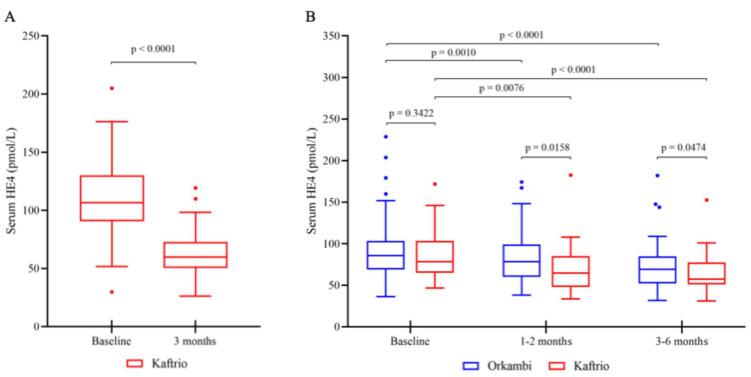
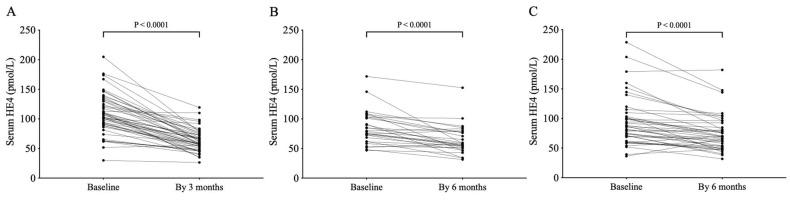
Elevated human epididymis protein 4 (HE4) levels decreased in patients with CF (pwCF) in response to CFTR-specific drugs and negatively correlated with FEV1% predicted values (ppFEV1). Although // (ETI, Kaftrio) demonstrates more substantial effectiveness than / (LUM/IVA, Orkambi) in pwCF, plasma biomarkers have not been used to compare treatment efficacy. Hence, our aim was to correlate the change in HE4 levels and the clinical effects of these CFTR modulators (CFTRm). Serum HE4 concentrations were measured in a total of 123 pwCF homozygous for the variant before treatment and 1-6 months after either ETI or LUM/IVA administration. A correlation between serum HE4 and ppFEV1 was assessed using the Spearman test. HE4 protein levels were also analyzed in the supernatants of CFBE 41o- cells before and after treatment with these CFTRm, and their direct effect on CFTR function was monitored by the whole-cell patch-clamp technique. Serum HE4 levels were reduced below baseline after 3 months of either ETI or LUM/IVA (mean delta HE4: -38.5 vs. -18.5 pmol/L, respectively) when the mean change of ppFEV1 was 13.6 vs. 1.6% and remained decreased up to 6 months. A significant inverse correlation between HE4 and ppFEV1 was observed in both study cohorts (r = -0.537 and r = -0.575, respectively; < 0.0001). In agreement with ex vivo results, the effect on was more pronounced by ETI than LUM/IVA in CFBE cells, showing a larger improvement in function and reductions in HE4 levels at 24 h. Serum HE4 negatively correlates with lung function improvement and monitors better drug efficacy in pwCF under ETI than LUM/IVA.
囊性纤维化患者(pwCF)在使用CFTR特异性药物后,其升高的人附睾蛋白4(HE4)水平下降,且与预测的第一秒用力呼气容积百分比(ppFEV1)呈负相关。尽管在pwCF中,依特卡肽(ETI,Kaftrio)比鲁玛卡托/依伐卡托(LUM/IVA,Orkambi)显示出更显著的疗效,但血浆生物标志物尚未用于比较治疗效果。因此,我们的目的是关联HE4水平的变化与这些CFTR调节剂(CFTRm)的临床效果。在123例携带该变异的纯合子pwCF患者治疗前以及接受依特卡肽或鲁玛卡托/依伐卡托治疗后1 - 6个月测量血清HE4浓度。使用Spearman检验评估血清HE4与ppFEV1之间的相关性。在用这些CFTRm处理前后,还分析了CFBE 41o -细胞上清液中的HE4蛋白水平,并通过全细胞膜片钳技术监测它们对CFTR功能的直接影响。在接受依特卡肽或鲁玛卡托/依伐卡托治疗3个月后,血清HE4水平降至基线以下(平均HE4变化量:分别为 - 38.5和 - 18.5 pmol/L),此时ppFEV1的平均变化量为13.6%和1.6%,并且在长达6个月时仍保持下降。在两个研究队列中均观察到HE4与ppFEV1之间存在显著的负相关(r分别为 - 0.537和 - 0.575;P < 0.0001)。与体外实验结果一致,在CFBE细胞中,依特卡肽对CFTR功能的影响比鲁玛卡托/依伐卡托更显著,在处理24小时时显示出CFTR功能有更大改善且HE4水平降低。血清HE4与肺功能改善呈负相关,并且在pwCF患者中,与鲁玛卡托/依伐卡托相比,依特卡肽治疗下血清HE4能更好地监测药物疗效。



 Zotero 插件