
血清炎症生物标志物驱动的机器学习模型在手术局限期小细胞肺癌预后分层中的开发与验证
Development and validation of a serum inflammatory biomarker-driven machine-learning model for prognostic stratification in surgical limited-stage small cell lung cancer.
作者信息
Yao Zhiyuan, Li Changlei, Han Fengyi, Qin Yi, Sun Xiao, Wang Guohua, Yu Enzheng, Song Peng, Liu Hanqun, Jiao Wenjie
机构信息
Department of Thoracic Surgery, The Affiliated Hospital of Qingdao University, Qingdao, China.
Department of Hepatobiliary and Pancreatic Surgery, The Affiliated Hospital of Qingdao University, Qingdao, China.
出版信息
Transl Lung Cancer Res. 2025 Aug 31;14(8):2983-2995. doi: 10.21037/tlcr-2025-182. Epub 2025 Aug 14.
BACKGROUND
Robust prognostic markers for small cell lung cancer (SCLC) are currently lacking, underscoring the need for novel prediction models to optimize individualized treatment and improve patient outcomes. Inflammatory/nutritional indexes have been extensively employed in prognostic investigations of malignant tumors. The study aimed to precisely ascertain the prognosis of SCLC patients undergoing surgery by preoperative serological indexes.
METHODS
We included patients with SCLC who underwent surgery at The Affiliated Hospital of Qingdao University. Potential predictors included basic clinical characteristics and preoperative serum inflammatory/nutritional indexes. We employed 10 machine learning algorithms and their 101 combinations to select the superior model and establish a novel nomogram. Follow-up involved regular clinic visits or telephone contact, with imaging and laboratory tests conducted at defined intervals to assess overall survival (OS) and progression-free survival (PFS). The cohort was randomly split into training and validation cohorts in a 7:3 ratio. Harrell's C-index, Kaplan-Meier curves, log-rank tests, and Cox regression analyses were used for model evaluation and prognostic assessment.
RESULTS
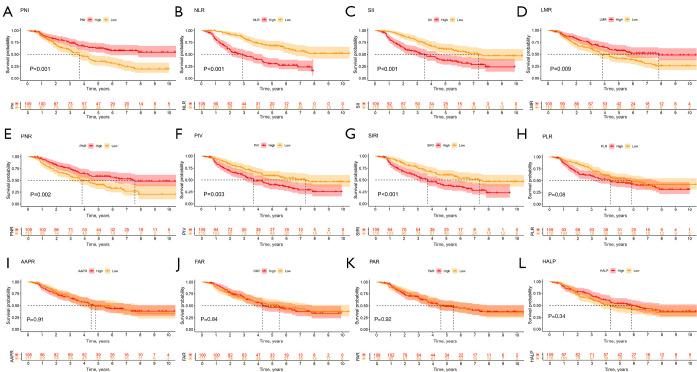
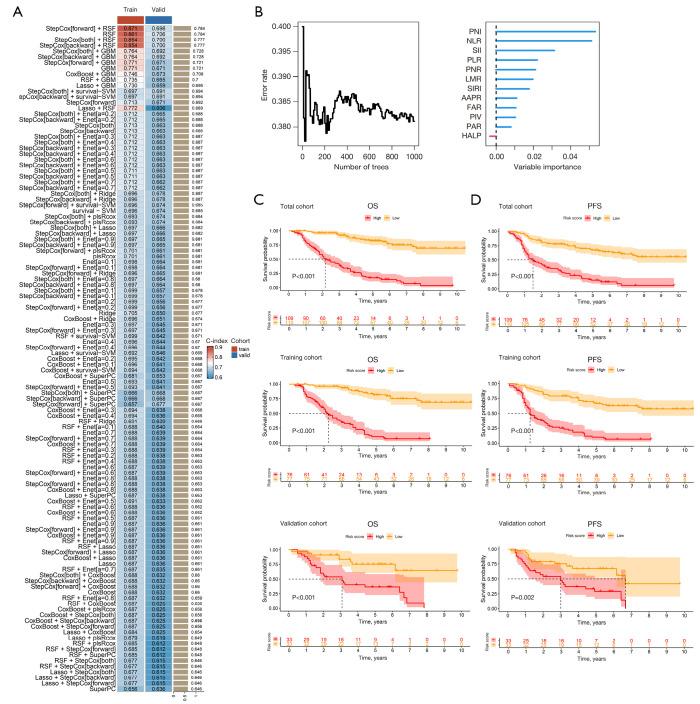
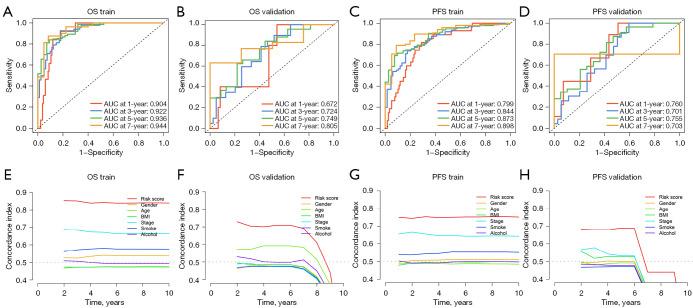
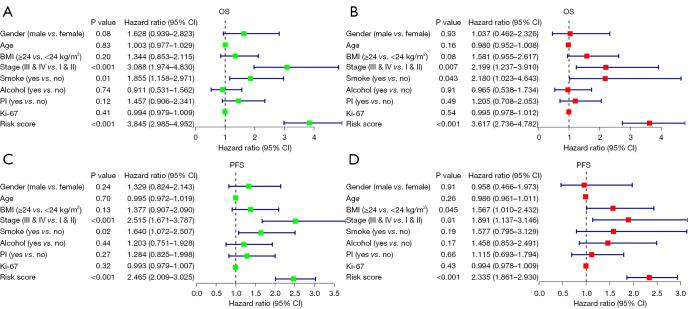
A total of 219 patients were included in this study. Prognostic nutritional index (PNI), lymphocyte-to-monocyte ratio (LMR), platelet-to-neutrophil ratio (PNR), neutrophil-to-lymphocyte ratio (NLR), systemic immune-inflammatory index (SII), pan-immune-inflammation value (PIV), and systemic inflammatory response index (SIRI) were correlated with the prognosis of SCLC patients. Smoking status and the tumor-node-metastasis (TNM) stage were independent prognostic indicators of OS. The Random Forest model achieved the highest mean concordance index (C-index) (0.784). Patients classified as high-risk based on this model exhibited a higher prevalence of smoking and more advanced pathological N stage and TNM stage. No significant differences were observed between risk groups regarding age, gender, body mass index (BMI), alcohol history, tumor site, pathological T stage, Ki-67 index, or visceral pleural invasion (VPI). Nomograms based on risk grouping, smoking status, and TNM stage demonstrated high precision and considerable clinical value. Multivariate Cox analysis identified PNI and NLR as the most valuable prognostic markers, with optimal cut-off values of 50.6 and 1.99, respectively.
CONCLUSIONS
A machine learning model based on serological inflammatory/nutritional indexes can reasonably estimate the long-term prognosis of SCLC patients and is anticipated to serve as a practical instrument for identifying the ideal candidates for thoracic surgery.
背景
目前缺乏用于小细胞肺癌(SCLC)的可靠预后标志物,这凸显了需要新的预测模型来优化个体化治疗并改善患者预后。炎症/营养指标已广泛应用于恶性肿瘤的预后研究中。本研究旨在通过术前血清学指标准确确定接受手术的SCLC患者的预后。
方法
我们纳入了在青岛大学附属医院接受手术的SCLC患者。潜在预测因素包括基本临床特征和术前血清炎症/营养指标。我们采用10种机器学习算法及其101种组合来选择最优模型并建立一个新的列线图。随访包括定期门诊就诊或电话联系,并在规定间隔进行影像学和实验室检查以评估总生存期(OS)和无进展生存期(PFS)。该队列以7:3的比例随机分为训练队列和验证队列。采用Harrell's C指数、Kaplan-Meier曲线、对数秩检验和Cox回归分析进行模型评估和预后评估。
结果
本研究共纳入219例患者。预后营养指数(PNI)、淋巴细胞与单核细胞比值(LMR)、血小板与中性粒细胞比值(PNR)、中性粒细胞与淋巴细胞比值(NLR)、全身免疫炎症指数(SII)、全免疫炎症值(PIV)和全身炎症反应指数(SIRI)与SCLC患者的预后相关。吸烟状态和肿瘤-淋巴结-转移(TNM)分期是OS的独立预后指标。随机森林模型的平均一致性指数(C指数)最高(0.784)。基于该模型分类为高危的患者吸烟率更高,病理N分期和TNM分期更晚。风险组在年龄、性别、体重指数(BMI)、饮酒史、肿瘤部位、病理T分期、Ki-67指数或脏层胸膜侵犯(VPI)方面未观察到显著差异。基于风险分组、吸烟状态和TNM分期的列线图显示出高精度和相当大的临床价值。多因素Cox分析确定PNI和NLR为最有价值的预后标志物,最佳截断值分别为50.6和1.99。
结论
基于血清学炎症/营养指标的机器学习模型可以合理估计SCLC患者的长期预后,并有望作为一种实用工具来识别胸外科手术的理想候选人。


 Zotero 插件