
甘油三酯-葡萄糖指数、肾功能、睡眠时间与心肌梗死:一项英国生物银行队列研究
Triglyceride-glucose index, renal function, sleep duration, and myocardial infarction: a UK biobank cohort study.
作者信息
Liu Zeyan, Wang Jinbo, Pan Xiaodong, Zhang Pan, Yang Min, Zhang Ye
机构信息
Department of Emergency Internal Medicine, Second Affiliated Hospital of Anhui Medical University, Anhui, Hefei, China.
Chest Pain Center, Second Affiliated Hospital of Anhui Medical University, Anhui, Hefei, China.
出版信息
Front Nutr. 2025 Aug 29;12:1646627. doi: 10.3389/fnut.2025.1646627. eCollection 2025.
BACKGROUND
Myocardial infarction (MI) remains a leading cause of cardiovascular morbidity and mortality globally. Insulin resistance, renal function, and sleep duration are key risk factors, yet their combined impact on MI risk is underexplored.
METHODS
In this UK Biobank cohort study, 415,757 participants were included. Cox proportional hazards models estimated hazard ratios (HRs) for MI risk across quartiles of triglyceride-glucose (TyG) indices (TyG, TyG-BMI, TyG-WC, TyG-WHTR), stratified by eGFR and sleep duration categories. Mediation analyses evaluated interrelationships among TyG indices, eGFR, sleep duration, and MI.
RESULTS
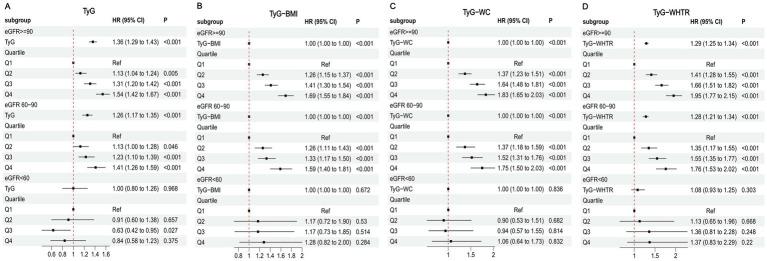
Over follow-up, 13,484 participants developed MI. Higher TyG indices were associated with increased MI risk; TyG-WHTR showed the strongest effect (Q4 vs. Q1, HR: 1.90, 95% CI: 1.76-2.06). Reduced eGFR (<60) was linked to higher MI risk (HR: 1.71, 95% CI: 1.51-1.93), as were short (<7 h; HR: 1.20, 95% CI: 1.11-1.29) and long (>9 h; HR: 1.43, 95% CI: 1.22-1.68) sleep durations. TyG-MI associations were significant in participants with preserved renal function (eGFR ≥60) and short/normal sleep. Mediation analyses revealed that eGFR and sleep duration partially mediated the associations between TyG indices and MI risk, and vice versa, indicating complex interrelations.
CONCLUSION
TyG-related indices are valuable predictors of MI risk, particularly in individuals with preserved renal function and typical sleep duration. The interplay among insulin resistance, renal function, and sleep patterns underscores the importance of integrated metabolic and lifestyle factors in cardiovascular risk stratification.
背景
心肌梗死(MI)仍是全球心血管疾病发病和死亡的主要原因。胰岛素抵抗、肾功能和睡眠时间是关键风险因素,然而它们对心肌梗死风险的综合影响尚未得到充分研究。
方法
在这项英国生物银行队列研究中,纳入了415757名参与者。Cox比例风险模型估计了甘油三酯-葡萄糖(TyG)指数(TyG、TyG-BMI、TyG-WC、TyG-WHTR)四分位数的心肌梗死风险的风险比(HRs),并按估算肾小球滤过率(eGFR)和睡眠时间类别进行分层。中介分析评估了TyG指数、eGFR、睡眠时间和心肌梗死之间的相互关系。
结果
在随访期间,13484名参与者发生了心肌梗死。较高的TyG指数与心肌梗死风险增加相关;TyG-WHTR显示出最强的影响(Q4与Q1相比,HR:1.90,95%CI:1.76-2.06)。估算肾小球滤过率降低(<60)与较高的心肌梗死风险相关(HR:1.71,95%CI:1.51-1.93),短睡眠时间(<7小时;HR:1.20,95%CI:1.11-1.29)和长睡眠时间(>9小时;HR:1.43,95%CI:1.22-1.68)也是如此。TyG与心肌梗死的关联在肾功能正常(eGFR≥60)和短/正常睡眠时间的参与者中显著。中介分析显示,eGFR和睡眠时间部分介导了TyG指数与心肌梗死风险之间的关联,反之亦然,表明存在复杂的相互关系。
结论
TyG相关指数是心肌梗死风险的重要预测指标,特别是在肾功能正常和睡眠时间正常的个体中。胰岛素抵抗、肾功能和睡眠模式之间的相互作用强调了综合代谢和生活方式因素在心血管风险分层中的重要性。


 Zotero 插件