
载脂蛋白E-ε4等位基因之外的淀粉样蛋白相关成像异常(ARIA)。
Amyloid-Related Imaging Abnormality (ARIA) Beyond the APOE-ε4 Allele.
作者信息
Besin Valentinus, Humardani Farizky Martriano, Yudiarto Fenny Lanawati, Ong Paulus Anam, Putra Sulistyo Emantoko Dwi, Ningrum Ratih Asmana
机构信息
Faculty of Medicine University of Surabaya Surabaya Indonesia.
Doctoral Program in Medical Science Faculty of Medicine Universitas Brawijaya Malang Indonesia.
出版信息
Chronic Dis Transl Med. 2025 Apr 24;11(3):186-196. doi: 10.1002/cdt3.70006. eCollection 2025 Sep.
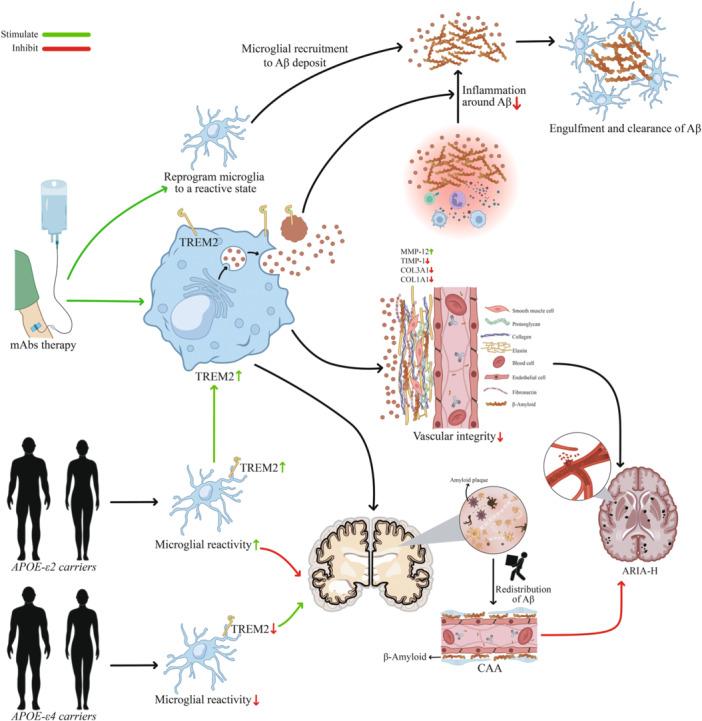
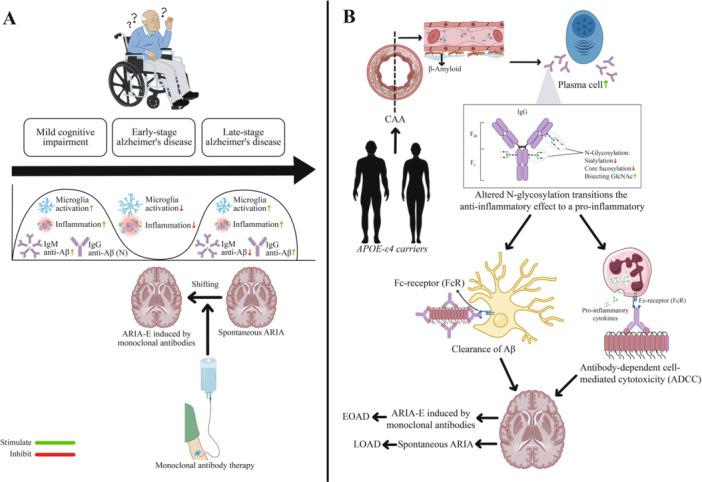
Monoclonal antibodies (mAbs) have made significant progress in the treatment of Alzheimer's disease (AD). However, mAbs are associated with adverse effects, including Amyloid-Related Imaging Abnormality (ARIA), which manifests as edema or effusion (ARIA-E) and hemorrhage (ARIA-H). The mechanisms behind these effects are not yet fully understood. Moreover, spontaneous ARIA has been insufficiently explored, and mAb therapies, particularly lecanemab, have mainly focused on patients with the allele carrier. This review aims to address this gap by examining the mechanisms of spontaneous ARIA, ARIA induced by mAbs, and the influence of genetic variants on ARIA development. The autoantibody-Aβ-mediated immune response targets excessive Aβ deposits, increasing immune activity through microglial reactivity. The heightened immune response, driven by Aβ accumulation in blood vessels, promotes angiopathy and inflammation, potentially contributing to spontaneous ARIA. The allele carrier is more strongly associated with ARIA-E because it redistributes Aβ deposition from the brain to blood vessels, influencing microglial reactivity. The redistribution enhances vascular integrity and reduces the risk of ARIA-H. However, it also increases the likelihood of ARIA-E due to Aβ accumulation in the vasculature, triggering inflammation. In contrast, the development of ARIA-H is linked to increased expression and microglial reactivity, leading to impaired vascular integrity and disrupted matrix remodeling, which worsens the condition. Additionally, the adverse effects of mAbs may extend beyond the allele, possibly impacting other genetic variants involved in microglial reactivity, Aβ redistribution, and vascular integrity.
单克隆抗体(mAbs)在阿尔茨海默病(AD)治疗方面取得了显著进展。然而,单克隆抗体与不良反应相关,包括淀粉样蛋白相关影像学异常(ARIA),其表现为水肿或积液(ARIA-E)和出血(ARIA-H)。这些效应背后的机制尚未完全了解。此外,自发性ARIA的研究尚不充分,单克隆抗体疗法,尤其是lecanemab,主要集中于携带该等位基因的患者。本综述旨在通过研究自发性ARIA的机制、单克隆抗体诱导的ARIA以及基因变异对ARIA发展的影响来填补这一空白。自身抗体-Aβ介导的免疫反应针对过量的Aβ沉积物,通过小胶质细胞反应性增加免疫活性。由血管中Aβ积累驱动的增强的免疫反应促进血管病变和炎症,可能导致自发性ARIA。携带该等位基因与ARIA-E的关联更强,因为它将Aβ沉积从大脑重新分布到血管,影响小胶质细胞反应性。这种重新分布增强了血管完整性并降低了ARIA-H的风险。然而,由于血管系统中Aβ积累引发炎症,它也增加了ARIA-E的可能性。相比之下,ARIA-H的发展与该基因表达增加和小胶质细胞反应性有关,导致血管完整性受损和基质重塑破坏,从而使病情恶化。此外,单克隆抗体的不良反应可能不仅限于该等位基因,可能还会影响参与小胶质细胞反应性、Aβ重新分布和血管完整性的其他基因变异。

 Zotero 插件