
心脏代谢疾病对从轻度认知障碍进展为痴呆症的影响:一项大型队列研究。
Impact of cardiometabolic conditions on the progression from mild cognitive impairment to dementia: A large cohort study.
作者信息
Anagnostakis Filippos, Kokkorakis Michail, Asvestis Christos, Papadimopoulos Ilias, Nagarajan Shrihari, Talbot Konrad, Li Lu, Chen Yong, Nasrallah Ilya M, Wen Junhao, Davatzikos Christos
机构信息
Artificial Intelligence in Biomedical Imaging Laboratory (AIBIL), Center for AI and Data Science for Integrated Diagnostics (AI2D), Perelman School of Medicine, University of Pennsylvania, Philadelphia, Pennsylvania, USA.
Laboratory of AI and Biomedical Science (LABS), Columbia University, New York, New York, USA.
出版信息
Alzheimers Dement. 2025 Sep;21(9):e70692. doi: 10.1002/alz.70692.
INTRODUCTION
This study investigates the impact of cardiometabolic conditions, including type 2 diabetes, hyperlipidemia, hypertension, and obesity, on the progression of mild cognitive impairment (MCI) to dementia.
METHODS
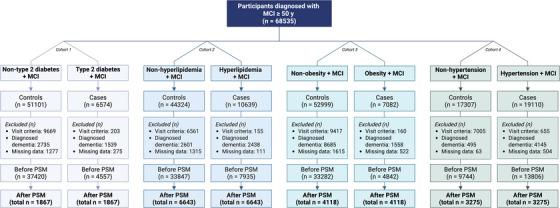
The cohort included adults ≥ 50 years old with MCI and a cardiometabolic condition identified through electronic health records. Propensity score matching was applied to control for confounders, and Kaplan-Meier analysis was used to assess time-to-event outcomes.
RESULTS
During a 7-year median follow-up, type 2 diabetes was associated with the highest risk of all-cause dementia (hazard ratio [HR] 1.18, 95% confidence interval [CI]: 1.06 to 1.31), followed by hypertension and hyperlipidemia. For vascular dementia, type 2 diabetes conferred the greatest risk (HR 1.33, 95% CI: 1.07 to 1.64). Hyperlipidemia was the sole cardiometabolic factor significantly associated with Alzheimer's disease (AD) risk (HR 1.21, 95% CI: 1.11 to 1.32).
CONCLUSIONS
Hyperlipidemia is primarily associated with AD dementia risk, while type 2 diabetes is the major contributor to vascular dementia and all-cause risk in individuals with MCI.
HIGHLIGHTS
Type 2 diabetes, hypertension, and hyperlipidemia are associated with a high risk of developing all-cause dementia in participants already diagnosed with mild cognitive impairment (MCI). Type 2 diabetes was shown to pose a high risk for the progression from MCI to vascular dementia. Hyperlipidemia was associated with Alzheimer's disease progression in individuals with MCI.
引言
本研究调查了包括2型糖尿病、高脂血症、高血压和肥胖在内的心脏代谢疾病对轻度认知障碍(MCI)进展为痴呆症的影响。
方法
该队列包括通过电子健康记录确定的年龄≥50岁且患有MCI和心脏代谢疾病的成年人。应用倾向得分匹配法控制混杂因素,并使用Kaplan-Meier分析评估事件发生时间结局。
结果
在中位7年的随访期间,2型糖尿病与全因痴呆症的最高风险相关(风险比[HR]1.18,95%置信区间[CI]:1.06至1.31),其次是高血压和高脂血症。对于血管性痴呆,2型糖尿病的风险最大(HR 1.33,95%CI:1.07至1.64)。高脂血症是与阿尔茨海默病(AD)风险显著相关的唯一心脏代谢因素(HR 1.21,95%CI:1.11至1.32)。
结论
高脂血症主要与AD痴呆症风险相关,而2型糖尿病是MCI患者血管性痴呆和全因风险的主要促成因素。
要点
2型糖尿病、高血压和高脂血症与已诊断为轻度认知障碍(MCI)的参与者发生全因痴呆症的高风险相关。2型糖尿病被证明是MCI进展为血管性痴呆的高风险因素。高脂血症与MCI患者的阿尔茨海默病进展相关。



 Zotero 插件