
SETD2和EZH2:前列腺癌的两种表观遗传驱动因素。
SETD2 and EZH2: Two epigenetic drivers of prostate cancer.
作者信息
Wang Jiamin, Xiang Longquan, Zhang Haiyan, Zhang Xiangyu
机构信息
School of Clinical Medicine, Shandong Second Medical University, Weifang, Shandong 261053, P.R. China.
Department of Pathology, Jining No.1 People's Hospital, Jining, Shandong 272000, P.R. China.
出版信息
J Cancer. 2025 Jul 28;16(12):3673-3683. doi: 10.7150/jca.115715. eCollection 2025.
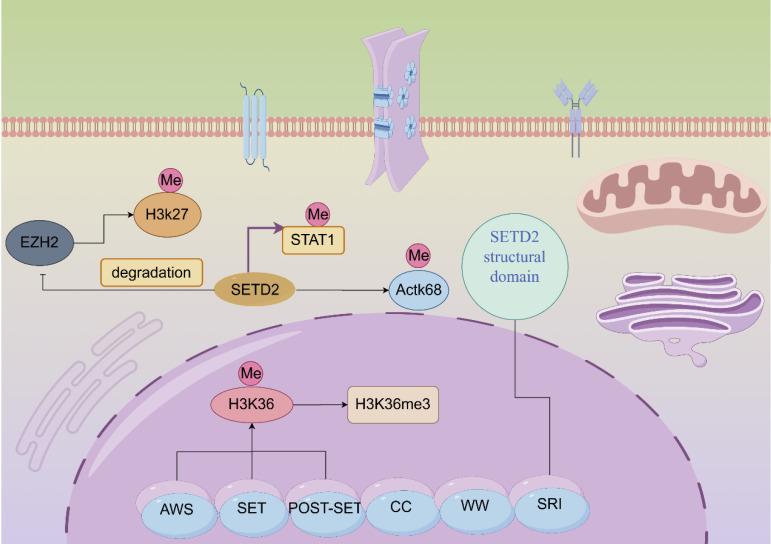
Prostate cancer is a prevalent malignancy among men, characterized by complex mechanisms underlying metastasis and treatment resistance. Epigenetic modifications play a crucial role in regulating prostate cancer progression, particularly involving histone methyltransferases such as SET-domain containing 2 (SETD2) and Enhancer of Zeste homolog 2 (EZH2). SETD2 contributes to chromatin stability by catalyzing the trimethylation of histone H3 lysine 36 (H3K36me3), and its downregulation is strongly correlated with increased invasiveness and epithelial-mesenchymal transition in prostate cancer. Conversely, EZH2, the catalytic subunit of Polycomb Repressive Complex 2, mediates gene silencing through H3K27me3 modification and is frequently overexpressed in advanced disease, promoting tumor metastasis and resistance to therapy. Notably, SETD2 regulates EZH2 stability through direct protein interactions, highlighting a coordinated epigenetic regulatory axis. Multi-omics studies have revealed that SETD2 loss induces aberrant DNA methylation and activates oncogenic signaling pathways, whereas EZH2 overexpression cooperates with PI3K-AKT pathway dysregulation to drive castration-resistant prostate cancer. Although inhibitors targeting SETD2 (e.g., EZM0414) and EZH2 (e.g., tazemetostat) demonstrate antitumor activity in preclinical models, their clinical efficacy remains constrained by drug resistance and tumor microenvironment heterogeneity. Emerging evidence suggests that combining epigenetic therapies with immunotherapy may enhance therapeutic outcomes. This review comprehensively systematically examines the molecular mechanisms underlying the SETD2/EZH2 axis in prostate cancer, providing a theoretical foundation for developing precision therapies based on SETD2- or EZH2-mediated epigenetic modifications.
前列腺癌是男性中一种常见的恶性肿瘤,其特征在于转移和治疗抗性背后的复杂机制。表观遗传修饰在调节前列腺癌进展中起关键作用,尤其涉及含SET结构域蛋白2(SETD2)和增强子结合蛋白2(EZH2)等组蛋白甲基转移酶。SETD2通过催化组蛋白H3赖氨酸36(H3K36me3)的三甲基化来促进染色质稳定性,其下调与前列腺癌侵袭性增加和上皮-间质转化密切相关。相反,EZH2是多梳抑制复合体2的催化亚基,通过H3K27me3修饰介导基因沉默,在晚期疾病中经常过度表达,促进肿瘤转移和治疗抗性。值得注意的是,SETD2通过直接蛋白质相互作用调节EZH2稳定性,突出了一个协调的表观遗传调控轴。多组学研究表明,SETD2缺失会诱导异常DNA甲基化并激活致癌信号通路,而EZH2过表达与PI3K-AKT通路失调协同驱动去势抵抗性前列腺癌。尽管靶向SETD2(如EZM0414)和EZH2(如他泽司他)的抑制剂在临床前模型中显示出抗肿瘤活性,但其临床疗效仍受耐药性和肿瘤微环境异质性的限制。新出现的证据表明,将表观遗传疗法与免疫疗法相结合可能会提高治疗效果。本综述全面系统地研究了前列腺癌中SETD2/EZH2轴的分子机制,为基于SETD2或EZH2介导的表观遗传修饰开发精准疗法提供了理论基础。

 Zotero 插件