
1990年至2023年期间,204个国家和地区(包括660个次国家级地区)375种疾病和损伤的负担、88种风险因素的风险归因负担以及健康预期寿命:全球疾病负担研究2023的系统分析
Burden of 375 diseases and injuries, risk-attributable burden of 88 risk factors, and healthy life expectancy in 204 countries and territories, including 660 subnational locations, 1990-2023: a systematic analysis for the Global Burden of Disease Study 2023.
出版信息
Lancet. 2025 Oct 18;406(10513):1873-1922. doi: 10.1016/S0140-6736(25)01637-X. Epub 2025 Oct 12.
BACKGROUND
For more than three decades, the Global Burden of Diseases, Injuries, and Risk Factors Study (GBD) has provided a framework to quantify health loss due to diseases, injuries, and associated risk factors. This paper presents GBD 2023 findings on disease and injury burden and risk-attributable health loss, offering a global audit of the state of world health to inform public health priorities. This work captures the evolving landscape of health metrics across age groups, sexes, and locations, while reflecting on the remaining post-COVID-19 challenges to achieving our collective global health ambitions.
METHODS
The GBD 2023 combined analysis estimated years lived with disability (YLDs), years of life lost (YLLs), and disability-adjusted life-years (DALYs) for 375 diseases and injuries, and risk-attributable burden associated with 88 modifiable risk factors. Of the more than 310 000 total data sources used for all GBD 2023 (about 30% of which were new to this estimation round), more than 120 000 sources were used for estimation of disease and injury burden and 59 000 for risk factor estimation, and included vital registration systems, surveys, disease registries, and published scientific literature. Data were analysed using previously established modelling approaches, such as disease modelling meta-regression version 2.1 (DisMod-MR 2.1) and comparative risk assessment methods. Diseases and injuries were categorised into four levels on the basis of the established GBD cause hierarchy, as were risk factors using the GBD risk hierarchy. Estimates stratified by age, sex, location, and year from 1990 to 2023 were focused on disease-specific time trends over the 2010-23 period and presented as counts (to three significant figures) and age-standardised rates per 100 000 person-years (to one decimal place). For each measure, 95% uncertainty intervals [UIs] were calculated with the 2·5th and 97·5th percentile ordered values from a 250-draw distribution.
FINDINGS
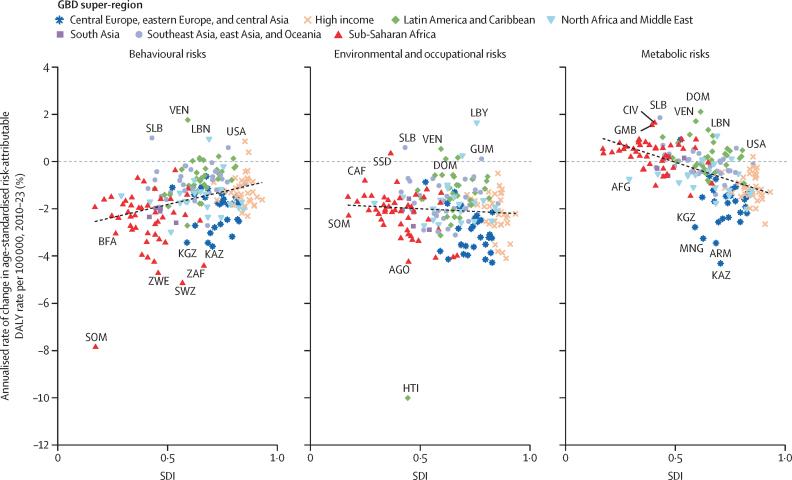
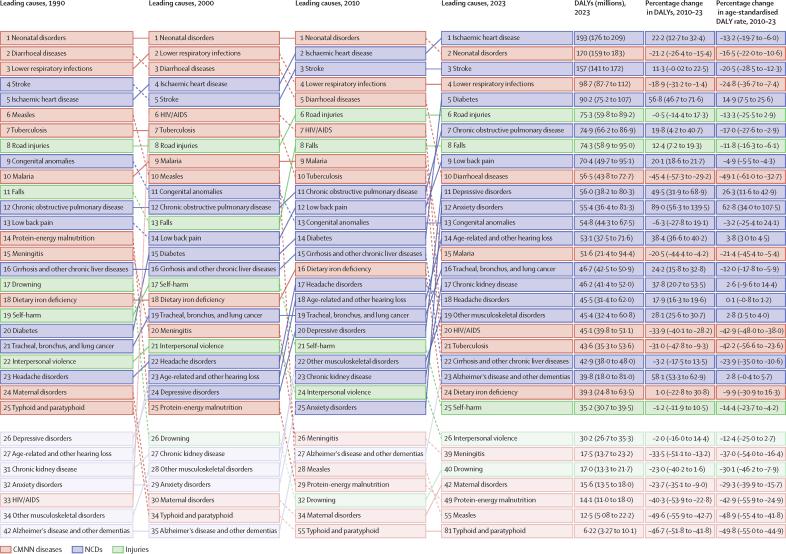
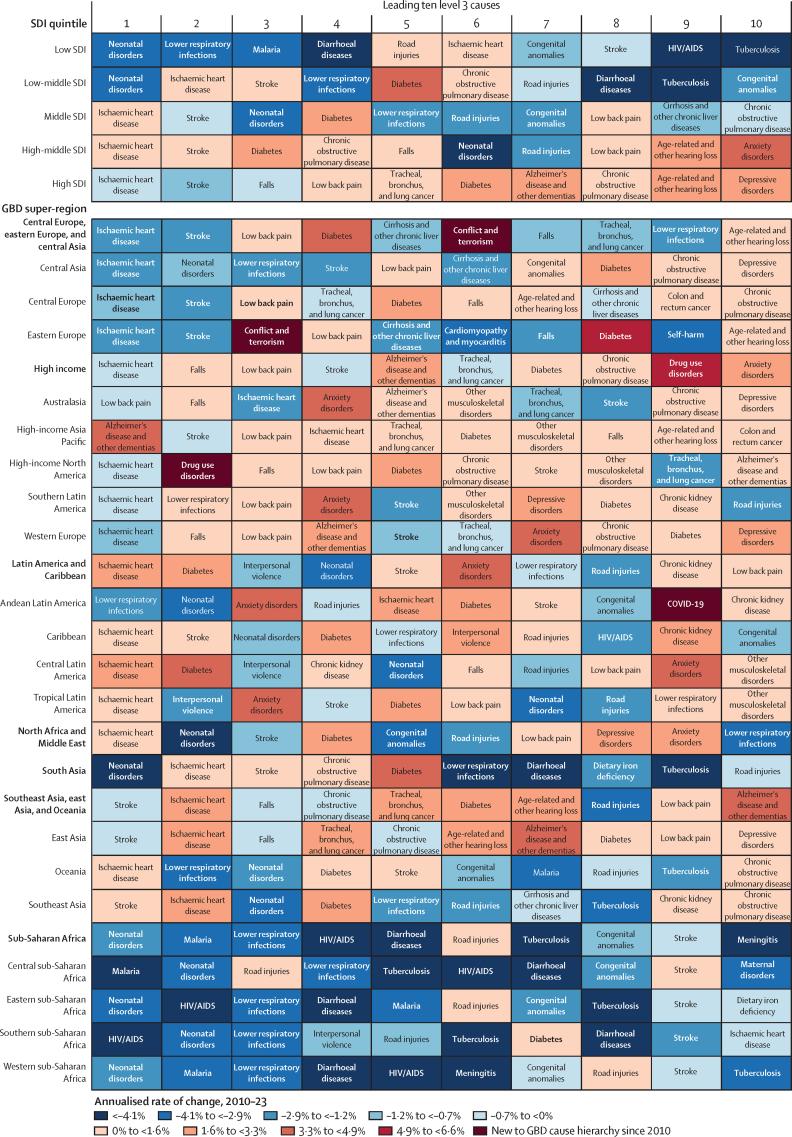
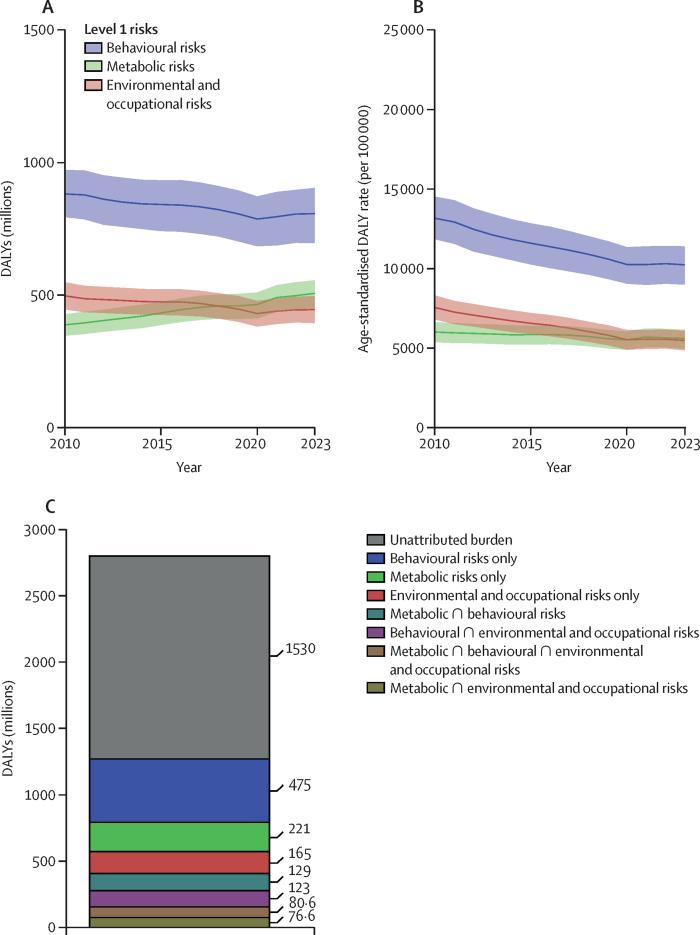
Total numbers of global DALYs grew 6·1% (95% UI 4·0-8·1), from 2·64 billion (2·46-2·86) in 2010 to 2·80 billion (2·57-3·08) in 2023, but age-standardised DALY rates, which account for population growth and ageing, decreased by 12·6% (11·0-14·1), revealing large long-term health improvements. Non-communicable diseases (NCDs) contributed 1·45 billion (1·31-1·61) global DALYs in 2010, increasing to 1·80 billion (1·63-2·03) in 2023, alongside a concurrent 4·1% (1·9-6·3) reduction in age-standardised rates. Based on DALY counts, the leading level 3 NCDs in 2023 were ischaemic heart disease (193 million [176-209] DALYs), stroke (157 million [141-172]), and diabetes (90·2 million [75·2-107]), with the largest increases in age-standardised rates since 2010 occurring for anxiety disorders (62·8% [34·0-107·5]), depressive disorders (26·3% [11·6-42·9]), and diabetes (14·9% [7·5-25·6]). Remarkable health gains were made for communicable, maternal, neonatal, and nutritional (CMNN) diseases, with DALYs falling from 874 million (837-917) in 2010 to 681 million (642-736) in 2023, and a 25·8% (22·6-28·7) reduction in age-standardised DALY rates. During the COVID-19 pandemic, DALYs due to CMNN diseases rose but returned to pre-pandemic levels by 2023. From 2010 to 2023, decreases in age-standardised rates for CMNN diseases were led by rate decreases of 49·1% (32·7-61·0) for diarrhoeal diseases, 42·9% (38·0-48·0) for HIV/AIDS, and 42·2% (23·6-56·6) for tuberculosis. Neonatal disorders and lower respiratory infections remained the leading level 3 CMNN causes globally in 2023, although both showed notable rate decreases from 2010, declining by 16·5% (10·6-22·0) and 24·8% (7·4-36·7), respectively. Injury-related age-standardised DALY rates decreased by 15·6% (10·7-19·8) over the same period. Differences in burden due to NCDs, CMNN diseases, and injuries persisted across age, sex, time, and location. Based on our risk analysis, nearly 50% (1·27 billion [1·18-1·38]) of the roughly 2·80 billion total global DALYs in 2023 were attributable to the 88 risk factors analysed in GBD. Globally, the five level 3 risk factors contributing the highest proportion of risk-attributable DALYs were high systolic blood pressure (SBP), particulate matter pollution, high fasting plasma glucose (FPG), smoking, and low birthweight and short gestation-with high SBP accounting for 8·4% (6·9-10·0) of total DALYs. Of the three overarching level 1 GBD risk factor categories-behavioural, metabolic, and environmental and occupational-risk-attributable DALYs rose between 2010 and 2023 only for metabolic risks, increasing by 30·7% (24·8-37·3); however, age-standardised DALY rates attributable to metabolic risks decreased by 6·7% (2·0-11·0) over the same period. For all but three of the 25 leading level 3 risk factors, age-standardised rates dropped between 2010 and 2023-eg, declining by 54·4% (38·7-65·3) for unsafe sanitation, 50·5% (33·3-63·1) for unsafe water source, and 45·2% (25·6-72·0) for no access to handwashing facility, and by 44·9% (37·3-53·5) for child growth failure. The three leading level 3 risk factors for which age-standardised attributable DALY rates rose were high BMI (10·5% [0·1 to 20·9]), drug use (8·4% [2·6 to 15·3]), and high FPG (6·2% [-2·7 to 15·6]; non-significant).
INTERPRETATION
Our findings underscore the complex and dynamic nature of global health challenges. Since 2010, there have been large decreases in burden due to CMNN diseases and many environmental and behavioural risk factors, juxtaposed with sizeable increases in DALYs attributable to metabolic risk factors and NCDs in growing and ageing populations. This long-observed consequence of the global epidemiological transition was only temporarily interrupted by the COVID-19 pandemic. The substantially decreasing CMNN disease burden, despite the 2008 global financial crisis and pandemic-related disruptions, is one of the greatest collective public health successes known. However, these achievements are at risk of being reversed due to major cuts to development assistance for health globally, the effects of which will hit low-income countries with high burden the hardest. Without sustained investment in evidence-based interventions and policies, progress could stall or reverse, leading to widespread human costs and geopolitical instability. Moreover, the rising NCD burden necessitates intensified efforts to mitigate exposure to leading risk factors-eg, air pollution, smoking, and metabolic risks, such as high SBP, BMI, and FPG-including policies that promote food security, healthier diets, physical activity, and equitable and expanded access to potential treatments, such as GLP-1 receptor agonists. Decisive, coordinated action is needed to address long-standing yet growing health challenges, including depressive and anxiety disorders. Yet this can be only part of the solution. Our response to the NCD syndemic-the complex interaction of multiple health risks, social determinants, and systemic challenges-will define the future landscape of global health. To ensure human wellbeing, economic stability, and social equity, global action to sustain and advance health gains must prioritise reducing disparities by addressing socioeconomic and demographic determinants, ensuring equitable health-care access, tackling malnutrition, strengthening health systems, and improving vaccination coverage. We live in times of great opportunity.
FUNDING
Gates Foundation and Bloomberg Philanthropies.
背景
三十多年来,全球疾病、伤害及风险因素负担研究(GBD)提供了一个框架,用于量化因疾病、伤害及相关风险因素导致的健康损失。本文展示了GBD 2023关于疾病和伤害负担以及风险归因健康损失的研究结果,对世界卫生状况进行了全球审查,以为公共卫生重点工作提供参考。这项工作呈现了不同年龄组、性别和地区健康指标的演变态势,同时思考了后新冠疫情时代在实现全球共同健康目标方面仍面临的挑战。
方法
GBD 2023综合分析估计了375种疾病和伤害的残疾调整生命年(YLDs)、生命损失年数(YLLs)和伤残调整生命年(DALYs),以及与88种可改变风险因素相关的风险归因负担。在用于所有GBD 2023的超过31万个总数据源中(约30%是本轮估计新增的),超过12万个数据源用于疾病和伤害负担估计,5.9万个用于风险因素估计,包括生命登记系统、调查、疾病登记处和已发表的科学文献。数据使用先前建立的建模方法进行分析,如疾病建模元回归版本2.1(DisMod-MR 2.1)和比较风险评估方法。疾病和伤害根据既定的GBD病因层次分为四个级别,风险因素也根据GBD风险层次进行分类。按年龄、性别、地区和1990年至2023年的年份分层的估计重点关注2010 - 23年期间特定疾病的时间趋势,并以计数(保留三位有效数字)和每10万人年的年龄标准化率(保留一位小数)呈现。对于每个指标,95%不确定性区间[UIs]根据250次抽样分布的第2.5百分位数和第97.5百分位数排序值计算得出。
结果
全球DALYs总数增长了6.1%(95% UI 4.0 - 8.1),从2010年的26.4亿(24.6 - 28.6)增至2023年的28.0亿(25.7 - 30.8),但考虑到人口增长和老龄化的年龄标准化DALY率下降了12.6%(11.0 - 14.1),显示出长期健康状况有大幅改善。2010年非传染性疾病(NCDs)导致全球14.5亿(13.1 - 16.1)DALYs,2023年增至18.0亿(16.3 - 20.3),同时年龄标准化率下降了4.1%(1.9 - 6.3)。基于DALY计数,2023年3级主要NCDs为缺血性心脏病(1.93亿[1.76 - 2.09] DALYs)、中风(1.57亿[1.41 - 1.72])和糖尿病(9020万[7520 - 1.07]),自2010年以来年龄标准化率增长最大的是焦虑症(62.8%[34.0 - 107.5])、抑郁症(26.3%[11.6 - 42.9])和糖尿病(14.9%[7.5 - 25.6])。传染病、孕产妇、新生儿和营养性(CMNN)疾病取得了显著的健康改善,DALYs从2010年的8.74亿(8.37 - 9.17)降至2023年的6.81亿(6.42 - 7.36),年龄标准化DALY率下降了25.8%(22.6 - 28.7)。在新冠疫情期间,CMNN疾病导致的DALYs上升,但到2023年恢复到疫情前水平。2010年至2023年,CMNN疾病年龄标准化率下降主要是由于腹泻病下降了49.1%(32.7 - 61.0)、艾滋病毒/艾滋病下降了42.9%(38.0 - 48.0)、结核病下降了42.2%(23.6 - 56.6)。新生儿疾病和下呼吸道感染在2023年仍是全球主要的3级CMNN病因,尽管两者自2010年以来率均显著下降,分别下降了16.5%(10.6 - 22.0)和24.8%(7.4 - 36.7)。同期,与伤害相关的年龄标准化DALY率下降了15.6%(10.7 - 19.8)。NCDs、CMNN疾病和伤害造成的负担在年龄、性别、时间和地区上存在差异。基于我们的风险分析,2023年全球约28.0亿总DALYs中近50%(12.7亿[11.8 - 13.8])可归因于GBD分析的88种风险因素。全球范围内,导致风险归因DALYs比例最高的5种3级风险因素是收缩压升高(SBP)、颗粒物污染、空腹血糖升高(FPG)、吸烟以及低出生体重和早产,其中收缩压升高占总DALYs的8.4%(6.9 - 10.0)。在GBD的三个主要1级风险因素类别——行为、代谢以及环境和职业因素中,2010年至2023年期间仅代谢风险导致的风险归因DALYs有所上升,增加了30.7%(24.8 - 37.3);然而,同期代谢风险导致的年龄标准化DALY率下降了6.7%(2.0 - 11.0)。在25个主要3级风险因素中,除了三个因素外,2010年至2023年期间年龄标准化率均下降,例如不安全卫生设施下降了54.4%(38.7 - 65.3)、不安全水源下降了50.5%(33.3 - 63.1)、无法使用洗手设施下降了45.2%(25.6 - 72.0),儿童生长发育不良下降了44.9%(37.3 - 53.5)。年龄标准化归因DALY率上升的三个主要3级风险因素是高体重指数(BMI)(10.5%[0.1至20.9])、药物使用(8.4%[2.6至15.3])和高FPG(6.2%[-2.7至15.6];不显著)。
解读
我们的研究结果强调了全球健康挑战的复杂性和动态性。自2010年以来,CMNN疾病以及许多环境和行为风险因素导致的负担大幅下降,与此同时,在不断增长和老龄化的人口中,代谢风险因素和NCDs导致的DALYs大幅增加。这种全球流行病学转变长期以来的结果仅因新冠疫情而暂时中断。尽管经历了2008年全球金融危机和疫情相关干扰,CMNN疾病负担大幅下降是已知的最大公共卫生集体成功之一。然而,由于全球卫生发展援助大幅削减,这些成就面临逆转风险,其影响将对负担沉重的低收入国家打击最大。如果不对基于证据的干预措施和政策持续投资,进展可能停滞或逆转,导致广泛的人力成本和地缘政治不稳定。此外,NCD负担不断上升,需要加大力度减少接触主要风险因素,如空气污染、吸烟以及代谢风险,如高SBP、BMI和FPG,包括促进粮食安全、更健康饮食、体育活动以及公平和扩大获取潜在治疗方法(如胰高血糖素样肽-1受体激动剂)的政策。需要采取果断、协调一致的行动来应对长期存在且不断增加的健康挑战,包括抑郁症和焦虑症。然而,这只是解决方案的一部分。我们对NCD综合征(多种健康风险、社会决定因素和系统性挑战的复杂相互作用)的应对将决定全球健康的未来格局。为确保人类福祉、经济稳定和社会公平,维持和推进健康成果的全球行动必须优先通过解决社会经济和人口决定因素来减少差距,确保公平获得医疗保健,解决营养不良问题,加强卫生系统,并提高疫苗接种覆盖率。我们生活在充满巨大机遇的时代。
资金来源
盖茨基金会和彭博慈善基金会。





 Zotero 插件