
通过光氧化还原催化开启难以捉摸的有机金属机制。
Switching on elusive organometallic mechanisms with photoredox catalysis.
作者信息
Terrett Jack A, Cuthbertson James D, Shurtleff Valerie W, MacMillan David W C
机构信息
Merck Center for Catalysis at Princeton University, Princeton, New Jersey 08544, USA.
出版信息
Nature. 2015 Aug 20;524(7565):330-4. doi: 10.1038/nature14875. Epub 2015 Aug 12.
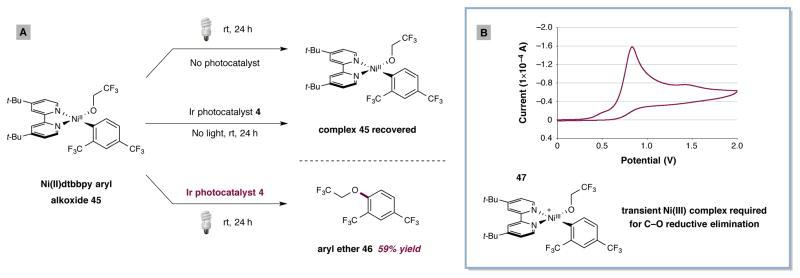
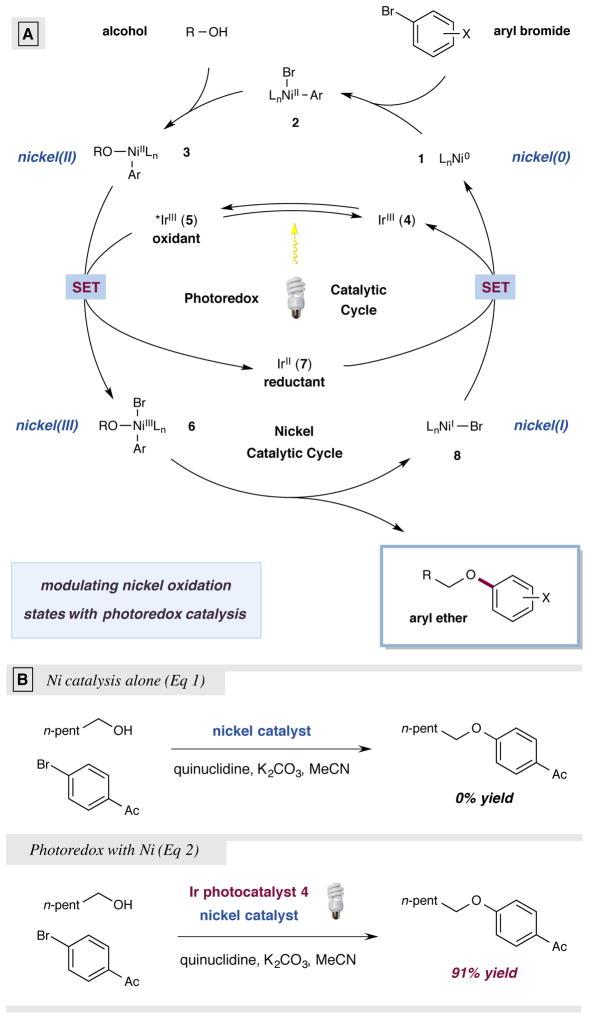
Transition-metal-catalysed cross-coupling reactions have become one of the most used carbon-carbon and carbon-heteroatom bond-forming reactions in chemical synthesis. Recently, nickel catalysis has been shown to participate in a wide variety of C-C bond-forming reactions, most notably Negishi, Suzuki-Miyaura, Stille, Kumada and Hiyama couplings. Despite the tremendous advances in C-C fragment couplings, the ability to forge C-O bonds in a general fashion via nickel catalysis has been largely unsuccessful. The challenge for nickel-mediated alcohol couplings has been the mechanistic requirement for the critical C-O bond-forming step (formally known as the reductive elimination step) to occur via a Ni(III) alkoxide intermediate. Here we demonstrate that visible-light-excited photoredox catalysts can modulate the preferred oxidation states of nickel alkoxides in an operative catalytic cycle, thereby providing transient access to Ni(III) species that readily participate in reductive elimination. Using this synergistic merger of photoredox and nickel catalysis, we have developed a highly efficient and general carbon-oxygen coupling reaction using abundant alcohols and aryl bromides. More notably, we have developed a general strategy to 'switch on' important yet elusive organometallic mechanisms via oxidation state modulations using only weak light and single-electron-transfer catalysts.
过渡金属催化的交叉偶联反应已成为化学合成中最常用的碳-碳和碳-杂原子成键反应之一。最近,镍催化已被证明可参与多种碳-碳成键反应,最显著的是根岸偶联、铃木-宫浦偶联、施蒂勒偶联、熊田偶联和日山偶联。尽管碳-碳片段偶联取得了巨大进展,但通过镍催化以通用方式形成碳-氧键的能力在很大程度上并不成功。镍介导的醇偶联面临的挑战在于关键的碳-氧键形成步骤(正式称为还原消除步骤)需要通过镍(III)醇盐中间体发生的机理要求。在此,我们证明可见光激发的光氧化还原催化剂可以在操作催化循环中调节镍醇盐的优先氧化态,从而提供对易于参与还原消除的镍(III)物种的瞬态 access。利用这种光氧化还原和镍催化的协同结合,我们开发了一种使用丰富的醇和芳基溴的高效通用碳-氧偶联反应。更值得注意的是,我们开发了一种通用策略,仅使用弱光和单电子转移催化剂,通过氧化态调制来“开启”重要但难以捉摸的有机金属机理。


 Zotero 插件