
中国武汉严重 COVID-19 患者的临床病程和结局:一项单中心、回顾性、观察性研究。
Clinical course and outcomes of critically ill patients with SARS-CoV-2 pneumonia in Wuhan, China: a single-centered, retrospective, observational study.
机构信息
Department of Critical Care Medicine, Tongji Medical College, Huazhong University of Science and Technology, Wuhan, China; Institute of Anesthesiology and Critical Care Medicine, Tongji Medical College, Huazhong University of Science and Technology, Wuhan, China; Jin Yin-tan Hospital, Wuhan, China.
Department of Critical Care Medicine, Tongji Medical College, Huazhong University of Science and Technology, Wuhan, China; Institute of Anesthesiology and Critical Care Medicine, Tongji Medical College, Huazhong University of Science and Technology, Wuhan, China.
出版信息
Lancet Respir Med. 2020 May;8(5):475-481. doi: 10.1016/S2213-2600(20)30079-5. Epub 2020 Feb 24.
BACKGROUND
An ongoing outbreak of pneumonia associated with the severe acute respiratory coronavirus 2 (SARS-CoV-2) started in December, 2019, in Wuhan, China. Information about critically ill patients with SARS-CoV-2 infection is scarce. We aimed to describe the clinical course and outcomes of critically ill patients with SARS-CoV-2 pneumonia.
METHODS
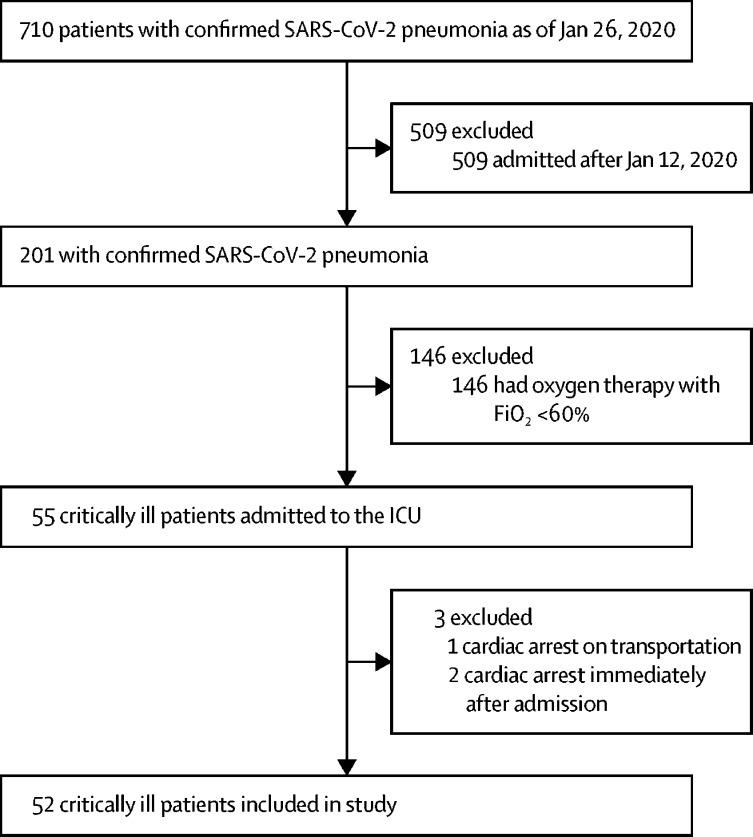
In this single-centered, retrospective, observational study, we enrolled 52 critically ill adult patients with SARS-CoV-2 pneumonia who were admitted to the intensive care unit (ICU) of Wuhan Jin Yin-tan hospital (Wuhan, China) between late December, 2019, and Jan 26, 2020. Demographic data, symptoms, laboratory values, comorbidities, treatments, and clinical outcomes were all collected. Data were compared between survivors and non-survivors. The primary outcome was 28-day mortality, as of Feb 9, 2020. Secondary outcomes included incidence of SARS-CoV-2-related acute respiratory distress syndrome (ARDS) and the proportion of patients requiring mechanical ventilation.
FINDINGS
Of 710 patients with SARS-CoV-2 pneumonia, 52 critically ill adult patients were included. The mean age of the 52 patients was 59·7 (SD 13·3) years, 35 (67%) were men, 21 (40%) had chronic illness, 51 (98%) had fever. 32 (61·5%) patients had died at 28 days, and the median duration from admission to the intensive care unit (ICU) to death was 7 (IQR 3-11) days for non-survivors. Compared with survivors, non-survivors were older (64·6 years [11·2] vs 51·9 years [12·9]), more likely to develop ARDS (26 [81%] patients vs 9 [45%] patients), and more likely to receive mechanical ventilation (30 [94%] patients vs 7 [35%] patients), either invasively or non-invasively. Most patients had organ function damage, including 35 (67%) with ARDS, 15 (29%) with acute kidney injury, 12 (23%) with cardiac injury, 15 (29%) with liver dysfunction, and one (2%) with pneumothorax. 37 (71%) patients required mechanical ventilation. Hospital-acquired infection occurred in seven (13·5%) patients.
INTERPRETATION
The mortality of critically ill patients with SARS-CoV-2 pneumonia is considerable. The survival time of the non-survivors is likely to be within 1-2 weeks after ICU admission. Older patients (>65 years) with comorbidities and ARDS are at increased risk of death. The severity of SARS-CoV-2 pneumonia poses great strain on critical care resources in hospitals, especially if they are not adequately staffed or resourced.
FUNDING
None.
背景
自 2019 年 12 月以来,中国武汉爆发了与严重急性呼吸冠状病毒 2(SARS-CoV-2)相关的肺炎疫情。有关重症 SARS-CoV-2 感染患者的信息很少。本研究旨在描述重症 SARS-CoV-2 肺炎患者的临床病程和结局。
方法
在这项单中心、回顾性、观察性研究中,我们纳入了 52 例于 2019 年 12 月下旬至 2019 年 1 月 26 日期间入住中国武汉金银潭医院重症监护病房(ICU)的重症成年 SARS-CoV-2 肺炎患者。收集了人口统计学数据、症状、实验室值、合并症、治疗和临床结局。比较了幸存者和非幸存者之间的数据。主要结局为截至 2020 年 2 月 9 日的 28 天死亡率。次要结局包括 SARS-CoV-2 相关急性呼吸窘迫综合征(ARDS)的发生率和需要机械通气的患者比例。
结果
在 710 例 SARS-CoV-2 肺炎患者中,纳入了 52 例重症成年患者。52 例患者的平均年龄为 59.7(13.3)岁,35 例(67%)为男性,21 例(40%)患有慢性疾病,51 例(98%)有发热。28 天病死率为 61.5%(32/52),非幸存者从入 ICU 到死亡的中位时间为 7(IQR 3-11)天。与幸存者相比,非幸存者年龄更大(64.6 岁[11.2] vs. 51.9 岁[12.9]),更易发生 ARDS(26[81%] vs. 9[45%]),更易接受机械通气(30[94%] vs. 7[35%]),无论是有创还是无创。大多数患者存在器官功能损伤,包括 35 例(67%)ARDS、15 例(29%)急性肾损伤、12 例(23%)心肌损伤、15 例(29%)肝功能异常和 1 例(2%)气胸。37 例(71%)患者需要机械通气。7 例(13.5%)患者发生医院获得性感染。
结论
重症 SARS-CoV-2 肺炎患者的死亡率相当高。非幸存者的存活时间可能在 ICU 入院后 1-2 周内。有合并症和 ARDS 的老年(>65 岁)患者死亡风险增加。SARS-CoV-2 肺炎的严重程度对医院的重症监护资源造成了巨大压力,特别是如果这些资源配备不足或没有得到充分利用。
资金
无。

 Zotero 插件