
鉴定由人类组织相容性抗原(HLA)-DRB4*0101-0103呈递、并被表达NY-ESO-1的黑色素瘤患者的CD4(+) T淋巴细胞识别的NY-ESO-1表位。
Identification of NY-ESO-1 epitopes presented by human histocompatibility antigen (HLA)-DRB4*0101-0103 and recognized by CD4(+) T lymphocytes of patients with NY-ESO-1-expressing melanoma.
作者信息
Jäger E, Jäger D, Karbach J, Chen Y T, Ritter G, Nagata Y, Gnjatic S, Stockert E, Arand M, Old L J, Knuth A
机构信息
Medizinische Klinik II, Hämatologie-Onkologie, Krankenhaus Nordwest, 60488 Frankfurt, Germany.
出版信息
J Exp Med. 2000 Feb 21;191(4):625-30. doi: 10.1084/jem.191.4.625.
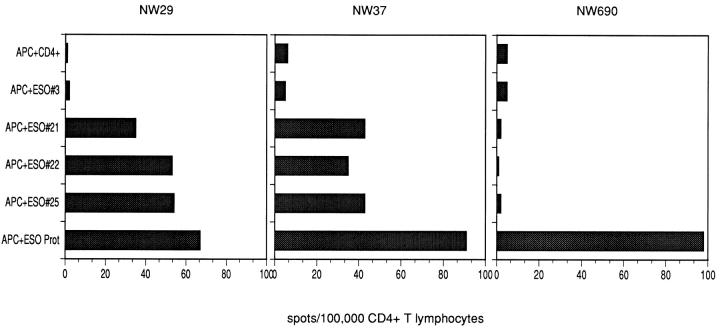
NY-ESO-1 is a member of the cancer-testis family of tumor antigens that elicits strong humoral and cellular immune responses in patients with NY-ESO-1-expressing cancers. Since CD4(+) T lymphocytes play a critical role in generating antigen-specific cytotoxic T lymphocyte and antibody responses, we searched for NY-ESO-1 epitopes presented by histocompatibility leukocyte antigen (HLA) class II molecules. Autologous monocyte-derived dendritic cells of cancer patients were incubated with recombinant NY-ESO-1 protein and used in enzyme-linked immunospot (ELISPOT) assays to detect NY-ESO-1-specific CD4(+) T lymphocyte responses. To identify possible epitopes presented by distinct HLA class II alleles, overlapping 18-mer peptides derived from NY-ESO-1 were synthetized and tested for recognition by CD4(+) T lymphocytes in autologous settings. We identified three NY-ESO-1-derived peptides presented by DRB4*0101-0103 and recognized by CD4(+) T lymphocytes of two melanoma patients sharing these HLA class II alleles. Specificity of recognition was confirmed by proliferation assays. The characterization of HLA class II-restricted epitopes will be useful for the assessment of spontaneous and vaccine-induced immune responses of cancer patients against defined tumor antigens. Further, the therapeutic efficacy of active immunization using antigenic HLA class I-restricted peptides may be improved by adding HLA class II-presented epitopes.
NY-ESO-1是肿瘤抗原癌胚抗原家族的成员,在表达NY-ESO-1的癌症患者中可引发强烈的体液免疫和细胞免疫反应。由于CD4(+) T淋巴细胞在产生抗原特异性细胞毒性T淋巴细胞和抗体反应中起关键作用,我们寻找了由组织相容性白细胞抗原(HLA)II类分子呈递的NY-ESO-1表位。将癌症患者的自体单核细胞衍生的树突状细胞与重组NY-ESO-1蛋白孵育,并用于酶联免疫斑点(ELISPOT)分析,以检测NY-ESO-1特异性CD4(+) T淋巴细胞反应。为了鉴定由不同HLA II类等位基因呈递的可能表位,合成了源自NY-ESO-1的重叠18聚体肽,并在自体环境中测试其被CD4(+) T淋巴细胞识别的情况。我们鉴定出由DRB4*0101 - 0103呈递且被两名共享这些HLA II类等位基因的黑色素瘤患者的CD4(+) T淋巴细胞识别的三种源自NY-ESO-1的肽。通过增殖分析证实了识别的特异性。HLA II类限制性表位的表征将有助于评估癌症患者针对特定肿瘤抗原的自发免疫反应和疫苗诱导的免疫反应。此外,通过添加HLA II类呈递的表位,使用抗原性HLA I类限制性肽进行主动免疫的治疗效果可能会得到改善。
 Zotero 插件