
传统肩关节造影磁共振成像与外展外旋肩关节造影磁共振成像在显示肩胛下盂唇前下撕裂方面的比较。
Comparison between conventional MR arthrography and abduction and external rotation MR arthrography in revealing tears of the antero-inferior glenoid labrum.
作者信息
Choi J A, Suh S I, Kim B H, Cha S H, Kim M G, Lee K Y, Lee C H
机构信息
Department of Radiology, College of Medicine, Korea University Guro Hospital, Korea.
出版信息
Korean J Radiol. 2001 Oct-Dec;2(4):216-21. doi: 10.3348/kjr.2001.2.4.216.
OBJECTIVE
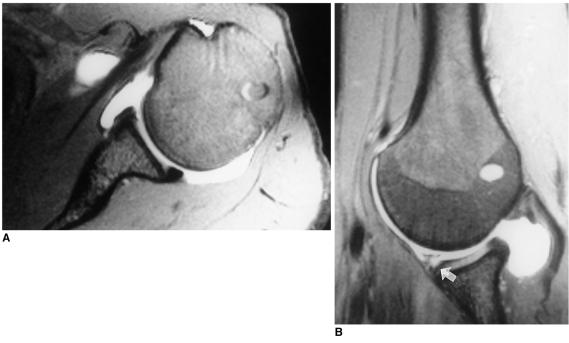
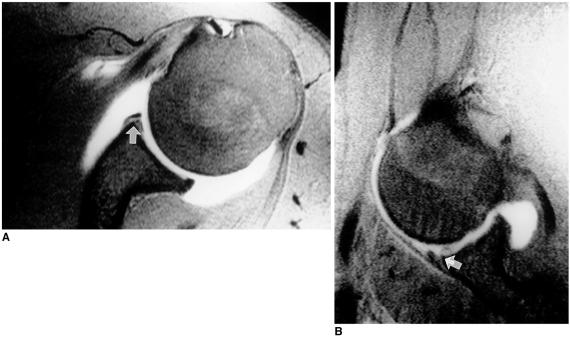
To compare, in terms of their demonstration of tears of the anterior glenoid labrum, oblique axial MR arthrography obtained with the patient's shoulder in the abduction and external rotation (ABER) position, with conventional axial MR arthrography obtained with the patient's arm in the neutral position.
MATERIALS AND METHODS
MR arthrography of the shoulder, including additional oblique axial sequences with the patient in the ABER position, was performed in 30 patients with a clinical history of recurrent anterior shoulder dislocation. The degree of anterior glenoid labral tear or defect was evaluated in both the conventional axial and the ABER position by two radiologists. Decisions were reached by consensus, and a three-point scale was used: grade 1=normal; grade 2=probable tear, diagnosed when subtle increased signal intensity in the labrum was apparent; grade 3=definite tear/defect, when a contrast material-filled gap between the labrum and the glenoid rim or deficient labrum was present. The scores for each imaging sequence were averaged and to compare conventional axial and ABER position scans, Student's t test was performed.
RESULTS
In 21 (70%) of 30 patients, the same degree of anterior instability was revealed by both imaging sequences. Eight (27%) had a lower grade in the axial position than in the ABER position, while one (3%) had a higher grade in the axial position. Three whose axial scan was grade 1 showed only equivocal evidence of tearing, but their ABER-position scan, in which a contrast material-filled gap between the labrum and the glenoid rim was present, was grade 3. The average grade was 2.5 (SD=0.73) for axial scans and 2.8 (SD=0.46) for the ABER position. The difference between axial and ABER-position scans was statistically significant (p<0.05).
CONCLUSION
MR arthrography with the patient's shoulder in the ABER position is more efficient than conventional axial scanning in revealing the degree of tear or defect of the anterior glenoid labrum. When equivocal features are seen at conventional axial MR arthrography, oblique axial imaging in the ABER position is helpful.
目的
比较患者肩部处于外展和外旋(ABER)位时获得的斜轴位磁共振关节造影与患者手臂处于中立位时获得的传统轴位磁共振关节造影在前盂唇撕裂显示方面的差异。
材料与方法
对30例有复发性前肩关节脱位临床病史的患者进行了肩部磁共振关节造影,包括患者处于ABER位时的额外斜轴位序列。由两名放射科医生在传统轴位和ABER位评估前盂唇撕裂或缺损的程度。通过共识达成决定,并使用三分制:1级=正常;2级=可能撕裂,当盂唇内信号强度轻微增加时诊断;3级=明确撕裂/缺损,当盂唇与关节盂边缘之间存在造影剂填充间隙或盂唇缺损时。对每个成像序列的评分进行平均,并对传统轴位和ABER位扫描进行比较,采用Student t检验。
结果
30例患者中有21例(70%)两种成像序列显示相同程度的前向不稳定。8例(27%)在轴位的分级低于ABER位,而1例(3%)在轴位的分级较高。3例轴位扫描为1级的患者仅显示撕裂的可疑证据,但他们在ABER位的扫描显示盂唇与关节盂边缘之间存在造影剂填充间隙,为3级。轴位扫描的平均分级为2.5(标准差=0.73),ABER位为2.8(标准差=0.46)。轴位和ABER位扫描之间的差异具有统计学意义(p<0.05)。
结论
患者肩部处于ABER位时的磁共振关节造影在显示前盂唇撕裂或缺损程度方面比传统轴位扫描更有效。当传统轴位磁共振关节造影出现可疑特征时,ABER位的斜轴位成像有帮助。


 Zotero 插件