
气道上皮细胞对铜绿假单胞菌的耐受性。
Airway epithelial cell tolerance to Pseudomonas aeruginosa.
作者信息
Wu Qi, Lu Zhong, Verghese Margrith W, Randell Scott H
机构信息
Cystic Fibrosis/Pulmonary Research and Treatment Center, Department of Medicine, The University of North Carolina, Chapel Hill, NC 27599, USA.
出版信息
Respir Res. 2005 Apr 1;6(1):26. doi: 10.1186/1465-9921-6-26.
BACKGROUND
The respiratory tract epithelium is a critical environmental interface that regulates inflammation. In chronic infectious airway diseases, pathogens may permanently colonize normally sterile luminal environments. Host-pathogen interactions determine the intensity of inflammation and thus, rates of tissue injury. Although many cells become refractory to stimulation by pathogen products, it is unknown whether the airway epithelium becomes either tolerant or hypersensitive in the setting of chronic infection. Our goals were to characterize the response of well-differentiated primary human tracheobronchial epithelial cells to Pseudomonas aeruginosa, to understand whether repeated exposure induced tolerance and, if so, to explore the mechanism(s).
METHODS
The apical surface of well-differentiated primary human tracheobronchial epithelial cell cultures was repetitively challenged with Pseudomonas aeruginosa culture filtrates or the bacterial media control. Toxicity, cytokine production, signal transduction events and specific effects of dominant negative forms of signaling molecules were examined. Additional experiments included using IL-1beta and TNFalpha as challenge agents, and performing comparative studies with a novel airway epithelial cell line.
RESULTS
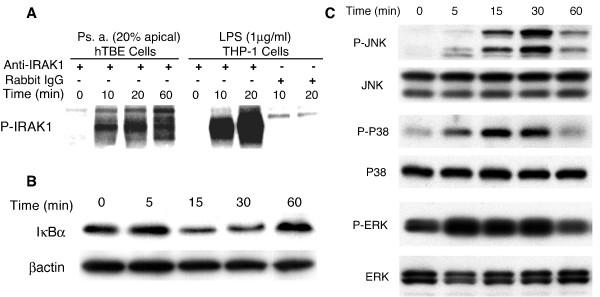
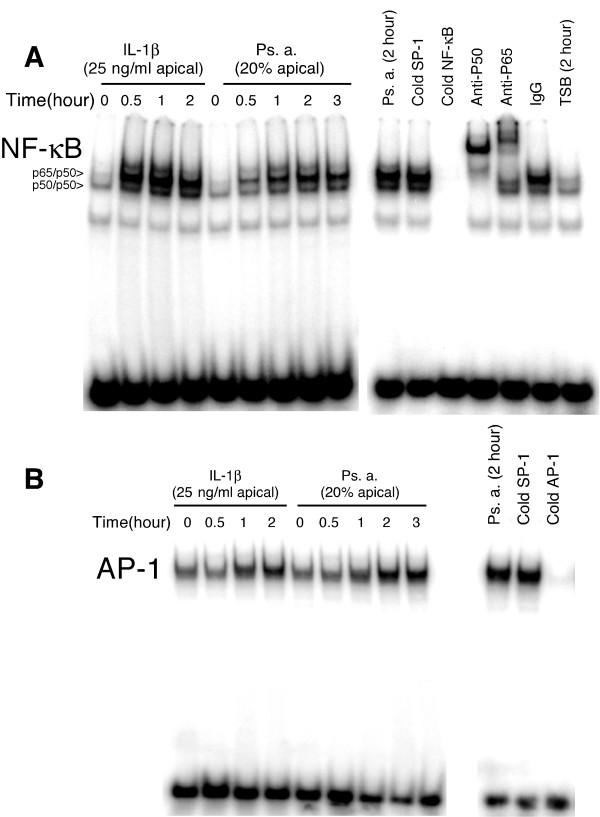
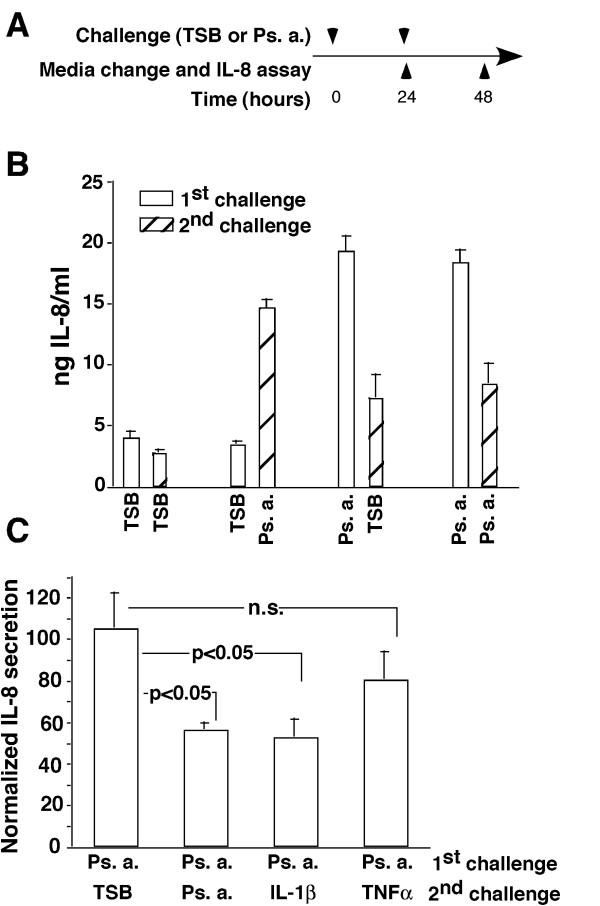
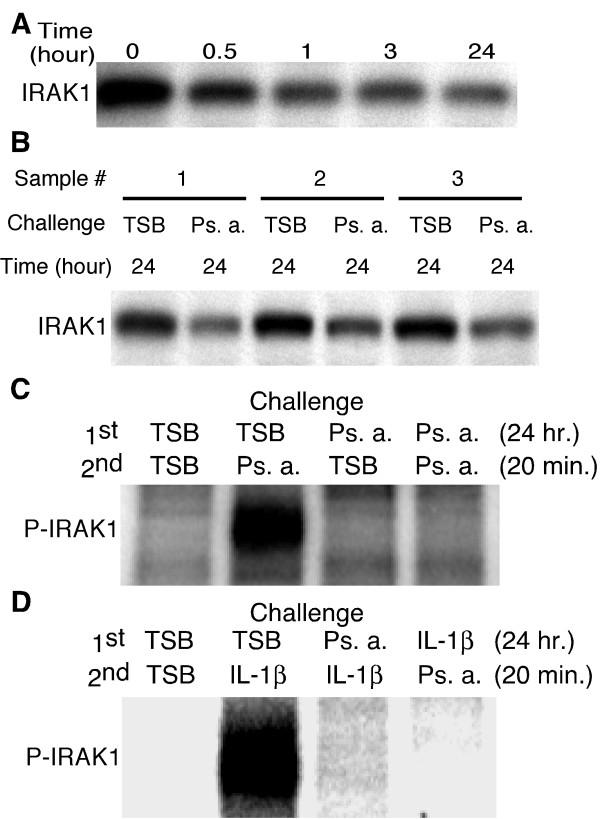
An initial challenge of the apical surface of polarized human airway epithelial cells with Pseudomonas aeruginosa culture filtrates induced phosphorylation of IRAK1, JNK, p38, and ERK, caused degradation of IkappaBalpha, generation of NF-kappaB and AP-1 transcription factor activity, and resulted in IL-8 secretion, consistent with activation of the Toll-like receptor signal transduction pathway. These responses were strongly attenuated following a second Pseudomonas aeruginosa, or IL-1beta, but not TNFalpha, challenge. Tolerance was associated with decreased IRAK1 protein content and kinase activity and dominant negative IRAK1 inhibited Pseudomonas aeruginosa--stimulated NF-kappaB transcriptional activity.
CONCLUSION
The airway epithelial cell response to Pseudomonas aeruginosa entails adaptation and tolerance likely mediated, in part, by down-regulation of IRAK1.
背景
呼吸道上皮是调节炎症的关键环境界面。在慢性感染性气道疾病中,病原体可能会永久定植于通常无菌的管腔环境。宿主与病原体的相互作用决定炎症的强度,进而决定组织损伤的速率。尽管许多细胞对病原体产物的刺激变得不敏感,但尚不清楚在慢性感染情况下气道上皮是变得耐受还是超敏。我们的目标是表征分化良好的原代人气管支气管上皮细胞对铜绿假单胞菌的反应,了解反复暴露是否会诱导耐受,如果是,则探索其机制。
方法
用铜绿假单胞菌培养滤液或细菌培养基对照反复刺激分化良好的原代人气管支气管上皮细胞培养物的顶端表面。检测毒性、细胞因子产生、信号转导事件以及信号分子显性负性形式的特定作用。其他实验包括使用白细胞介素-1β和肿瘤坏死因子-α作为刺激剂,以及与一种新型气道上皮细胞系进行比较研究。
结果
用铜绿假单胞菌培养滤液初次刺激极化的人气道上皮细胞顶端表面可诱导白细胞介素-1受体相关激酶1(IRAK1)、应激活化蛋白激酶(JNK)、p38和细胞外信号调节激酶(ERK)磷酸化,导致核因子κB抑制蛋白α(IkappaBalpha)降解、核因子κB(NF-κB)和激活蛋白-1(AP-1)转录因子活性产生,并导致白细胞介素-8分泌,这与Toll样受体信号转导途径的激活一致。在第二次用铜绿假单胞菌或白细胞介素-1β刺激后,这些反应强烈减弱,但用肿瘤坏死因子-α刺激则不然。耐受与IRAK1蛋白含量和激酶活性降低有关,显性负性IRAK1抑制铜绿假单胞菌刺激的NF-κB转录活性。
结论
气道上皮细胞对铜绿假单胞菌的反应需要适应和耐受,这可能部分由IRAK1的下调介导。




 Zotero 插件