
美国人健康状况评估:与健康相关的平均生活质量及其在个体和群体间的不平等状况。
Assessment of the health of Americans: the average health-related quality of life and its inequality across individuals and groups.
作者信息
Asada Yukiko
机构信息
Department of Community Health and Epidemiology, Faculty of Medicine, Dalhousie University, Halifax, Nova Scotia, B3H 1V7, Canada.
出版信息
Popul Health Metr. 2005 Jul 13;3:7. doi: 10.1186/1478-7954-3-7.
BACKGROUND
The assessment of population health has traditionally relied on the population's average health measured by mortality related indicators. Researchers have increasingly recognized the importance of including information on health inequality and health-related quality of life (HRQL) in the assessment of population health. The objective of this study is to assess the health of Americans in the 1990s by describing the average HRQL and its inequality across individuals and groups.
METHODS
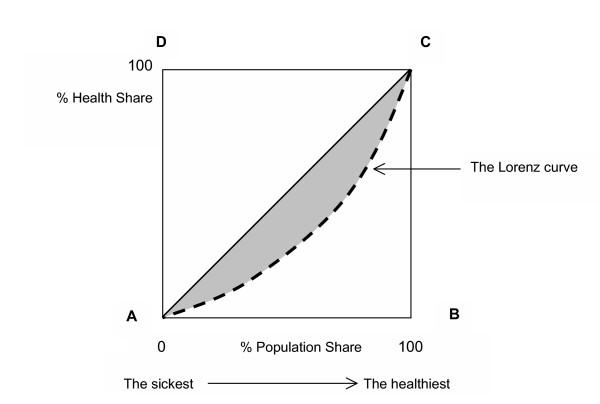
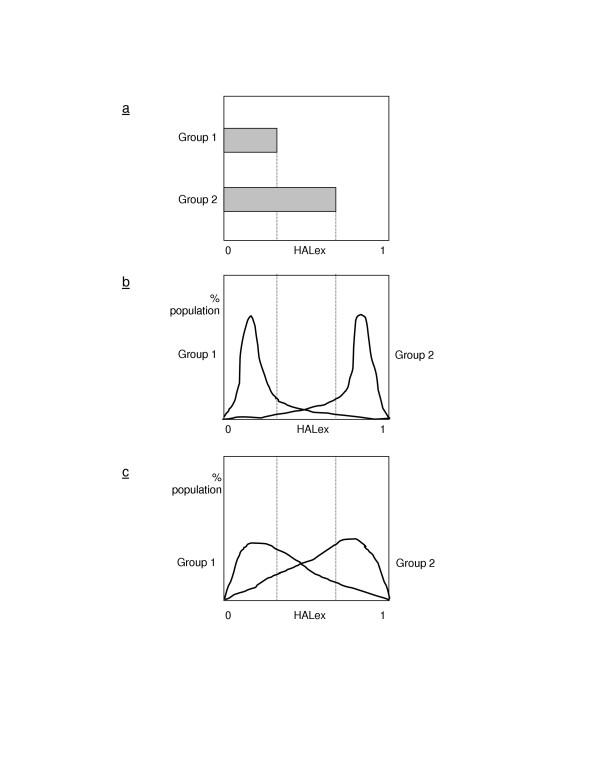
This study uses the 1990 and 1995 National Health Interview Survey from the United States. The measure of HRQL is the Health and Activity Limitation Index (HALex). The measure of health inequality across individuals is the Gini coefficient. This study provides confidence intervals (CI) for the Gini coefficient by a bootstrap method. To describe health inequality by group, this study decomposes the overall Gini coefficient into the between-group, within-group, and overlap Gini coefficient using race (White, Black, and other) as an example. This study looks at how much contribution the overlap Gini coefficient makes to the overall Gini coefficient, in addition to the absolute mean differences between groups.
RESULTS
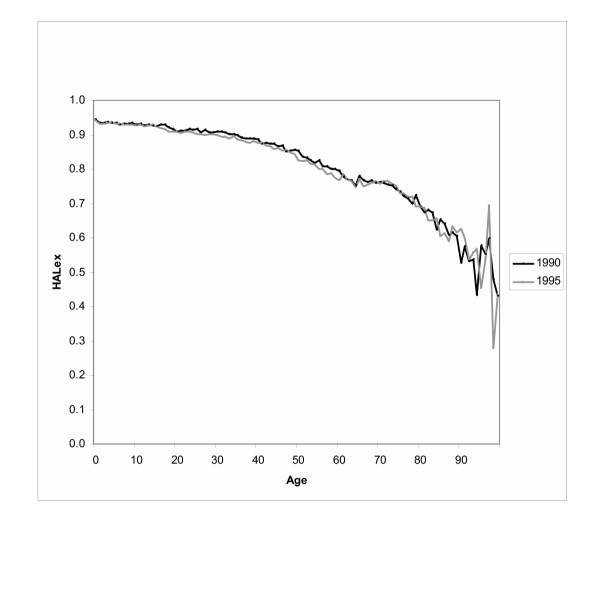
The average HALex was the same in 1990 (0.87, 95% CI: 0.87, 0.88) and 1995 (0.87, 95% CI: 0.86, 0.87). The Gini coefficient for the HALex distribution across individuals was greater in 1995 (0.097, 95% CI: 0.096, 0.099) than 1990 (0.092, 95% CI: 0.091, 0.094). Differences in the average HALex between all racial groups were the same in 1995 as 1990. The contribution of the overlap to the overall Gini coefficient was greater in 1995 than in 1990 by 2.4%. In both years, inequality between racial groups accounted only for 4-5% of overall inequality.
CONCLUSION
The average HRQL of Americans was the same in 1990 and 1995, but inequality in HRQL across individuals was greater in 1995 than 1990. Inequality in HRQL by race was smaller in 1995 than 1990 because race had smaller effect on the way health was distributed in 1995 than 1990. Analysis of the average HRQL and its inequality provides information on the health of a population invisible in the traditional analysis of population health.
背景
传统上,对人群健康的评估依赖于通过与死亡率相关的指标来衡量人群的平均健康状况。研究人员越来越认识到在人群健康评估中纳入健康不平等和健康相关生活质量(HRQL)信息的重要性。本研究的目的是通过描述个体和群体间的平均HRQL及其不平等情况,来评估20世纪90年代美国人的健康状况。
方法
本研究使用了美国1990年和1995年的国家健康访谈调查。HRQL的衡量指标是健康与活动受限指数(HALex)。个体间健康不平等的衡量指标是基尼系数。本研究通过自助法为基尼系数提供置信区间(CI)。为了按群体描述健康不平等情况,本研究以种族(白人、黑人及其他)为例,将总体基尼系数分解为组间、组内和重叠基尼系数。除了群体间的绝对平均差异外,本研究还考察了重叠基尼系数对总体基尼系数的贡献程度。
结果
1990年(0.87,95%CI:0.87,0.88)和1995年(0.87,95%CI:0.86,0.87)的平均HALex相同。1995年个体间HALex分布的基尼系数(0.097,95%CI:0.096,0.099)高于1990年(0.092,95%CI:0.091,0.094)。1995年所有种族群体间平均HALex的差异与1990年相同。1995年重叠部分对总体基尼系数的贡献比1990年高2.4%。在这两年中,种族间的不平等仅占总体不平等的4 - 5%。
结论
1990年和1995年美国人的平均HRQL相同,但1995年个体间HRQL的不平等程度高于1990年。1995年按种族划分的HRQL不平等程度低于1990年,因为与1990年相比,1995年种族对健康分布方式的影响较小。对平均HRQL及其不平等情况的分析提供了在传统人群健康分析中无法看到的有关人群健康的信息。
 Zotero 插件