
泰国农村地区肺炎的诊断:胸部X光远程放射学中数码相机与胶片数字化仪的比较
Diagnosing pneumonia in rural Thailand: Digital cameras versus film digitizers for chest radiograph teleradiology.
作者信息
Javadi Massoud, Subhannachart Ponglada, Levine Sunisa, Vijitsanguan Chomphunut, Tungsagunwattana Sutarat, Dowell Scott F, Olsen Sonja J
机构信息
International Emerging Infections Program, Thai MOPH - US CDC Collaboration, 3rd Floor, DDC Building 7, Ministry of Public Health, Muang Nonthaburi, 11000 Thailand.
出版信息
Int J Infect Dis. 2006 Mar;10(2):129-35. doi: 10.1016/j.ijid.2005.01.007. Epub 2005 Oct 21.
BACKGROUND
Accurate surveillance for pneumonia requires standardized classification of chest radiographs. Digital imaging permits rapid electronic transfer of data to radiologists, and recent improvements in digital camera technology present high quality, yet cheaper, options.
METHODS
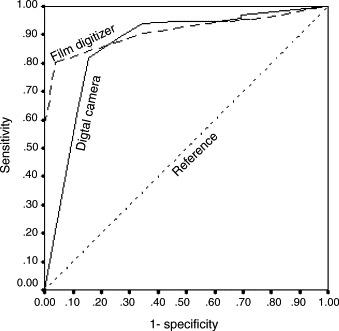
We evaluated the comparative utility of digital camera versus film digitizer in capturing chest radiographs in a pneumonia surveillance system in rural Thailand using a panel of radiologists; the gold standard was the hard-copy radiograph. We calculated sensitivity and specificity and conducted a receiver operator characteristics (ROC) analysis.
RESULTS
Of the 192 radiographs from patients with clinical pneumonia, 166 (86%) were classified as pneumonia on the hard copies. Sensitivity and specificity for identifying pneumonia were 89% and 73% for the camera and 90% and 65% for the digitizer. In the ROC analysis, there was no statistically significant difference in the area under the curve (camera, 0.86; film digitizer, 0.91, p = 0.29). The digital camera set cost 965 dollars compared to 3000 dollars for the film digitizer.
CONCLUSION
Detection of pneumonia was not measurably compromised by using digital cameras compared with film digitizers. The 3-fold lower cost of the digital camera makes this technology an affordable and widely accessible alternative for surveillance systems, vaccine trials, and perhaps clinical use.
背景
肺炎的准确监测需要对胸部X光片进行标准化分类。数字成像允许将数据快速电子传输给放射科医生,并且数码相机技术最近的改进提供了高质量但更便宜的选择。
方法
我们在泰国农村的一个肺炎监测系统中,使用一组放射科医生评估了数码相机与胶片数字化仪在拍摄胸部X光片方面的相对效用;金标准是硬拷贝X光片。我们计算了敏感性和特异性,并进行了受试者操作特征(ROC)分析。
结果
在192例临床肺炎患者的X光片中,166例(86%)在硬拷贝上被分类为肺炎。相机识别肺炎的敏感性和特异性分别为89%和73%,数字化仪分别为90%和65%。在ROC分析中,曲线下面积无统计学显著差异(相机为0.86;胶片数字化仪为0.91,p = 0.29)。数码相机套装成本为965美元,而胶片数字化仪为3000美元。
结论
与胶片数字化仪相比,使用数码相机检测肺炎并没有明显受损。数码相机成本低3倍,使这项技术成为监测系统、疫苗试验以及可能的临床应用中一种经济实惠且广泛可用的替代方案。
 Zotero 插件